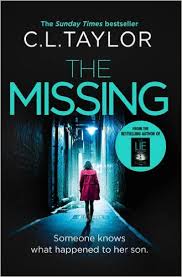
#TheMissing Blog Tour: Get a peep at Chapter 1 of C.L. Taylor’s The Missing

Unknown

Today I’m thrilled to be hosting a stop on the lovely C.L. Taylor’s THE MISSING Blog Tour and letting you get a read of the first chapter of her latest thriller.

Firstly, here’s the blurb: “When fifteen-year-old Billy Wilkinson goes missing in the middle of the night, his mother, Claire Wilkinson, blames herself. She’s not the only one. There isn’t a single member of Billy’s family that doesn’t feel guilty. But the Wilkinson’s are so used to keeping secrets from one another that it isn’t until six months later, after an appeal for information goes horribly wrong, that the truth begins to surface. Claire is sure of two things – that Billy is still alive and that her friends and family had nothing to do with is disappearance. A mother’s instinct is never wrong. Or is it? Sometimes those closest to us are the ones with the most to hide …”

THE MISSING

Chapter 1

Wednesday 5th August 2015

What do you wear when you peer into the barrel of a camera and plead for someone, anyone, to please, please tell you where your child is? A blouse? A jumper? Armour?

Today is the day of the second television appeal. It’s been six months since my son disappeared. Six months? How can it be that long? The counsellor I started seeing four weeks after he was taken from us told me the pain would lessen, that I would never feel his loss as keenly as I did that first day.

She lied.

It takes me the best part of an hour before I can look at myself in the bedroom mirror without crying. My hair, cut in a short elfin style last week, doesn’t suit my wide, angular face and my eyes look dark and deep-set beneath the new fringe. The blouse I’d deemed sensible and presentable last night suddenly looks thin and cheap, the knee-length pencil skirt too tight on my hips. I select a pair of navy trousers and a soft grey jumper instead. Smart, but not too smart, serious but not sombre.

Mark is not in the bedroom with me. He got up at 5.37 a.m. and slipped silently out of the room without acknowledging my soft grunt as I peered at the time on the alarm clock. When we went to bed last night we lay in silence side by side, not touching, too tense to talk. It took a long time for sleep to come.

I didn’t say anything when Mark got up. He’s always been an early riser and enjoys a solitary hour or so, pottering around the house, before everyone else wakes up.

Our house was always so noisy in the morning, with Billy and Jake fighting over who got to use the bathroom first and then turning up their stereos full volume when they returned to their rooms to get changed. I’d pound on their bedroom doors and shout at them to turn the music down. Mark’s never been very good with noise. He spends hours each week driving from city to city as part of his job as a pharmaceutical sales rep but always in silence – no music, audiobooks or radio for him.

‘Mark?’ It’s 7.30 a.m. when I pad into the kitchen, taking care to step over the cracked tile by the fridge so I don’t snag my pop socks. Three years ago Billy opened the fridge and a bottle of wine fell out, cracking the tiles that Mark had only finished laying the day before. I told him it was my fault.

‘Mark?’

The kettle is still warm but there’s no sign of my husband. I poke my head around the living-room door but he’s not there either. I return to the kitchen, and open the back door that leads to the driveway at the side of the house. The garage door is open. The rrr-rrr-rrr splutter of the lawnmower being started drifts towards me.

‘Mark?’ I slip my feet into a pair of Jake’s size ten trainers that have been abandoned next to the mat and slip-slide across the driveway towards the garage. It’s August and the sun is already high in the sky, the park on the other side of the street is a riot of colour and our lawn is damp with dew. ‘You’re not planning on cutting the grass now, surel—’

I stop short at the garage door. My tall, fair-haired husband is bent over the lawnmower in his best navy suit, a greasy black oil stain just above the knee of his left trouser leg.

‘Mark! What the hell are you doing?’

He doesn’t look up.

‘Servicing the lawnmower.’ He gives the starting cord another yank and the machine growls in protest.

‘Now?’

‘I haven’t used it for a month. It’ll rust up if it’s not serviced.’

I don’t know whether to laugh or cry.

‘But Mark, it’s Billy’s appeal.’

‘I know what day it is.’ This time he does look up. His cheeks are flushed and there’s a sheen of sweat that stretches from his thick, unkempt eyebrows all the way up to his receding hairline. He passes a hand over his brow, then wipes it on his trouser leg, rubbing sweat into the greasy oil stain. I want to scream at him that he’s ruined his best suit and he can’t go to Billy’s appeal like that, but today isn’t the day for an argument, so I take a deep breath instead.

‘It’s seven-thirty,’ I say. ‘We need to get going in half an hour. DS Forbes said he’d meet us at eight-thirty to go through a few things.’

Mark rubs a clenched fist against his lower back as he straightens up. ‘Is Jake ready?’

‘I don’t think so. His door was shut as I came downstairs and I couldn’t hear voices.’

Jake shares his bedroom with his girlfriend Kira. They started dating at school when they were sixteen and they’ve been together three years now, sharing a room in our house for the last eighteen months. Jake begged me to let her stay. Her mum’s drinking had got worse and she’d started lashing out at Kira, phys­ically and verbally. He told me that if I didn’t let her live with us she’d have to move up to Edinburgh to live with her grandfather and they’d never get to see each other.

‘Well, if Jake can’t be bothered to get up, then let’s go without him,’ Mark says. ‘I haven’t got the energy to deal with him. Not today.’

It was Billy who used to disappoint Mark. Billy with his ‘I don’t give a shit’ attitude about school and his belief that life owed him fame and fortune. Jake was always Mark’s golden boy in comparison. He worked hard at school, gained six A- to C-grade GCSEs and passed his electrician course at college with flying colours. These days it’s phone calls about Jake’s poor attendance at work that we’re dealing with, not Billy’s.

I haven’t got the energy to deal with Jake either but I can’t just shrug my shoulders like Mark. We need to present a united front to the media. We all need to be there, sitting side by side behind the desk. A strong family, in appearance if nothing else.

‘I’m going back to the house. I’ll get your other suit out of the wardrobe,’ I say but Mark has already turned his attention to the lawnmower.

I shuffle back to the path, Jake’s oversized shoes leaving a trail in the gravel, and reach for the handle of the back door.

I hear the scream the second I push it open.

THE MISSING is out now. You can buy it from Waterstones here, or Amazon here

To find out more about C.L. Taylor hop over to her website here and follow her on Twitter @callytaylor

And don’t forget to check out all the other great stops along THE MISSING Blog Tour:

The Blog Tour

#ATappingAtMyDoor Blog Tour: David Jackson on the importance of “Bum Glue”

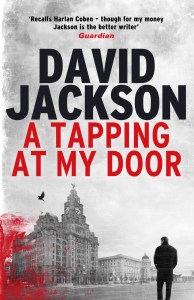
A Tapping at my Door

Today I’m delighted to welcome the lovely David Jackson to the CTG blog for a stop on his #ATappingAtMyDoor blog tour. Following the success of his Callum Doyle novels, A Tapping At My Door is the first book in a fantastic new crime series featuring DS Nathan Cody. As well as being a best selling crime writer, David is a university lecturer, so he knows the challenges of juggling two jobs. In this post he’s sharing just how he manages to do both, with the help of a little “bum glue” …

To an author, bum glue is important stuff. You can’t buy it in a shop (you could try asking for it, but I dread to think what you’d get), but you’re going to need plenty of it if you’re going to get that novel finished.

Bum glue is a term used to represent the staying power you’ll need to keep your butt in a chair while you write. Writing – or at least writing well – can be hard work, and many of us will avoid hard work if we can get away with it. This is especially true when there are untold numbers of other demands on our time.

It’s no different for me. I’m not a full time author: I have a day job as a university academic. I have a family. I also want a life. I want to watch TV and read and socialise and sit in the garden and go on long walks and sleep. All that quickly eats into the precious commodity called time.

So how on earth do I get my books written? People ask me that a lot. And I have two answers – one philosophical and one practical.

The philosophical answer is that, if you want something badly enough, you will always find time for it. Nobody who is thinking of having kids says they haven’t got the time. It’s a given that you will make time. You may be constantly tired and irritable, and you may have to say goodbye to a social life, but you will make time. Think of writing a book as a slightly less intense version of the ordeal that is child-raising, and you’ll be fine!

Those of you who haven’t already decided that writing a book sounds like the seventh circle of Hell will want to be rewarded with something a little bit more practical at this point, so here’s my tip of the week.

Jackson, Dave

First of all, get out of the mindset that writing HAS to be regular and HAS to be of uniform consistency. Writing is not a bowel movement! I sometimes go for days without writing a word, and that’s okay. I’ll make up for it on another day. Getting worked up about missed sessions can lead to guilt, a sense of failure, and ultimately quitting.

Next, stop searching for all those hours you think you’ll need. The likelihood is that you won’t find enough of them, and again you’ll get frustrated. Instead, find minutes. Ten of them will do. Maybe even five. Even the busiest of us can find five spare minutes. And in those five minutes, write like hell.

If you do this, two things will happen. The first is that you will have made a start, and that’s half the battle (Initium est dimidium facti, as the Romans were fond of saying). The other thing is that, once you’ve got into your story, you won’t want to finish. And nor should you. Your five minutes are up – so what? Just keep the momentum going. Five minutes will quickly become ten, and before you know it you’ll have been writing for half an hour or more.

Later in the day, find another five minutes and repeat. The secret is to trick your own mind into believing that the task is not as daunting as it appears.

Got five minutes now? Sure you have. Why not write some words?


Big thanks to the fabulous David Jackson for chatting to us today about bum glue.

A TAPPING AT MY DOOR is the first book in a fantastic new crime series featuring Nathan Cody. Here’s the blurb: “A woman at home in Liverpool is disturbed by a persistent tapping at her back door. She’s unnerved to discover the culprit is a raven, and tries to shoo it away. Which is when the killer strikes. DS Nathan Cody, just back to work after an undercover mission that went horrifyingly wrong, is put on the case. But the police have no leads, except the body of the bird – and the victim’s missing eyes. As flashbacks from his past begin to intrude, Cody realizes he is battling not just a murderer, but his own inner demons too. And then there’s a second murder, and Cody realizes the threat isn’t to the people of Liverpool after all – it’s to the police.”

A TAPPING AT MY DOOR is out in hardback and eBook on the 7th April. You can pre-order it here from Amazon.

You can find out more about David Jackson by hopping over to his website www.davidjacksonbooks.com and following him on Twitter @Author_Dave

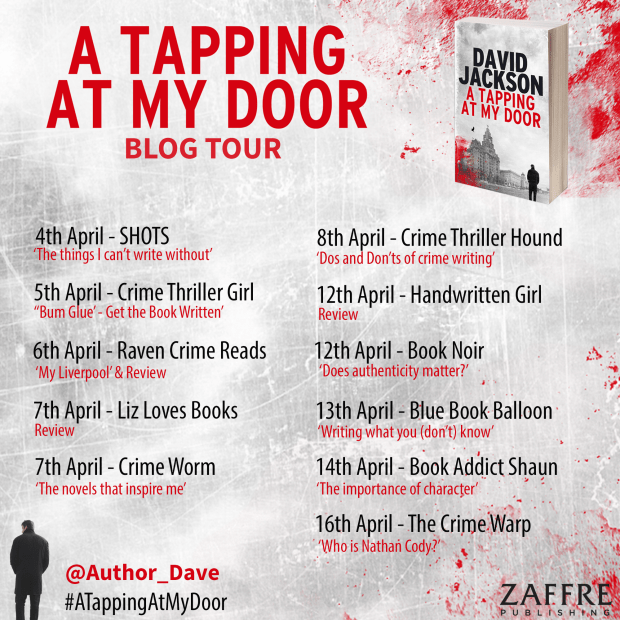
And be sure to check out all the other great stops along the route of the A Tapping At My Door Blog Tour:

A Tapping at my Door Blog Banner FINAL

#WickedGame Blog Tour – Guest Post: Losing a Friend by Matt Johnson

unspecified-2

Today it’s my pleasure to welcome Matt Johnson to the CTG blog. Matt served as a solider and Metropolitan Police officer for 25 years. Blown off his feet at the London Baltic Exchange bombing in 1992, and one of the first police officers on the scene of the 1982 Regent’s Park bombing, Matt was also at the Libyan People’s Bureau shooting in 1984 where he escorted his mortally wounded friend and colleague, Yvonne Fletcher, to hospital. Hidden wounds took there toll and in 1999 Matt was discharged from the police with Post Traumatic Stress Disorder. While undergoing treatment, he was encouraged to write about his career and his experiences. One evening, Matt sat at his computer and started to pull these notes together into a work of fiction that he described as having a tremendously cathartic effect. His novel, Wicked Game, was the result. 

Losing a Friend by Matt Johnson:

The 17th of April this year sees the 32nd anniversary of one of the worst days I have ever experienced. It was the day when a friend and colleague was shot and killed. Three decades later, despite the identity of the killer being known, he remains a free man.

On 17th April 1984, I was a 27-year-old advanced car driver working in central London in a police traffic car.

On 17th April 1984, WPC Yvonne Fletcher was a 25-year-old officer on the Vice Squad at West End Central Police Station. My wife at that time served on this same squad. Yvonne was one of her best mates and part of our circle of friends.

Yvonne had been at a house-warming party at my home a few weeks before this fateful day. My lasting memory is of seeing her sitting at the bottom of the stairs in my house, looking relaxed and chatting with friends.

At 10.18 am Yvonne was among a small contingent of officers supervising a demonstration outside the Libyan Peoples Bureau in St James Square, London. Her fiancé was among the officers with her. Yvonne had her back to the Bureau.

Without warning, someone in the Libyan Bureau fired a Sterling submachine gun into the group of protesters and police officers. Eleven people were hit by bullets, including Yvonne.

An ambulance was quickly sent to the scene and my patrol car was sent to escort the ambulance to the Westminster Hospital.

Anyone who has worked in central London will know just how quickly a major incident can cause the streets to become blocked. Main roads rapidly snarl up and the side streets and rat runs that the taxis and locals use soon follow. Gridlock is the result.

Getting the ambulance to the hospital proved to be a nightmare. We were forced to drive onto pavements and, on several occasions, we had to get out of the car to get vehicles moved so we could get through. At that time we were aware that the casualty was a police officer, but we did not know whom.

I remember that the ambulance overtook the police car just before we reached the hospital. We had to get out of the car to clear traffic from a junction and the crew seized the opportunity to make progress and get through. When we pulled in behind the ambulance, Yvonne had already been taken into the emergency area. I remember seeing the fantastic efforts and the work that was being put in by the nursing staff to help her. They couldn’t have tried harder.

Yvonne died from her wounds one hour later. She had been shot in the back and abdomen.

After escorting the ambulance, my car was sent to help with the traffic chaos that followed the start of the resulting siege.

I went home that afternoon and switched on the six o’clock news. It was only then that my former wife and I learned that the murdered officer was our friend.

The following day, I was assigned as a driver to the SAS team that had been brought in and stationed at a nearby RAF base. My job was to run the lads around – in short I was a gofer and taxi driver. I made frequent trips to the infamous ‘blue screen’ that was built to block the view into the square and I was present on the night that something amazing happened.

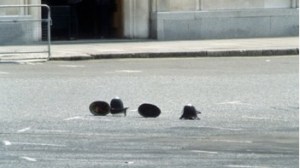
Yvonne’s hat and four other officers’ helmets were left lying in the square during the siege of the embassy. Images of them were shown repeatedly in the British media. They came to represent something quite iconic – a symbol of unarmed police officers who had been attacked so ruthlessly.

hats

What happened was that a PC, acting completely on his own, ran into the square and snatched Yvonne’s hat. There were shouts of ‘get back, get back’ from the firearms officers, but the unarmed PC was determined and fast. As he returned to the blue screen, he was bundled away by a senior officer and a firearms officer. I never did find out what happened to the PC but I suspect he got into trouble.

Fact is, what he did was a reckless thing to do. It is quite possible that the hat may have been playing a part in the hostage negotiations that were going on behind the scenes. We will never know. But what I can tell you is how much that PC’s actions lifted the spirits of people like me, who were sitting watching while the ‘powers that be’ seemed to be doing very little. Grabbing Yvonne’s hat from under the noses of the terrorists stuck two fingers up to them and told them what we thought of them.

To that anonymous PC, I say thanks.

The ‘Peoples Bureau’ was surrounded by armed police for eleven days, in one of the longest police sieges in London’s history. Meanwhile, in Libya, Colonel Gaddafi claimed that the embassy was under attack from British forces, and Libyan soldiers surrounded the British Embassy in Tripoli.

No satisfactory conclusion was reached in the UK, and following the taking of six hostages in Tripoli, the occupiers of the Bureau were allowed to fly out of the UK. The Tripoli hostages were not released for several months, ironically almost on the exact day that the memorial to Yvonne Fletcher was unveiled.

In July 2012 Andrew Gilligan of The Sunday Telegraph received reliable reports that Salah Eddin Khalifa, a pro-Gaddafi student, fired the fatal shot. Unlike a previous suspect named as the killer, Mr Khalifa is known to be alive and may, one day, be arrested. He is currently living in Cairo, a city to which he moved as the Gaddafi regime crumbled.

Yvonne’s death is still the only murder of a British cop on UK soil to remain unsolved. But, we haven’t forgotten. We will never forget.

***

Wicked Game – the novel shaped by Matt Johnson’s experiences as a soldier and in the police – is published by Orenda Books.

Here’s the blurb: “2001. Age is catching up with Robert Finlay, a police officer on the Royalty Protection team based in London. He’s looking forward to returning to uniform policing and a less stressful life with his new family. But fate has other plans.  Finlay’s deeply traumatic, carefully concealed past is about to return to haunt him. A policeman is killed by a bomb blast, and a second is gunned down in his own driveway. Both of the murdered men were former Army colleagues from Finlay’s own SAS regiment, and in a series of explosive events, it becomes clear that he is not the ordinary man that his colleagues, friends and new family think he is. And so begins a game of cat and mouse – a wicked game – in which Finlay is the target, forced to test his long-buried skills in a fight against a determined and unidentified enemy.”

You can buy Wicked Game from Waterstones here or Amazon here

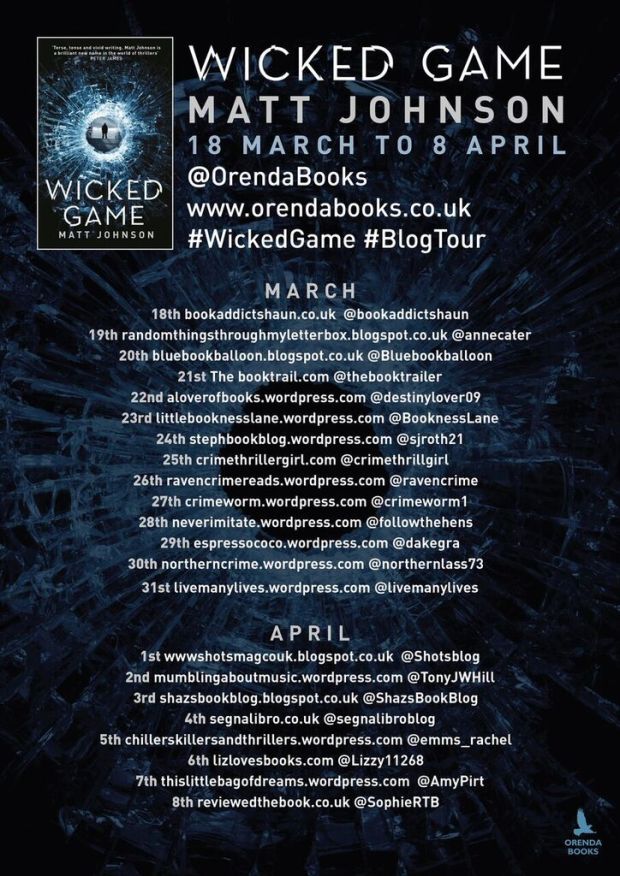
Find out more about Matt Johnson at www.orendabooks.co.uk and follow him on Twitter @Matt_Johnson_UK and be sure to check out all the other stops along his blog tour:

unspecified

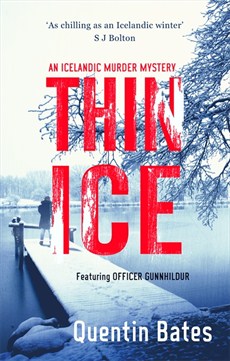
The #ThinIce Blog Tour: Icelandic Noir crime writer Quentin Bates talks rough justice

isbn9781472121509-detail

Today I’m delighted to welcome the charming Icelandic Noir crime writer Quentin Bates to the CTG blog as part of his THIN ICE Blog Tour. For this stop on his marathon tour, Quentin’s talking about the process of writing Thin Ice and rough justice.

Over to Quentin …

It’s not easy to write about Thin Ice. it was started so long ago, also finished so long ago that now I’m deep into another book and the details are starting to get hazy.

Thin Ice was started with the first couple of chapters written and then put aside while I finished something else (Summerchill, the novella that was published last year) and the Thin Ice characters gradually began to take shape in the background. Normally any time I had a long drive is when they’d start to come to life, with details scribbled down at motorway cafés.

It hinged on with Magni, the good-natured, burly, practically-minded former trawlerman down on his luck and lured into making a quick buck as hired muscle for a real criminal. That’s Össur, the wannabe crime kingpin who has the ruthless lack of scruples the role needs but not the brains, which is why he has always been angrily in the shadow of smarter criminals.

The other key characters, Erna and Tinna Lind, the two women Össur and Magni carjack when their escape to the sun goes so badly wrong, took a while to come together and there were a few false starts until the relationships between the four of them, stranded in a closed-for-winter upcountry hotel, started to gel. The alliances and animosities crystallised as hidden talents for survival appeared and the tensions ramped up over a large bag of stolen cash and the knowledge that the underworld as well as the police would be searching high and low for Össur and Magni.

I had written half the book and had no firm idea of how it would all come together before I started writing the police side of the tale. A good copper needs a respectable adversary, and once I had the bad guys in place, the parts played by Gunna and her two sidekicks, Helgi and Eiríkur, slotted in around the willing and unwilling fugitives, right up to the last fifty pages where things start to go badly wrong, or right, depending on your point of view.

I do like a good villain, but a decent villain can’t be entirely bad. There has to be something in there that you can sympathise with, as one-hundred-per-cent evil people with no redeeming features don’t exist. Or do they? Or are they just extremely rare?

Magni’s no genuine bad guy, just someone who agrees to do something stupid after a run of bad luck and a few beers. Össur really is bad, but with a past like his and the old trauma that makes him sweat with fear every time he sits in a car, the reader gets an insight into why he’s as screwed up as he is.

The bad guys are the ones who are fun to write. They can range from outright evil to mildly flawed, with every kind of variation between the two extremes and can go off on odd tangents, while the sleuths need to be fairly sensible – well, most of the time. That’s not to say I’m not deeply fond of my rotund heroine (even though I give her a rough time of it) and her colleagues and family, because I am. But a good villain and a crime is what sets the ball rolling.

I also like a villain who gets away with it. That’s the way things happen in real life as criminals all too frequently get away with the goods and live happily ever after, especially if they can afford good lawyers. I know that’s not to everyone’s taste and a majority of readers like to see justice being done. So while I also like to dish out justice, the form it takes might take you by surprise.

So is there justice in Thin Ice? Do the bad guys get off scot-free or does Gunna get her man? Let’s just say there’s some justice done, but it’s not what you might expect.

THIN ICE is published now. Here’s the blurb: “Snowed in with a couple of psychopaths for the winter … When two small-time crooks rob Reykjavik’s premier drugs dealer, hoping for a quick escape to the sun, their plans start to unravel after their getaway driver fails to show. Tensions mount between the pair and the two women they have grabbed as hostages when they find themselves holed upcountry in an isolated hotel that has been mothballed for the season. Back in the capital, Gunnhildur, Eirikur and Helgi find themselves at a dead end investigating what appear to be the unrelated disappearance of a mother, her daughter and their car during a day’s shopping, and the death of a thief in a house fire. Gunna and her team are faced with a set of riddles but as more people are quizzed it begins to emerge that all these unrelated incidents are in fact linked. And at the same time, two increasingly desperate lowlifes have no choice but to make some big decisions on how to get rid of their accident hostages …”

To find out more about Quentin Bates and his books pop on over to his website at www.graskeggur.com and follow him on Twitter @graskeggur

You can buy THIN ICE from Waterstones here, or from Amazon here

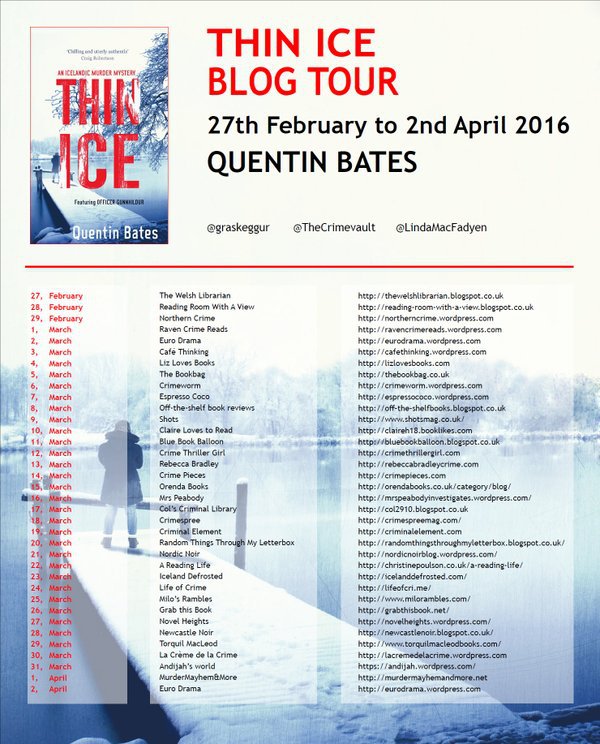
And be sure to check out all the fabulous stops on the THIN ICE Blog Tour …

thin-ice

The #JIHADI Blog Tour: PANTSER OR PLOTTER? MY JIHADI BREAKTHROUGH by Yusuf Toropov


unspecified-2

It’s a real pleasure to welcome Yusuf Toropov to the CTG blog. Yusuf is an American Muslim writer, he’s authored and co-authored a number of non-fiction books and has had plays produced off-Broadway. His highly acclaimed debut novel – Jihadi: A Love Story – is published by Orenda Books and is out now.

Today, Yusuf’s kindly agreed to talk about his experience of writing a novel, and whether he’s a pantser or a plotter …

There are, Plot Whisperer author Martha Alderson tells us, two kinds of fiction writers: writers who navigate by the seat of their pants, making stuff up as they go along, often without any clear sense of where a scene might actually belong in the book’s sequence … and writers who delight in plotting out events, conflicts, and resolutions ahead of time before attempting to actually write a scene.

Martha’s right. If you’re a writer, you either want to know where the scene fits in your running order before you start to work on it, or you don’t. You’re one or the other, a Pantser or a Plotter. ‘Yeah but I’m both, yeah but I’m neither, yeah but yeah but yeah but.’ Ssh. It’s true. Now just keep reading. If you write fiction, there’s a breakthrough waiting for you here, the same one Martha made possible for me, and the only way for you to get it is to assume for a moment that you do lean one way or the other. And trust me. You do. This is just the reality of writing stories.

Alderson’s book, which you should read if you are writing a novel or even thinking about doing so, makes two important points about all this. First and foremost, you need to figure out which of the two groups you fall into.

I am a classic Pantser. I’m the guy who stumbles ahead without letting the fact that I haven’t set up much of a plot yet stop me. Even if there is a clear plot structure to a story I’ve been working on for a while, I tend to try to forget about it while I’m writing. I actually prefer the sensation of not having the least clue where a given scene is going. I love accidents, and I get some of my best stuff from noticing when something that I tried came out wrong – but interesting.

Case in point: the character Fatima Adara, from my novel Jihadi: A Love Story. Most people tell me she’s the most memorable thing about the book. Yet I stumbled across her. She was supposed to appear in one scene. I wrote about 50,000 words of the novel before I realized that she was a major character. (They weren’t all good words – I threw about half of them out.)

You read right: 50,000 words. Now, if you’re a Plotter, I suspect you just cannot imagine yourself investing the word counts that I did in a story that hadn’t yet identified all of its major characters. And you know what? You’re right. I probably shouldn’t have. At that point, I was traveling without a map. Which brings us to Alderson’s second big point, and the breakthrough she made possible for me and, maybe, for you.

It is this: Once you know which writing camp you fall into, Pantser or Plotter, you have to make a conscious effort to compensate for certain inherent weaknesses you bring to the table as a writer.

unspecified-3

If you’re a Plotter, Alderson asks you to consider that your likely weaknesses as a writer include the following: Compelling emotion may be lacking from some of your scenes. Ring any bells? Plotters, this is for you. In addition to plotting, you need to push yourself outside your comfort zone. You need to go beyond outlining. You need to find a way to experience, on a personal level, what your protagonist is experiencing. You need to notice what that obstacle she’s encountering feels like, on a sensory level, not just on an analytical level. You need to be there personally and get hurt, fall in love, be terrified, whatever. You need to experience whatever is happening first-hand if you really want to write about it. (This is something that Pantsers usually have no problem with, by the way.) You’ve got to put yourself into the character’s situation, live the scene, and notice what the emotion feels like before you start writing. Otherwise, you may ‘finish’ your book, but you may find that it is filled with scenes that don’t actually engage the reader on a gut level. Ouch.

If you’re a Pantser (like me) your likely weakness looks like this: You may never finish the damn book, because you’re ‘writing’ without a structure – travelling without a map. Pantsers, this is for you (and me): You just don’t like establishing specific plot points and themes ahead of time. You say it ‘handcuffs’ you. If you do ‘finish’ the book, though, you may find that Act Three has little or nothing to do with Acts One and Two. Again: Ouch. This was my big weakness as a writer, and overcoming it was my breakthrough. I really, really did not want to bother with setting up a Plot Planner (Alderson’s primary writing tool) when I began reading her book, but by the time I was done with it, I knew I had to go outside my comfort zone. So I identified the five essential Alderson turning points for my story, and I put them up on the wall, using her Plot Planner tool. On that wall, I started laying out a clear sequence of scenes, in outline. (A first for me.) Doing all this was not my first instinct. It wasn’t how I was used to writing. But it needed to happen.

As a result of going out of my comfort zone, I figured out, not only that Fatima was independent, intelligent, and a devout Muslim, but also what the big decision ended up making in Act Three of my novel was, and how it needed to be set up in Act One. Also how she connected to the novel’s themes. Also what, specifically, she heard in the very first scene she was in that affected my protagonist in Act Two. All that stuff I didn’t know before I completed my Plot Planner, and I have Martha to thank for it.

You can buy Martha Alderson’s indispensable book The Plot Whisperer here. You can buy Jihadi: A Love Story, on which I might still be working if it hadn’t been for Martha’s work, here.

A huge thank you to Yusuf for talking with us today about his writing process and how he wrote his debut novel – Jihadi: A Love Story. As a fellow pantser, I’m heading over to check out The Plot Whisperer right now!

I also highly recommend you check out Jihadi: A Love Story. Here’s the blurb: “A former intelligence agent stands accused of terrorism, held without charge in a secret overseas prison. His memoir is in the hands of a brilliant but erratic psychologist whose annotations paint a much darker picture. As the story unravels, we are forced to assess the truth for ourselves, and decide not only what really happened on one fateful overseas assignment, but who is the real terrorist. Peopled by a diverse and unforgettable cast of characters, whose reliability as narrators is always questioned, and with a multi-layered plot heaving with unexpected and often shocking developments, Jihadi: A Love Story is an intelligent thriller that asks big questions. Complex, intriguing and intricately woven, this is an astonishing debut that explores the nature of good and evil alongside notions of nationalism, terrorism and fidelity, and, above all, the fragility of the human mind.”

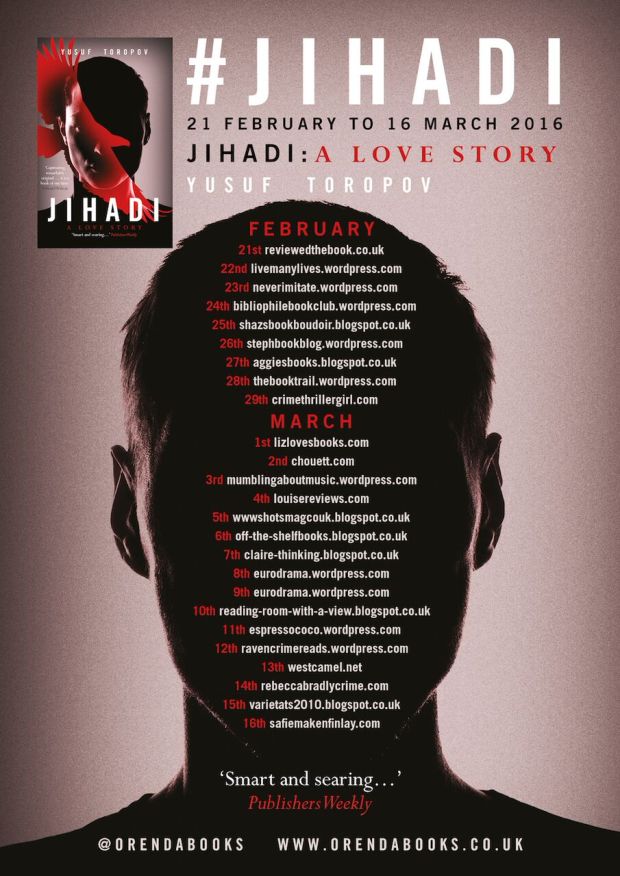
The Jihadi: A Love Story Blog Tour is running now. Be sure to pop over to all the wonderful stops …

unspecified

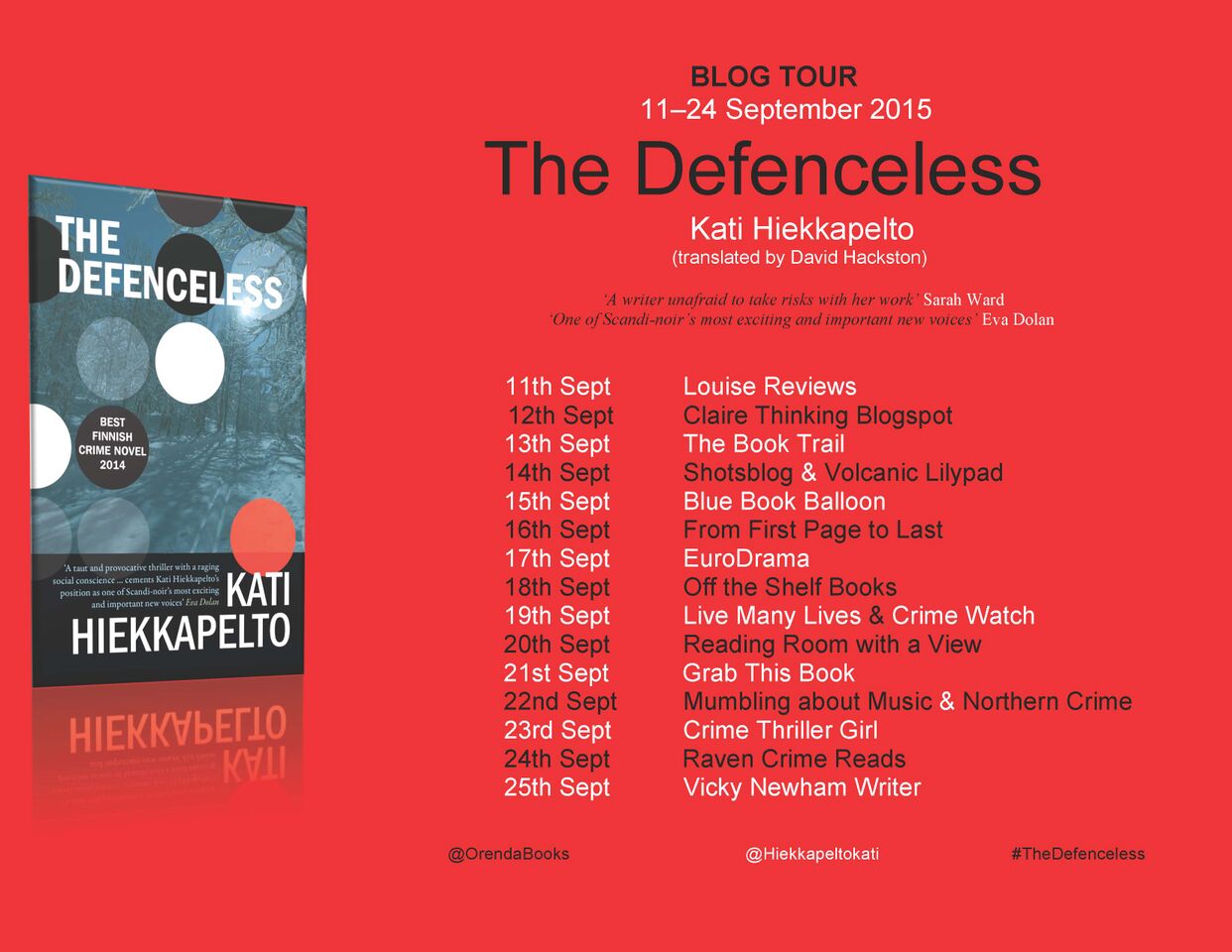
#TheDefenceless Blog Tour: Writing The Defenceless by Finnish crime writer Kati Hiekkapelto

cyscq21YEm-k8g9wsjB0dtQ8v1fqoRhPwxXpEmUUsv4

I’m delighted to welcome best-selling Finnish crime writer, Kati Hiekkapelto, to the CTG blog for today’s stop on her blog tour. For her guest post, Kati kindly agreed to talk about what it was like writing her latest book THE DEFENCELESS …

When I was writing The Defenceless, I read an article about Pakistani author Aslam Nadeem, who was locked in one room when he was writing the novel Wasted Vigil. Someone gave him food through the hatch in the door, and he requested that no one let him out until the book was finished. He stayed in that room for seven months without seeing anyone, doing nothing but writing and sleeping. My first thought after reading about his isolation, was Wow! That’s exactly what I need. To be an effective and productive writer I really do need total solitude, without Internet access – some sort of all-inclusive accommodation, somewhere far away and a secretary! Or even better, a wife.

I’ve often been asked if it is difficult to ‘return to normal life’ after an intensive writing session. The answer is yes. However, in my experience it is even more difficult to ‘return to writing life’ after an intensive period in real life. The trouble is that reality lurks everywhere, all the time, and it is often very invasive. It has the shape of family, friends, lawnmower, snow shovel, washing machine, grocery list, shopping centre, bills, and millions of other things you can not escape.

I usually work in the mornings. I like the purity of thought that occurs after a sleep and therefore I don’t allow myself to use the Internet or talk to anyone before I have written my daily words. I often disobey my own rules and check Facebook or emails. Sometimes I have to ring or text, or sit down for a chat with my children. Yes, I get disturbed, but I try to get over it. I have to. I write for between three and five hours a day and after that I answer my emails, surf the internet and take part in the usual round of social media that seems to be part of being a writer these days.

Then I have to stop. I have to cook, do the laundry, be with my children, clean the house, meet my friends and do all that stuff that everyone else has to do too. At first my thoughts and soul are absent from these activities – they want to remain in my fiction world and I want to keep them there, too. After a while reality and its never-ending responsibilities drag my mind into my body again and the text begins to fade away. Finally I’m present in my normal life.

And then the next morning it’s time to start writing again – forget about everything else, get into the right mood, find the right words, sentences, rhythm and try to ensure that the text continues to flow, that it takes on shape as a cohesive whole. And there it is again! That temptation winking at me from the real world, which suddenly seems fascinating. Even washing dishes and Hoovering suddenly looks like a good idea, as does time spent with my family. The longer the ‘real-life’ period lasts, the harder it is to get back to writing. But back I go, because I have to. Not just because it is my job, but because I am compelled.

uKQtKP_Vy5TXdyozXZTXEzymbPCmXSInpTi76jxb634

When I wrote my first novel, The Hummingbird, I did not have a designated room nor a good desk or even a decent chair. I sometimes wrote on the bathroom floor! (No wonder I had to go for physiotherapy several months after finishing the book.)

Nowadays my writing conditions have improved. I have a writing room and an electric desk – I like to write standing. I think my room absorbs all the feelings I want to have in the text and therefore it helps me to find the right mood every morning. Sometimes I need (or rather the text needs) a writing period longer than four hours per day and I have to pack my computer and notes and go away for couple days. When I wrote The Defenceless, I used my aunt´s cabin in Lapland. It was amazing to write murder mystery in the wilderness, surrounded by November darkness…

I envy my colleagues who can write in cafés surrounded by people and voices. I need absolute silence. Some authors also manage to write when they are travelling. Because of many foreign translations of The Hummingbird and The Defenceless, I have to spend a lot of time promoting my books abroad. It is fascinating and inspiring, of course, but it also means putting my writing aside to talk about previous books, which sometimes feels like schizophrenia. In that state of mind, I find it impossible to concentrate on writing!

The Defenceless was partly inspired by Nadeem’s Wasted Vigil. Conception of time is often circular in Eastern cultures, not horizontal as it is here in West, and Nadeem´s novel is a beautiful example of this. Because one of the main characters in The Defenceless is a young Pakistani man called Sammy, I wanted to get similar feeling of roundness in my book, as a reflection from his culture. Crime fiction is a very plot-orientated, horizontally proceeding genre and therefore I had to do my circles with a light hand. I was so happy when one Finnish literature journalist noticed my efforts! But I cannot escape reality around me, like Nadeem did, and, perhaps I wouldn’t want it after all. Maybe constant balancing between sinking down to the text and floating up to real-life duties is exactly what I need to be a productive writer. To have all the time and silence in the world and meals from a hatch would most likely make me so lonely, lazy and bored that I wouldn’t write anything worth reading. I have learned to work under in the ‘unsatisfactory circumstances’ otherwise known as ‘normal life’, and it is probably this that makes me the writer I am today.

A wife, however, would still be useful!

A huge thank you to Kati Hiekkapelto for taking over the reins of the CTG blog today and telling us about her writing process and how it felt when she was writing THE DEFENCELESS.

THE DEFENCELESS is out now from the fabulous Orenda Books. Here’s what the blurb says: “When an old man is found dead on the road – seemingly run over by a Hungarian au pair – police investigator Anna Fekete is certain that there is more to the incident than meets the eye. As she begins to unravel an increasingly complex case, she’s led on a deadly trail where illegal immigration, drugs and, ultimately, murder threaten not only her beliefs, but her life. Anna’s partner Esko is entrenched in a separate but equally dangerous investigation into the activities of an immigrant gang, where deportation orders and raids cause increasing tension and result in desperate measures by gang members – and the police themselves. Then a bloody knife is found in the snow, and the two cases come together in ways that no one could have predicted. As pressure mounts, it becomes clear that having the law on their side may not be enough for Anna and Esko. Chilling, disturbing and terrifyingly believable, The Defenceless is an extraordinary, vivid and gripping thriller by one of the most exciting new voices in crime fiction.”

You can find out more about Kati Hiekkapelto on the Orenda Books website and make sure you follow her on Twitter @HiekkapeltoKati

To get the book from Amazon, click on the book cover below:

http://

And be sure to check out all the other excellent stops on THE DEFENCELESS blog tour …

dByuxAcCrqmU8y70EfwFRPmMRUenBbLggq4C13iCVj4


#HeadlineMurder Blog Tour: Guest Post – HOW I FOUND COLIN CRAMPTON by Peter Bartram

cover

Today I’m delighted to welcome Peter Bartram, author of HEADLINE MURDER, to the CTG blog to tell us about the inspiration for his new Crampton of the Chronicle crime mystery series …

The seed for my new Crampton of the Chronicle series of crime mysteries was sown a couple of weeks after I took my first job as a reporter on a newspaper. But I only realised this years later.

   I came into the newsroom one morning and the chief reporter told me to get round to the magistrates’ court double quick. Our normal court reporter was off sick.

   This was the first time I’d been on a court reporting job. One of the cases concerned a young fellow who’d been charged with being drunk and disorderly. He was fined £5.

   Even as a rookie reporter, I knew this story didn’t merit even a single column inch. But as I made my way back to the paper, the bloke lay in wait for me. He flexed his not unimpressive muscles and made it clear that if a word appeared in the paper, I better watch my back.

   As I hadn’t anyway intended writing about his pathetic tale of puking on the highway, I passed on my way musing reflectively on how the chief reporter had been more right than he knew when he said I would meet interesting people. I mentioned the incident to him when I got back to the newsroom. He passed it on to the news editor. Who talked to the editor.

   And he decided the story would be written as long as possible for the front page. Threaten the Fourth Estate and take what’s coming to you!

   I decided to take a precautionary measure after the piece appeared. I knew of several hotels in town where if you went in the front door, you could thread your way through endless corridors and pop out at the back in a different street, usually after passing through the staff’s quarters. An ideal way to throw a troublesome follower off your tracks.

   As it happened, I never had to use the ruse, but I remembered it years later when I was writing Headline Murder. And I guess that early experience must have been one of the memories that made me realise that a crime reporter could be a great protagonist in a mystery novel.

   Anyway, here is an extract from the scene where our hero, Colin Crampton, crime reporter on the Brighton Evening Chronicle, has to throw a rival journo off his tail …

So as I stepped into the street, I stooped to re-tie my shoe lace and had a quick shufty at who was about. I wouldn’t put it past Houghton [crime reporter on the rival paper] to put a tail on me. The street was busy with shoppers. A couple of middle-aged matrons pushed passed me laden with shopping bags from Hannington’s. An old gent with a bowler hat and striped trousers ambled along smoking a pipe. A fancy piece wearing stilettos like daggers tottered by with a poodle on a leash.

Shoppers don’t spend much time standing in the same place. So it wasn’t difficult for me to spot Houghton’s nark. He was a young lad lounging beside the phone box on the other side of the road. He was reading the midday edition of the Chronicle. A nice touch to read the Chronicle rather than the Argus, his own paper. But not nice enough. He wasn’t waiting to make a call because the phone box was vacant. He’d have done better to stand inside and pretend to be on the phone. If you have to stand still when you’re on the qui vive, go somewhere where your target expects to see standing people. Such as a bus queue.

I recognised the lad as a trainee reporter who’d joined the Argus a couple of months earlier…

So after I’d re-tied my shoe, I headed towards The Lanes, the maze of eighteenth century passages in the centre of the town. As I sauntered into Meeting House Lane I caught a glimpse of his reflection in a shop window. Peregrine was doing well but he wouldn’t be ready for what I had in mind.

I hurried through The Lanes, turned right on to the seafront and walked towards the Old Ship Hotel. I slowed down and gave my tail a chance to come round the corner so that he could see me step into the hotel.

Peregrine didn’t disappoint. He still had his copy of the Chronicle under his arm as he bustled round the corner. I slipped in the door and made my way through the foyer to the restaurant. I entered the restaurant which was empty – the lunch service had long finished.

On the far side of the room were two service doors used by waiters to get between the kitchen and restaurant. I hurried over to one of them. Looked quickly behind to make sure my tail was out of sight. Slipped through the door.

In the kitchen Antoine, the head chef, was in the middle of berating a sous chef about some canapés. I caught a few choice words that hadn’t been in my school French dictionary. Antoine was everything you’d expect of a French chef – fat, quixotic, temperamental. He had a handlebar moustache and a goatee beard. He’d taken off his toque and was mopping his high forehead with a red polka dot handkerchief. When he saw me, he turned from the hapless sous chef.

“Colin, I am working with idiots. But you have come to speak with me. No?”

“No. I’m just passing through, Antoine. You haven’t seen me.”

“I get it.” He tapped the side of his large Gallic nose. “You are on one of your histoires, n’est ce pas?”

D’accord. Just need to avoid someone.”

“Antoine’s kitchen is the gateway to freedom. No?”

“Yes,” I said.

“And the temple of the gastronomie magnifique. No?”

“Yes.”

“But you must try one of these caviar canapés before your – how you say? – disparition. No?”

“Yes.”

He grabbed the platter from the sous chef and shoved it towards me. The canapés looked good. I took one and bit into it.

Délicieux,” I said. “But I must go. If anyone comes after me, see what you can do to hold them up.”

“Leave it to me,” Antoine said. “I give him caviar canapés sprinkled with – what you call? – Kruschen Salts.”

“That should slow him down a bit,” I said.

“The caviar hides the taste of the salts. No?”

“Yes.”

“He makes very loud – how you say? – framboises.”

“Raspberries.”

Ici.” He pointed to his ample rump.

“Don’t give him too large a dose,” I said. “He moves in elevated company.”

I crossed the kitchen and went out through the back door.


Big thanks to Peter Bartram for stopping by today and telling us about his inspiration for HEADLINE MURDER and the Crampton of the Chronicle crime mystery series.

Be sure to check out Peter’s website at http://www.peterbartram.co.uk

HEADLINE MURDER (published by Roundfire Books) is out in paperback and e-book today.

To see the book on Amazon click on the book cover below:

http://

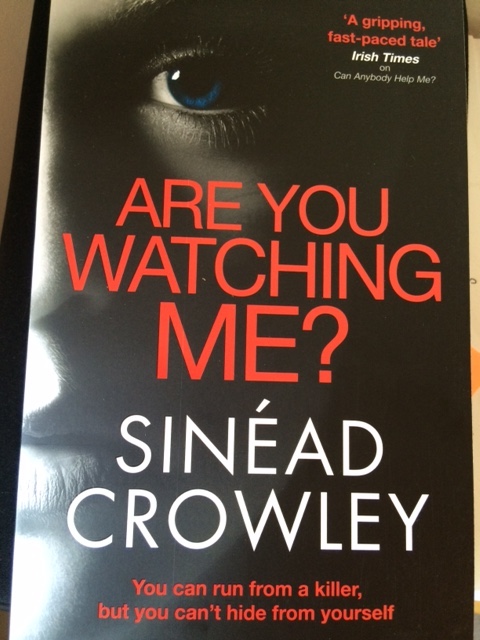
Guest Post: Author Sinéad Crowley talks about writing a Cop Duo #AreYouWatchingMe


cover image

cover image

Today I’m delighted to hand over the reins of the CTG blog to Sinéad Crowley. Sinéad’s debut thriller – CAN ANYBODY HELP ME? – was a bestseller in Ireland and shortlisted for Crime Book of the Year at the Irish Book Awards 2014. Her second novel – ARE YOU WATCHING ME? – is published this week and is another gripping read. So, over to Sinéad …

Good cop – better cop?

I didn’t set out to write a classic ‘cop duo’ story. Mind you – I didn’t set out to write a police procedural either – whoops! My first book, ‘Can Anybody Help Me?’ looked at the relationships between women on an internet parenting forum, and my original idea was to have the central character, a young woman called Yvonne, solve the mystery herself. But Yvonne was a new mother and quite a shy person, living in a new country and feeling, at times, totally overwhelmed. It wouldn’t have made sense to have her leap away from the computer, Nancy Drew style and start solving crimes. So, I needed a copper. And to keep things simple for myself – write what you know, eh? – I made her a woman. A pregnant woman, at that, who ended up falling into the internet parenting world herself.  Even at that stage, however, Claire was a background character, a means to an end, until my lovely and very astute agent read an early draft of the book and asked if she could she brought more centre stage. My agent, of course had her eye on a sequel – see what I mean by astute? – but she also saw something in Claire that I hadn’t fully recognised. A spark, something different. That indefinable thing that editors and agents look for and writers often don’t realise they have created at all.

So, I wrote more about Claire, and found myself warming to her. She’s a fascinating character to work with, not always likeable, but that’s part of the fun! Meanwhile, as I was writing her opening chapter, Philip Flynn walked into the room, completely unannounced. There was no need for him to be there at all. Claire was sitting in her office, moaning about feeling fat and hungry and all that needed to happen was that somebody had to give her a piece of information. It could have come via phone call or email, the method of passing it on was no big deal. But as I scribbled away in my usual ‘first draft’ style – throwing ideas down on the page in the hope that they would make sense later – in walked Philip Flynn to deliver the information in person. Philip, never Phil, a young ambitious guard with a neat haircut and an overly formal manner. When I looked up I realised I had written two paragraphs about this man who didn’t really have a part in my story at all. But I liked him, and he stayed.

So there I was, with a police procedural on my hands and two police characters who seemed, on the surface, to be like a thousand other police duos. One male, one female. One junior, one senior. One determined to play everything by the book, the other fully prepared to ‘go rogue’ to get what she wanted. But that’s where it got interesting, for me anyway. What SHE wanted. It was Claire who was the older, more experienced cop, and it was she who was prepared to do whatever it took to solve the crime. Even if that meant going against medical advice. Flynn meanwhile stuck to the rules, and concentrated on what he thought of as ‘real policing’. The questions and the answers, the door to door stuff. None of that internet malarkey. As a duo, they made sense.

Returning to them while writing ‘Are You Watching Me?’ was lovely. I won’t pretend writing a second book was easy, everything you’ve heard about ‘Second Book Syndrome’ is true. But revisiting Claire and Flynn was a joy. I really wanted to catch up with them, to find out how life had been in the six months or so since we’d last met. Claire of course is a mother now and finding out just how interesting life can be when your newest family member has a habit of yelling at you at three am. And Flynn has grown in confidence, both in his work and his personal life. One major murder investigation later, they have grown to trust each other and can bounce ideas off each other, and there’s a really useful professional relationship there now. They have each other’s backs. They’re not friends, not yet. But they are getting there. That might just be a job for Book Three…

Huge thanks to Sinéad Crowley for taking over the reins of the CTG blog today and telling us all about writing a duo. Her fabulous second novel – ARE YOU WATCHING ME? – is out this week.

To give you a taste of it, here’s the blurb: “Liz Cafferky is on the up. Rescued from her dark past by the owner of a drop-in centre for older men, Liz soon finds herself as the charity’s face – and the unwilling darling of the Dublin media. Amidst her claustophobic fame, Liz barely notices a letter from a new fan. But then one of the centre’s clients is brutally murdered, and Elizabeth receives another, more sinister note. Running from her ghosts, Liz is too scared to go to the police. And with no leads, there is little Sergeant Claire Boyle can do to protect her …”

To find out more about Sinéad and her books, hop on over to her Facebook page at https://www.facebook.com/cananybodyhelpme and be sure to follow her on Twitter @SCrowleyAuthor


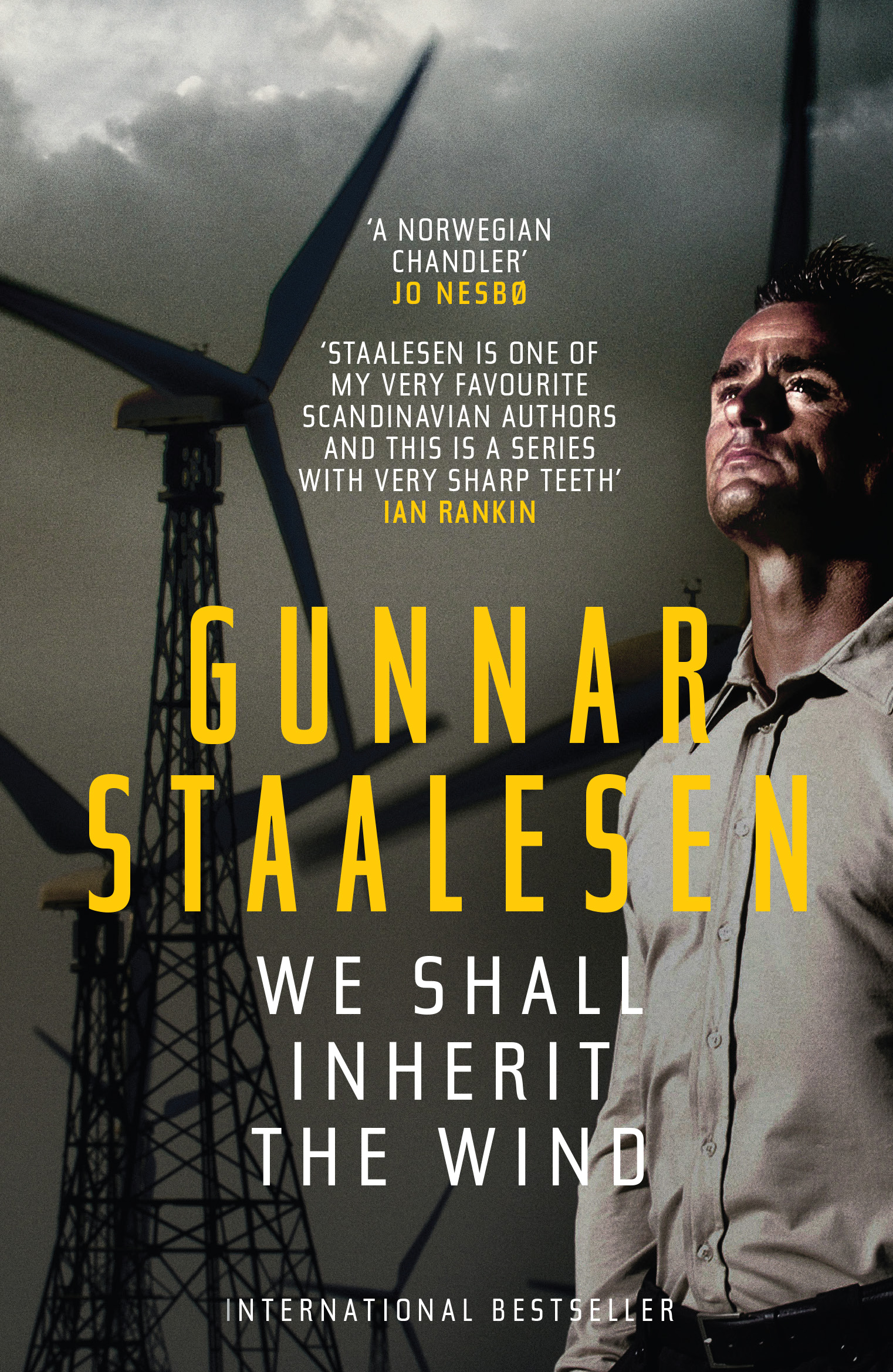
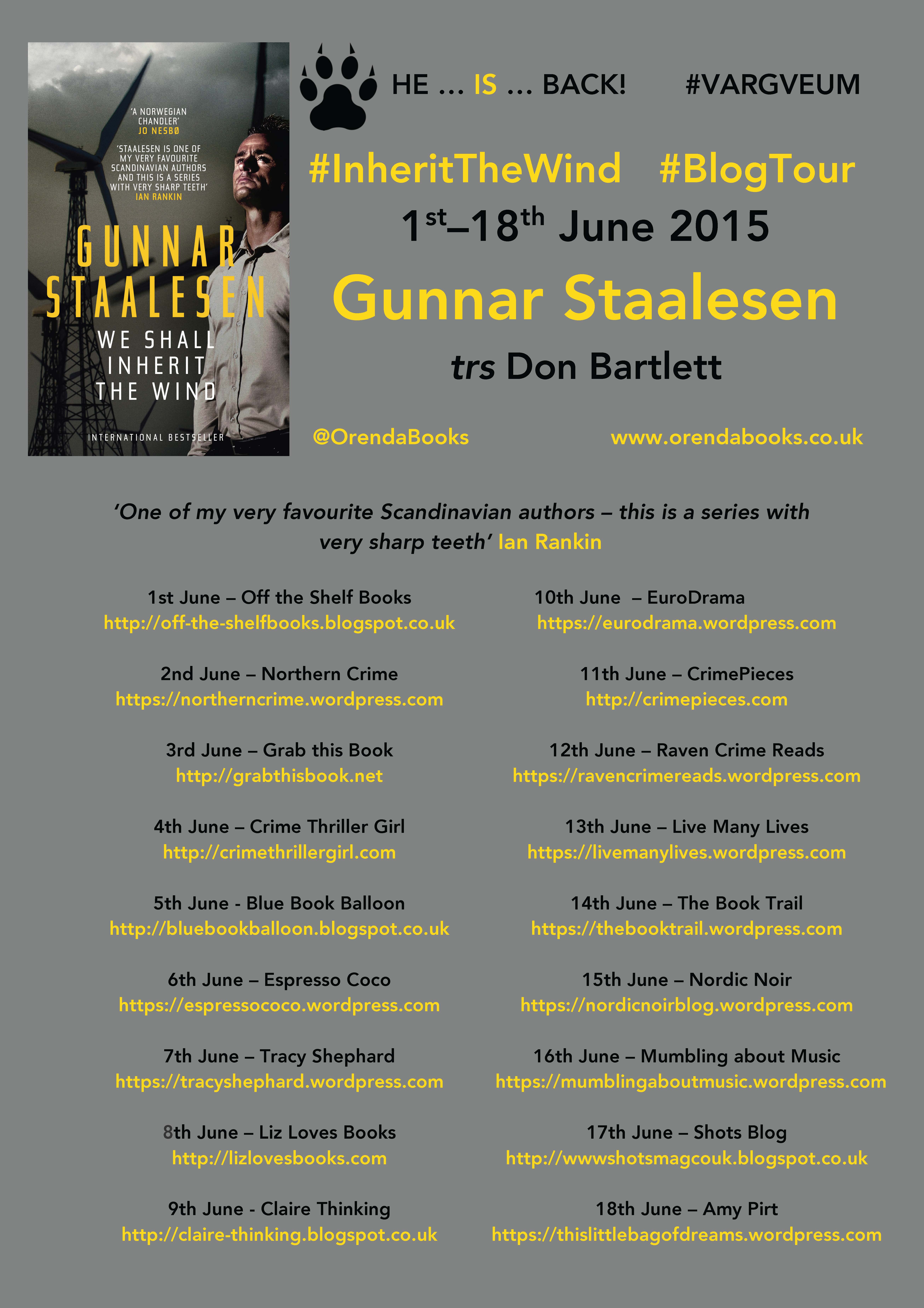
#InheritTheWind #BlogTour Guest Post: My Life with Varg Veum by Gunnar Staalesen

We Shall Inherit the Wind cover image

We Shall Inherit the Wind cover image

Today on the CTG blog I’m delighted to be hosting a guest post by best selling crime writer Gunnar Staalesen as part of the #InheritTheWind blog tour.

And so, over to Gunnar

I first met Varg Veum when he was 34 and I was 19 – almost 40 years ago. He had just opened his Private Investigator’s office on the Strand quay in Bergen, and I was working as a press secretary at the local theatre, Den Nationale Scene (The National Stage). Since then I have met him many, many times – at least every other year, in the beginning a little more often – and the result is 17 crime novels and about 15 short stories featuring my hero and good friend. I know him better with every year that passes, and I have no problem foreseeing what he is going to say – or what he will do in certain situations. Today we are both elderly people, I am 67 and he is – well, 72. However, because my books are set in the past, Varg Veum was only 59 in the last novel that was published here in Norway (None Is So Safe in Danger) with the action taking place in 2002, before his birthday. In We Shall Inherit the Wind, he is still a young man – only 56 years old …

Varg Veum is the modern kind of protagonist. He grows older, of course, but age is never a problem for a detective – even hardest-boiled ones. Hercule Poirot was around 70 when he started his career, and I guess Lew Archer must have been in his late sixties when we last met him. In August I will start writing my eighteenth novel about Varg Veum, and I have no plans to finish him off for many years yet. This is dependent upon my own health, of course, but my mother died when she was 94, my grandfather on that side when he was 93, so …

Throughout the years I have grown close to Varg Veum. When I first met him, he was newly divorced and had a five-year-old son. Today his son is a grown-up, and Varg Veum has just become a grandfather. Following his marriage, there have been several women in his life – natural for a freewheeling Private Eye like him – but for the last ten years he has been in a steady relationship with Karin Bjørge, who works at the Public Registration office. They were friends long before they became lovers, and she has become a very important part of this life. This goes some way to explaining the shock he is feeling in the opening chapters of We Shall Inherit the Wind, when something very dramatic has happened to Karin … I will say no more. You have to read the book.

Gunnar with the Varg Veum statue

Gunnar with the Varg Veum statue

I am often asked how much there is of me in Varg Veum, and the truth is that there isn’t much. I am not divorced, I do not drink as much aqua vita as he does, and I am not half as tough and witty as he is. But we are both kids from the same region in Bergen, a bit street-wise and definitely sharing the same view of the world around us, from more or less the same office. And when I drink my glass of aqua vita at the bar in Bergen where you can find Varg Veum’s corner, I always salute him, my closest friend for the last 40 years.

Skål! we say in Norwegian when we lift our glass. Skål, Varg! I say. Happy to have known you, and looking forward to the years to come. Perhaps, Varg, it is you and I who are going to inherit the wind.

A huge thank you to Gunnar Staalesen for making the CTG blog one of the stops on his #InheritTheWind blog tour.


We Shall Inherit the Wind is out now in ebook and on the 15th June in print.

Here’s the blurb: “1998. Varg Veum sits by the hospital bedside of his long-term girlfriend Karin, whose life-threatening injuries provide a deeply painful reminder of the mistakes he’s made. Investigating the seemingly innocent disappearance of a wind-farm inspector, Varg Veum is thrust into one of the most challenging cases of his career, riddled with conflicts, environmental terrorism, religious fanaticism, unsolved mysteries and dubious business ethics. Then, in one of the most heart-stopping scenes in crime fiction, the first body appears…”

To find out more about Gunnar Staalesen and his books hop on over to www.orendabooks.co.uk and follow them on Twitter @OrendaBooks

And be sure to visit the other fabulous tour stops on the #InheritThe Wind tour …

 We Shall Inherit the Wind Blog Tour


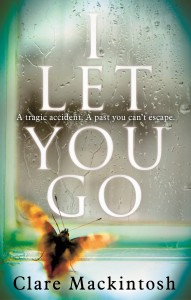
The #ILetYouGo Blog Tour: Guest Post by Clare Mackintosh – Twists

I Let You Go cover image

I Let You Go cover image

Today on the CTG blog I’m delighted to be joined by Clare Mackintosh author of I Let You Go – a phenomenal psychological thriller that’s out now. I Let You Go has a superb ‘gasp out loud’ twist and I’m thrilled that Clare is talking about twists here today.

So over to Clare …

They say writers should write the book they would like to read, rather than trying to meet any perceived trend or gap in the market. A life-long lover of crime (of the fictional kind) I have always read widely within the genre, but I began to seek out a particular element: twists.

Twists can be hard to define, but to my mind they are sections of a novel where the story takes a completely unexpected turn, turning upside down what the reader had previously believed. A good twist novel lures you in, making you believe one state of affairs, then slams you against the wall with the truth. Sometimes there can be more than one of these ‘gasp moments’, leaving you lurching from side to side like an out of control train.

It could be said that all crime books have twists in them, but when the story contains a cast of suspects, the reveal of an offender isn’t necessarily a ‘twist’. The big ‘reveal’ could certainly be surprising, even shocking, but in order to be a twist it should shake up a significant proportion of what you have read up to that point.

When I had the idea for I Let You Go, it was the twist that came first. I hugged it to myself for ages, not knowing exactly what would lead up to that point, or what would happen afterwards, but knowing it was the sort of twist that I loved to read. The story developed, changing significantly over the course of the next two years, but the twist remained the same, flanked by other, smaller twists. It was technically difficult to pull off: how could I ensure the twist was truly shocking, yet at the same time plant enough ‘clues’ that when the reader looked back they could see them?

I am lucky to have a fantastic editor, who helped me tighten the screws on the twist until it was as watertight as possible. By that point we had both read the manuscript so many times it was hard to know how the twist would work for a new reader. I became convinced my ‘oh so clever’ twist was utterly obvious. It was time to find out, so my editor passed the manuscript to a few trusted members of her team, and we held our breath…

When the first reaction came in I breathed a sigh of relief. The twist worked! It has been fantastic to see the tweets, emails and reviews from readers taken by surprise by the turns in the book, and I never tire of hearing about their ‘gasp’ moments. If you read I Let You Go do let me know what you think of the twist: maybe you’ll be the first one to guess it…

Clare Mackintosh

Clare Mackintosh

A big thank you to Clare for making the CTG blog one of the stops on her tour.

You can find out more about Clare by hopping over to her website at http://claremackintosh.com/, looking her up on Facebook at ClareMackWrites and following her on Twitter @claremackint0sh

I Let You Go is out today. Here’s what the blurb says: “In a split second, Jenna Gray’s world descends into a nightmare. Her only hope of moving on is to walk away from everything she knows to start afresh. Desperate to escape, Jenna moves to a remote cottage on the Welsh coast, but she is haunted by her fears, her grief and her memories of a cruel November night that changed her life forever. Slowly, Jenna begins to glimpse the potential for happiness in her future. But her past is about to catch up with her, and the consequences will be devastating …”

And here’s a sneaky peep at an extract from the story …

“When I wake, for a second I’m not sure what this feeling is. Everything is the same, and yet everything has changed. Then, before I have even opened my eyes, there is a rush of noise in my head, like an underground train. And there it is: playing out in Technicolor scenes I can’t pause or mute. I press the heels of my palms into my temples as though I can make the images subside through brute force alone, but still they come, thick and fast, as if without them I might forget. On my bedside cabinet is the brass alarm clock Eve gave me when I went to university – ‘Because you’ll never get to lectures, otherwise’ – and I’m shocked to see it’s ten-thirty already. The pain in my hand has been overshadowed by a headache that blinds me if I move my head too fast, and as I peel myself from the bed every muscle aches. I pull on yesterday’s clothes and go into the garden without stopping to make a coffee, even though my mouth is so dry it’s an effort to swallow. I can’t find my shoes, and the frost stings my feet as I make my way across the grass. The garden isn’t large, but winter is on its way, and by the time I reach the other side I can’t feel my toes. The garden studio has been my sanctuary for the last five years. Little more than a shed to the casual observer, it is where I come to think, to work, and to escape. The wooden floor is stained from the lumps of clay that drop from my wheel, firmly placed in the centre of the room, where I can move around it and stand back to view my work with a critical eye. Three sides of the shed are lined with shelves on which I place my sculptures, in an ordered chaos only I could understand. Works in progress, here; fired but not painted, here; waiting to go to customers, here. Hundreds of separate pieces, yet if I shut my eyes, I can still feel the shape of each one beneath my fingers, the wetness of the clay on my palms. I take the key from its hiding place under the window ledge and open the door. It’s worse than I thought. The floor lies unseen beneath a carpet of broken clay; rounded halves of pots ending abruptly in angry jagged peaks. The wooden shelves are all empty, my desk swept clear of work, and the tiny figurines on the window ledge are unrecognisable, crushed into shards that glisten in the sunlight. By the door lies a small statuette of a woman. I made her last year, as part of a series of figures I produced for a shop in Clifton. I had wanted to produce something real, something as far from perfection as it was possible to get, and yet for it still to be beautiful. I made ten women, each with their own distinctive curves, their own bumps and scars and imperfections. I based them on my mother; my sister; girls I taught at pottery class; women I saw walking in the park. This one is me. Loosely, and not so anyone would recognise, but nevertheless me. Chest a little too flat; hips a little too narrow; feet a little too big. A tangle of hair twisted into a knot at the base of the neck. I bend down and pick her up. I had thought her intact, but as I touch her the clay moves beneath my hands, and I’m left with two broken pieces. I look at them, then I hurl them with all my strength towards the wall, where they shatter into tiny pieces that shower down on to my desk. I take a deep breath and let it slowly out.”

I Let You Go is one of my top reads of 2015. Be sure to pop back tomorrow to check out my review.

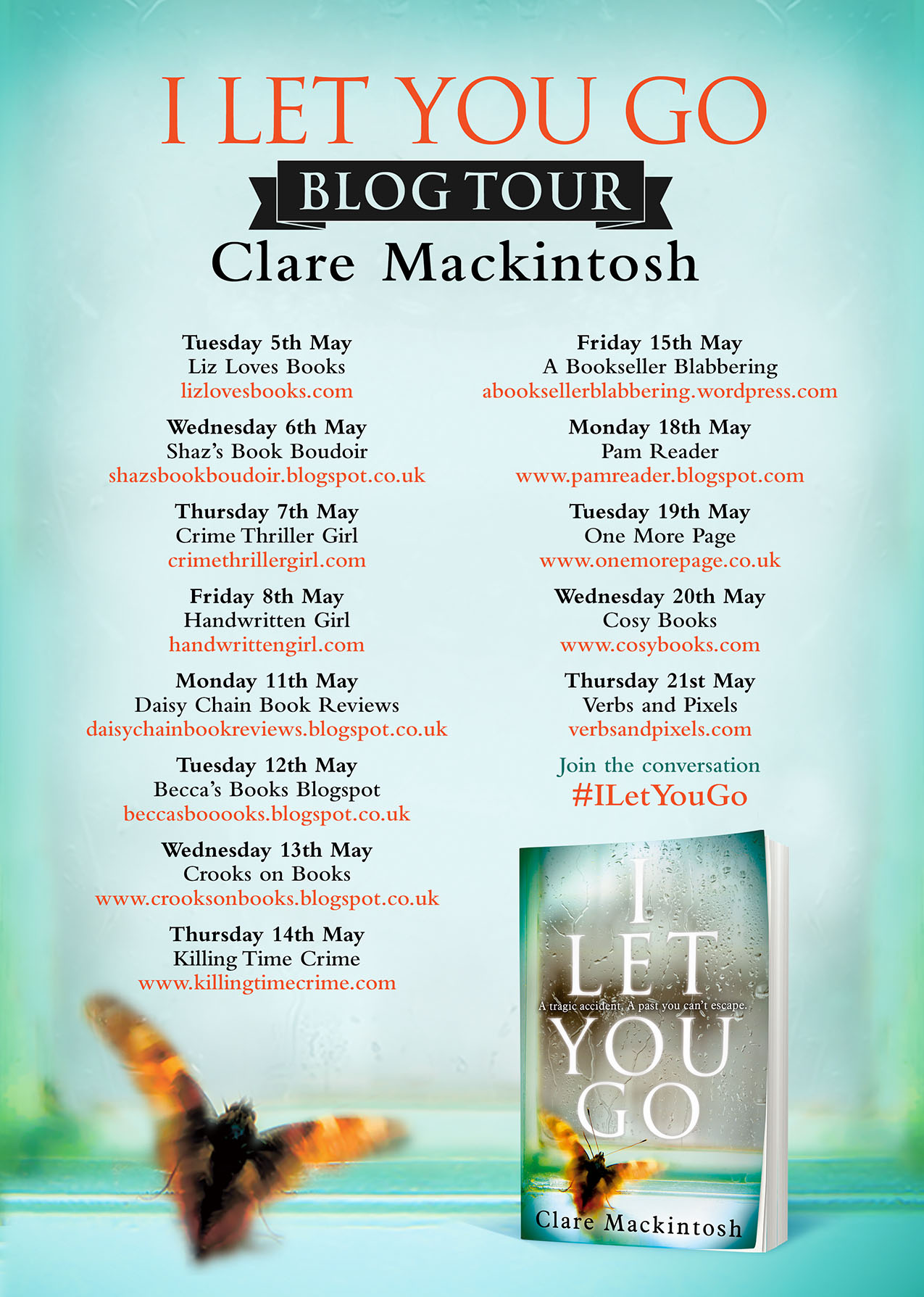
And, don’t forget to check out all the fabulous tour stops on the #ILetYouGo blog tour …

I_Let_You_Go_Blog_Poster (4)