#InHerWake Blog Tour: CTG reviews In Her Wake by Amanda Jennings

unspecified


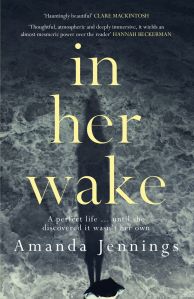
Today I’m delighted to be hosting a stop on Amanda Jennings’ blog tour for the stunning psychological thriller In Her Wake.

What the blurb says: “A perfect life … until she discovered it wasn’t her own: A tragic family event reveals devastating news that rips apart Bella’s comfortable existence. Embarking on a personal journey to uncover the truth, she faces a series of traumatic discoveries that take her to the ruggedly beautiful Cornish coast, where hidden truths, past betrayals and a 25-year-old mystery threaten not just her identity, but also her life.”

This is a remarkable book. Part psychological thriller, part coming-of-age story, it entices you in with a gloriously rich web of secrets and mystery, and holds you spell bound right through to the final heart-wrenching revelation.

Bella is an intriguing character. Shy and subdued, she seems to have let others dictate how things will be her whole life. But when her mother dies, a chain of events are set in motion that will rock the foundations her life has been built on, and cause her to question who she is and what she wants. Determined to find out the truth, she leaves her husband and her job and travels to Cornwall in search of the only people who can help. As she adjusts to life outside of her sheltered existence she starts to uncover not only the devastating lies and secrets that have kept her prisoner since she was a child, but also something inside her that she has never felt before – independence.

Beautifully written, In Her Wake is a story of toxic relationships, family betrayals and self-discovery. It’s both gritty and tragic, and achingly emotive and heart-warming. In short, it’s a stunning must-read of a novel.

To find out more about Amanda Jennings hop over to her website here and follow her on Twitter @MandaJJennings

In Her Wake is out now. You can buy it from Waterstones here; Goldsboro Books (Hardback Limited Edition) here; or Amazon here

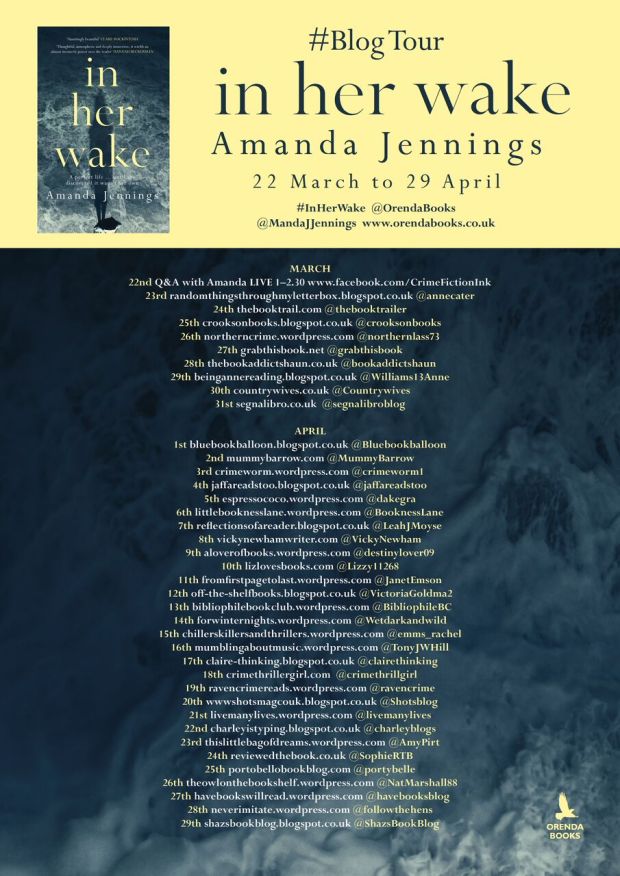
And be sure to check out all the other fabulous stops on the In Her Wake Blog Tour:

unspecified-2

The ‘ALL THROUGH THE NIGHT’ Blog Tour: Read an extract of All Through The Night by M.P. Wright

All Through the Night BT Small Banner

Today I’m delighted to be hosting a stop on M.P. Wright’s All Through The Night Blog Tour and letting you in on a sneaky peep at the book by sharing the Prologue with you.

But, firstly, here’s what the blurb says: “Bristol, Summer 1966 … Struggling to make ends meet, private detective JT Ellington sees a way to make some easy cash when approached by Ida Stephens, the administrator of a local orphanage. She offers him £500 to locate a disgraced Jamaican GP, Dr Ronald Fowler. Fowler has in his possession a number of potentially damaging files regarding deceased young children who have been living at the orphanage. Ida tells Ellington to track him down by any means necessary, retrieve the files and ask an important question: Where is the truth to be found? But Ellington has underestimated his assignment. He quickly finds himself up to his neck and running for his life, in a world where nothing is as it appears and the truth is beyond his imagination …”

ALL THROUGH THE NIGHT by M.P. WRIGHT

PROLOGUE

Thursday, 12 May 1966

The Douglas C-124 aircraft rose and fell in the air as it butted and fought its way through heavy rain, strong winds and gut-churning turbulence. Its four Pratt & Whitney engines roared in unison as it flew out some two hundred miles off the coast of mainland Scotland towards Keflavík airfield, on the western tip of Iceland. The plane had been in the air for just over two hours since taking off from the United States Strategic Air Command base at RAF Fairford, in the heart of Gloucestershire. In the cockpit, Captain Gene Westlake glanced quickly at his wristwatch, which read 5.45 a.m. He smiled to himself, pleased that they were still making good time despite the appalling weather conditions. He looked out of the small window on his left-hand side and saw below him the angry, swelling white tips of the North Atlantic beating against the craggy outcrop of the final edges of the Faroe Islands’ rugged coastline. There were five other crew members on board the “Old Shaky”, as the C-124 was fondly known by all those who flew in or worked on her. This was strictly an all-American crew of the Military Air Transport Service and had made the same long journey back to Dover airfield in Delaware State, USA, more times than they cared to remember.

Sat next to Westlake in the cockpit was his co-pilot, First Lieutenant Dan Knudson and, to their rear, Navigator Ed Barry. Below them in the vastness of the transport hold were loadmasters Carl Brett, Bobby Romaire and Mac Kepner. Once a week they flew the huge aircraft with its cargo of military freight. On a flight out to Britain it could be anything from confidential documentation, armaments and uniforms to newly spruced-up Willys jeeps and troop-carrying lorries. On a run to the US, the cargo could be servicemen and women, tours of duty complete, all cheerfully homeward bound after months away and packed in like sardines alongside countless sacks of mail bound for armed forces and to news-anxious parents and sweethearts back in the States. Same crew, normal trip, thought Gene Westlake, only today, what was in the cargo hold of his craft made him nervous.

It wasn’t unusual to have military police officers on board an aircraft bound for the US. You would normally find them in pairs escorting a soldier, sailor or airman who had committed a serious crime abroad and who would more often than not be tried in the UK before being returned back to a martial penitentiary to serve out their custodial sentence. But military police officers sergeants Paxton and Jardine were not taking the four-thousand-mile flight simply to guard over a criminal miscreant. This was a more personal, delicate enterprise. They sat expressionless beyond the closed door of the cockpit on the upper level of the Douglas aircraft, neither of them perturbed by the way the plane shook as it was buffeted by the squally storm. The seasoned, battle- hardened soldiers, white and in their mid forties, were both originally from different armpit, backwater, shithole towns in the Deep South, Mississippians and staunchly proud of it. Both men were confident that their latest mission would run smoothly, like the previous nine other operations had; a little bad weather wouldn’t change the task at hand. There was no going back. Such was the serious nature of their undertaking.

Under their supervision was a consignment that was both precious and unique and of considerable monetary value, not only to the two policemen but also to the five other crew members on board. With nine ‘special’ deliveries complete, they knew the stakes, the risks involved. They had all been keen to go, enjoyed the pay-offs, but one man had got cold feet and asked for this to be his last illicit exercise.

Twenty-four hours previously Bobby Romaire had sat in the mess room after evening chow down and told his fellow crew he wanted no further part in their business, that he’d had his fill and was looking to get transferred to a different unit. He assured the other guys that he wasn’t a squealer, that their secret was safe with him. But Romaire’s colleagues got spooked and couldn’t allow him to walk away that easily. Gene Westlake knew what had to be done and told the rest of his crew to be cool, to leave it to him.

On Wednesday evening Westlake made a couple of telephone calls and informed the military police officers Paxton and Jardine of Romaire’s decision to walk.

“Just fly the damn package back stateside, like we done all those times before, you understand? Now, you leave Airman Romaire to me,” Paxton had said icily before the line went dead. Gene Westlake put down the phone at his desk, then told himself that the conversation had never happened.

Loadmaster Bobby Romaire stood on the bottom deck at the rear of the cargo hold, staring blankly down at a five- foot-square wooden crate. The crate was held securely by thick black webbing straps that looped through into large metal D-rings that were riveted into the walls and floor of the aircraft. Drilled into the panels of the crate were eight silver-dollar-sized holes, and printed on each side of the large box in big black capital letters were the words “MILITARY POLICE DOG IN TRANSIT TO BE LOADED AND UNLOADED BY MPC STAFF ONLY”.

Inside, sleeping after being sedated, was a large three- year-old male German Shepherd. Romaire knelt on one knee at the side of the crate and put his ear to the wooden panel, then covered his other in an attempt to muffle out the thunderous hum of the engines. He thought he could pick out the steady, heavy breathing of the big, drugged-up dog as it slept.

The airman put his face flat against the panel of the crate and called out. The side of his mouth grazed the wood as he spoke.

“Hey . . . you hear me in there? Now you just hold tight, don’t you be scared none. It’s gonna be all right, I’m gonna have you outta there as soon as this here Old Shaky hits the ground. You’ll be safe, I promise you that.” Bobby Romaire again pushed his ear as hard as he could against the crate and as he did felt his scalp being grabbed tightly. His head was snatched back and violently slammed into the side of the wooden container. Struggling to remain conscious and unable to cry out, he felt only the briefest touch of cold metal on the nape of his neck as the flat hilt of a stiletto knife made contact with his clammy skin. The needle-like blade rapidly shot up and injected itself underneath the occipital bone and into the soft tissue of his brain. Bobby Romaire felt nothing else as he fell back onto the deck of the cargo hold. He thought he heard the faint voice of a child in his head softly speak the word “Truth” as his life spiralled uncontrollably away from him. Gold shards of light flickered briefly in front of his eyes as a cold darkness took hold of him and pulled a last sharp breath away from his now limp body.

Sergeant Paxton stood over Bobby Romaire’s corpse, the dead man’s lifeless eyes staring back up at him. The thin stiletto blade in Paxton’s right hand made a sweeping sound as it swiftly returned itself into the black lacquered handle. Paxton opened his olive-green tunic and carefully clipped the knife back into a small leather cradle on his belt, then turned around and watched as his colleague walked slowly along the length of the vast hold to join him. As Nathan Jardine grew closer he threw his thumb back over his shoulder towards the front of the plane, then bellowed out to Paxton over the deafening sound of the engines.

“Westlake’s starting to take this heap down a couple of thousand feet, says he’ll flash the droplight that’s over the floor chute, then we can lug this fucker’s carcass into the drink.”

Paxton smiled back at Jardine. The two men bent down, took hold of Bobby Romaine’s body and heaved it over towards the emergency exit situated in the hull of the plane, then waited until the red overhead light began to glow on and off. Jardine bent down and turned the first of three metal handles, then used all his strength to pull back the chute door to reveal the dark emptiness below them. The inside of the plane was filled with the piercing scream of the wind from outside mixed with the growling rumble of the four giant propellers.

Paxton lifted Romaire’s body up by the scruff of his lapels, pulling it towards the edge of the door chute, then stood with his legs over either side of it, dropped the cadaver’s head and shoulders out of the hatch, and let the dead man’s weight drag the rest of his bulk out. Both men watched as it tumbled out into the blackness over the North Atlantic. Paxton stood away from the gaping hole in the floor and brushed the palms of his hands across the other as if to congratulate himself on a job well done before helping Sergeant Jardine to close the door and secure it once again. Neither man spoke as they stood staring at each other. They took a moment to smooth down their tunics with the backs of their hands and straighten the knots on their ties before returning back to their seats behind the cockpit.

As both men strode away from the hold, Jack Paxton stopped in his tracks and quickly turned on his polished boot heels, staring suspiciously at the crate. He tapped at the bronze braid strip on the trouser leg of his dress uniform, his glare burning into the inside of the container. He took a step towards it, then halted again, realising that there really was no need to return to it. After all the contents were still safe and he knew that what was inside had no way of escaping. He’d come back to the caged creature and feed it later. Paxton flashed a fleeting grin at the wooden chest, shaking his head at it knowingly before rejoining his colleague.

From inside the crate, secretly partitioned off from the doped police dog, the watery eyes of a small child stared out. A little girl, no more than seven, peered through one of the drilled air holes at the two men as they walked away. The girl timidly expelled a slow rasp of air from her lungs. She had been holding her breath for what seemed like forever and had stifled her sobs by biting into the back of her hand as, petrified, she had watched the slaughter of the “good” man who had promised her that things would be all right. He’d told her that he would make sure she was safe, that no harm would come to her. But that promise was now broken, snatched away by the monster with the pointed knife. The little girl remembered the piercing, cruel gaze of the killer: he was the same person who had come to her room in the middle of the night and taken her away from the only family she’d ever known. She’d been placed on the back seat of a car, given sweets and told to eat them. She had done as she was told, then fallen asleep. She’d woken inside the crate. The man with the pointed knife had told her not to make a sound, that if she cried out he would release the big dog from behind the partition and the animal would tear her to pieces. She’d done as he said and not uttered a sound. Terrified and still dressed in her flannelette pyjamas, a series of coarse wool blankets had been wrapped around her for warmth. She’d remained silent and sat in a pool of her own cold urine for what seemed like forever. The girl began to cry again as she watched the two men disappear from her view. Then, rubbing away the wetness of the tears from her cheeks with her tiny hands, she slowly sank back into the shadowy, bleak recess of her captivity, curling up into a ball and closing her eyes tightly in the hope that it would shut out the horrific images now etched so deeply into her memory.


ALL THROUGH THE NIGHT is published by Black & White Publishing on April 14th. Pre-order a copy from Amazon here

You can find out more about M.P. Wright by following him on Twitter @EllingtonWright

And don’t forget to check out all these other great stops along the All Through The Night Blog Tour:
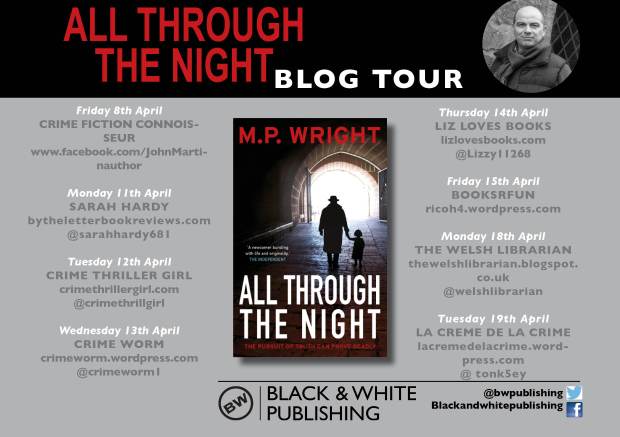

All Through the Night Blog Banner

CTG Reviews: The Girl Who Walked In The Shadows by Marnie Riches

Unknown

Today, I’m delighted to be hosting a stop on the fabulous Marnie Riches blog tour.

Marnie’s latest book – The Girl Who Walked In The Shadows – is the third book in her George McKenzie series. Here’s what the blurb says: “Europe is in the grip of an extreme Arctic blast and at the mercy of a killer who leaves no trace. His weapons of choice are razor-sharp icicles. This is Jack Frost.

Now a fully qualified criminologist, Georgina McKenzie is called upon by the Dutch police to profile this cunning and brutal murderer. Are they looking for a hit man or a frenzied serial-killer? Could there be a link to a cold missing persons’ case that George had worked with Chief Inspector Paul van den Bergen – two abducted toddlers he could never quite give up on?

The hunt for Jack Frost sparks a dangerous, heart-rending journey through the toughest neighbourhoods in Europe, where refugees and Roma gypsies scratch a living on the edge of society. Walking into the dark, violent world of a trans-national trafficking ring, can George outrun death to shed light on two terrible mysteries?”

Dr George McKenzie is a real kick-ass character. She’s tough in a street-smart, non-nonsense kind of a way, as well as clever and inquisitive. Her rather fiery brand of investigating complements the calmer Dutch detective Van den Bergen, and together they make for a formidable team. But the team is under pressure, both to connect the strange and gruesome Jack Frost murders that are taking place with seemingly unconnected victims, and to work out what the link might be to the disappearance of two children abducted from their own garden two years previously. The situation isn’t made any easier for George by her and Van den Bergen’s on-off love affair hovering in a tricky no mans land between on and off.

The sense of place, as ever in the series, is captured brilliantly. Set in the grip of a bitter snow covered winter, the story has an ice-cold atmosphere that will have you turning up the heating and wrapping yourself in an extra blanket as you read.

The Girl Who Walked In The Shadows is a fast paced thrill of a read, with a bucket-load of twists and turns, and some emotive and thought provoking issues at its core.

It’s an excellent addition to this very popular series and, although written as the third instalment, I think it would work well as a standalone for those new to the George McKenzie books.

Perfect for thriller fans.

To find out more about Marnie Riches pop over to her website and follow her on Twitter @Marnie_Riches

THE GIRL WHO WALKED IN THE SHADOWS is out now. You can buy it from Amazon here

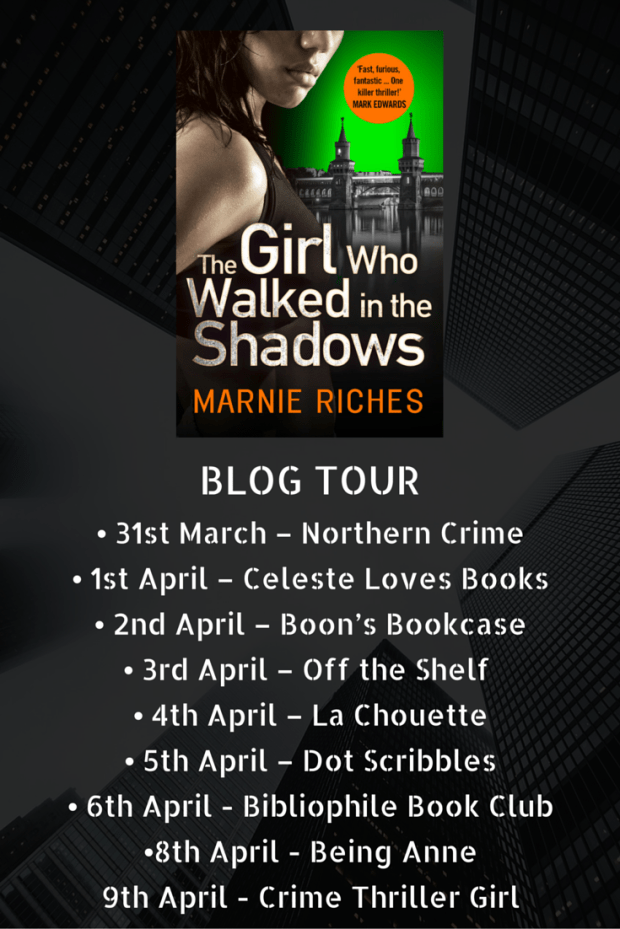
And be sure to check out all the other fabulous stops on the tour …

BLOG TOUR

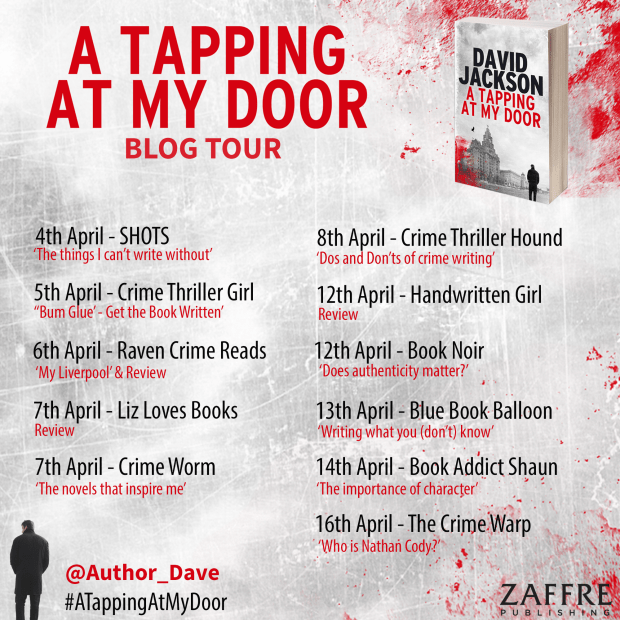
#ATappingAtMyDoor Blog Tour: David Jackson on the importance of “Bum Glue”

A Tapping at my Door

Today I’m delighted to welcome the lovely David Jackson to the CTG blog for a stop on his #ATappingAtMyDoor blog tour. Following the success of his Callum Doyle novels, A Tapping At My Door is the first book in a fantastic new crime series featuring DS Nathan Cody. As well as being a best selling crime writer, David is a university lecturer, so he knows the challenges of juggling two jobs. In this post he’s sharing just how he manages to do both, with the help of a little “bum glue” …

To an author, bum glue is important stuff. You can’t buy it in a shop (you could try asking for it, but I dread to think what you’d get), but you’re going to need plenty of it if you’re going to get that novel finished.

Bum glue is a term used to represent the staying power you’ll need to keep your butt in a chair while you write. Writing – or at least writing well – can be hard work, and many of us will avoid hard work if we can get away with it. This is especially true when there are untold numbers of other demands on our time.

It’s no different for me. I’m not a full time author: I have a day job as a university academic. I have a family. I also want a life. I want to watch TV and read and socialise and sit in the garden and go on long walks and sleep. All that quickly eats into the precious commodity called time.

So how on earth do I get my books written? People ask me that a lot. And I have two answers – one philosophical and one practical.

The philosophical answer is that, if you want something badly enough, you will always find time for it. Nobody who is thinking of having kids says they haven’t got the time. It’s a given that you will make time. You may be constantly tired and irritable, and you may have to say goodbye to a social life, but you will make time. Think of writing a book as a slightly less intense version of the ordeal that is child-raising, and you’ll be fine!

Those of you who haven’t already decided that writing a book sounds like the seventh circle of Hell will want to be rewarded with something a little bit more practical at this point, so here’s my tip of the week.

Jackson, Dave

First of all, get out of the mindset that writing HAS to be regular and HAS to be of uniform consistency. Writing is not a bowel movement! I sometimes go for days without writing a word, and that’s okay. I’ll make up for it on another day. Getting worked up about missed sessions can lead to guilt, a sense of failure, and ultimately quitting.

Next, stop searching for all those hours you think you’ll need. The likelihood is that you won’t find enough of them, and again you’ll get frustrated. Instead, find minutes. Ten of them will do. Maybe even five. Even the busiest of us can find five spare minutes. And in those five minutes, write like hell.

If you do this, two things will happen. The first is that you will have made a start, and that’s half the battle (Initium est dimidium facti, as the Romans were fond of saying). The other thing is that, once you’ve got into your story, you won’t want to finish. And nor should you. Your five minutes are up – so what? Just keep the momentum going. Five minutes will quickly become ten, and before you know it you’ll have been writing for half an hour or more.

Later in the day, find another five minutes and repeat. The secret is to trick your own mind into believing that the task is not as daunting as it appears.

Got five minutes now? Sure you have. Why not write some words?


Big thanks to the fabulous David Jackson for chatting to us today about bum glue.

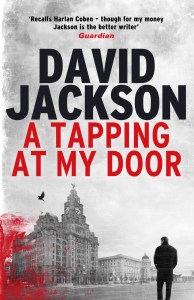
A TAPPING AT MY DOOR is the first book in a fantastic new crime series featuring Nathan Cody. Here’s the blurb: “A woman at home in Liverpool is disturbed by a persistent tapping at her back door. She’s unnerved to discover the culprit is a raven, and tries to shoo it away. Which is when the killer strikes. DS Nathan Cody, just back to work after an undercover mission that went horrifyingly wrong, is put on the case. But the police have no leads, except the body of the bird – and the victim’s missing eyes. As flashbacks from his past begin to intrude, Cody realizes he is battling not just a murderer, but his own inner demons too. And then there’s a second murder, and Cody realizes the threat isn’t to the people of Liverpool after all – it’s to the police.”

A TAPPING AT MY DOOR is out in hardback and eBook on the 7th April. You can pre-order it here from Amazon.

You can find out more about David Jackson by hopping over to his website www.davidjacksonbooks.com and following him on Twitter @Author_Dave

And be sure to check out all the other great stops along the route of the A Tapping At My Door Blog Tour:

A Tapping at my Door Blog Banner FINAL

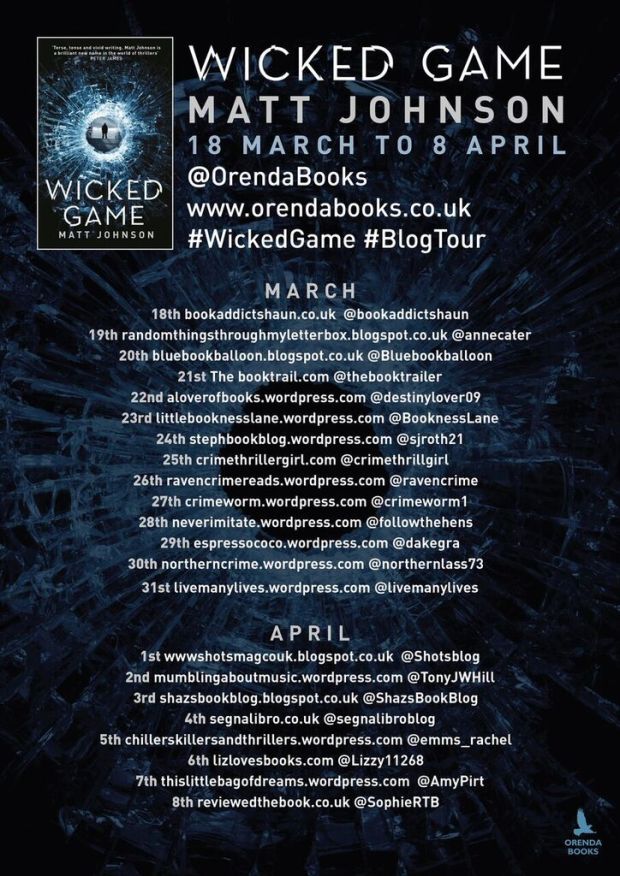
#WickedGame Blog Tour – Guest Post: Losing a Friend by Matt Johnson

unspecified-2

Today it’s my pleasure to welcome Matt Johnson to the CTG blog. Matt served as a solider and Metropolitan Police officer for 25 years. Blown off his feet at the London Baltic Exchange bombing in 1992, and one of the first police officers on the scene of the 1982 Regent’s Park bombing, Matt was also at the Libyan People’s Bureau shooting in 1984 where he escorted his mortally wounded friend and colleague, Yvonne Fletcher, to hospital. Hidden wounds took there toll and in 1999 Matt was discharged from the police with Post Traumatic Stress Disorder. While undergoing treatment, he was encouraged to write about his career and his experiences. One evening, Matt sat at his computer and started to pull these notes together into a work of fiction that he described as having a tremendously cathartic effect. His novel, Wicked Game, was the result. 

Losing a Friend by Matt Johnson:

The 17th of April this year sees the 32nd anniversary of one of the worst days I have ever experienced. It was the day when a friend and colleague was shot and killed. Three decades later, despite the identity of the killer being known, he remains a free man.

On 17th April 1984, I was a 27-year-old advanced car driver working in central London in a police traffic car.

On 17th April 1984, WPC Yvonne Fletcher was a 25-year-old officer on the Vice Squad at West End Central Police Station. My wife at that time served on this same squad. Yvonne was one of her best mates and part of our circle of friends.

Yvonne had been at a house-warming party at my home a few weeks before this fateful day. My lasting memory is of seeing her sitting at the bottom of the stairs in my house, looking relaxed and chatting with friends.

At 10.18 am Yvonne was among a small contingent of officers supervising a demonstration outside the Libyan Peoples Bureau in St James Square, London. Her fiancé was among the officers with her. Yvonne had her back to the Bureau.

Without warning, someone in the Libyan Bureau fired a Sterling submachine gun into the group of protesters and police officers. Eleven people were hit by bullets, including Yvonne.

An ambulance was quickly sent to the scene and my patrol car was sent to escort the ambulance to the Westminster Hospital.

Anyone who has worked in central London will know just how quickly a major incident can cause the streets to become blocked. Main roads rapidly snarl up and the side streets and rat runs that the taxis and locals use soon follow. Gridlock is the result.

Getting the ambulance to the hospital proved to be a nightmare. We were forced to drive onto pavements and, on several occasions, we had to get out of the car to get vehicles moved so we could get through. At that time we were aware that the casualty was a police officer, but we did not know whom.

I remember that the ambulance overtook the police car just before we reached the hospital. We had to get out of the car to clear traffic from a junction and the crew seized the opportunity to make progress and get through. When we pulled in behind the ambulance, Yvonne had already been taken into the emergency area. I remember seeing the fantastic efforts and the work that was being put in by the nursing staff to help her. They couldn’t have tried harder.

Yvonne died from her wounds one hour later. She had been shot in the back and abdomen.

After escorting the ambulance, my car was sent to help with the traffic chaos that followed the start of the resulting siege.

I went home that afternoon and switched on the six o’clock news. It was only then that my former wife and I learned that the murdered officer was our friend.

The following day, I was assigned as a driver to the SAS team that had been brought in and stationed at a nearby RAF base. My job was to run the lads around – in short I was a gofer and taxi driver. I made frequent trips to the infamous ‘blue screen’ that was built to block the view into the square and I was present on the night that something amazing happened.

Yvonne’s hat and four other officers’ helmets were left lying in the square during the siege of the embassy. Images of them were shown repeatedly in the British media. They came to represent something quite iconic – a symbol of unarmed police officers who had been attacked so ruthlessly.

hats

What happened was that a PC, acting completely on his own, ran into the square and snatched Yvonne’s hat. There were shouts of ‘get back, get back’ from the firearms officers, but the unarmed PC was determined and fast. As he returned to the blue screen, he was bundled away by a senior officer and a firearms officer. I never did find out what happened to the PC but I suspect he got into trouble.

Fact is, what he did was a reckless thing to do. It is quite possible that the hat may have been playing a part in the hostage negotiations that were going on behind the scenes. We will never know. But what I can tell you is how much that PC’s actions lifted the spirits of people like me, who were sitting watching while the ‘powers that be’ seemed to be doing very little. Grabbing Yvonne’s hat from under the noses of the terrorists stuck two fingers up to them and told them what we thought of them.

To that anonymous PC, I say thanks.

The ‘Peoples Bureau’ was surrounded by armed police for eleven days, in one of the longest police sieges in London’s history. Meanwhile, in Libya, Colonel Gaddafi claimed that the embassy was under attack from British forces, and Libyan soldiers surrounded the British Embassy in Tripoli.

No satisfactory conclusion was reached in the UK, and following the taking of six hostages in Tripoli, the occupiers of the Bureau were allowed to fly out of the UK. The Tripoli hostages were not released for several months, ironically almost on the exact day that the memorial to Yvonne Fletcher was unveiled.

In July 2012 Andrew Gilligan of The Sunday Telegraph received reliable reports that Salah Eddin Khalifa, a pro-Gaddafi student, fired the fatal shot. Unlike a previous suspect named as the killer, Mr Khalifa is known to be alive and may, one day, be arrested. He is currently living in Cairo, a city to which he moved as the Gaddafi regime crumbled.

Yvonne’s death is still the only murder of a British cop on UK soil to remain unsolved. But, we haven’t forgotten. We will never forget.

***

Wicked Game – the novel shaped by Matt Johnson’s experiences as a soldier and in the police – is published by Orenda Books.

Here’s the blurb: “2001. Age is catching up with Robert Finlay, a police officer on the Royalty Protection team based in London. He’s looking forward to returning to uniform policing and a less stressful life with his new family. But fate has other plans.  Finlay’s deeply traumatic, carefully concealed past is about to return to haunt him. A policeman is killed by a bomb blast, and a second is gunned down in his own driveway. Both of the murdered men were former Army colleagues from Finlay’s own SAS regiment, and in a series of explosive events, it becomes clear that he is not the ordinary man that his colleagues, friends and new family think he is. And so begins a game of cat and mouse – a wicked game – in which Finlay is the target, forced to test his long-buried skills in a fight against a determined and unidentified enemy.”

You can buy Wicked Game from Waterstones here or Amazon here

Find out more about Matt Johnson at www.orendabooks.co.uk and follow him on Twitter @Matt_Johnson_UK and be sure to check out all the other stops along his blog tour:

unspecified

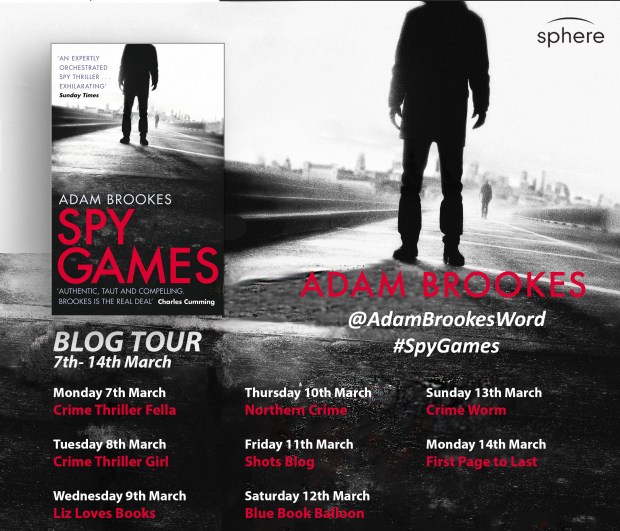
The #SPYGAMES Blog Tour: Read an extract of Spy Games by Adam Brookes

9780751552539

Today I’m delighted to be hosting a sneaky peep extract of thriller writer Adam Brookes’ latest book SPY GAMES as part of the SPY GAMES Blog Tour.

Here’s what the blurb says: “Journalist Philip Mangan throws himself back into the dangerous world of international secrets in the follow-up to the highly acclaimed thriller NIGHT HERON. But this time, no one is to be trusted… Fearing for his life, Mangan has gone into hiding from the Chinese agents who have identified him as a British spy. His reputation and life are in tatters. But when he is caught in a terrorist attack in East Africa and a shadowy figure approaches him in the dead of night with information on its origins, Mangan is suddenly back in the eye of the storm. Meanwhile, thousands of miles away on a humid Hong Kong night, a key MI6 source is murdered minutes after meeting spy Trish Patterson. From Washington D.C. to the hallowed halls of Oxford University and dusty African streets, a sinister power is stirring which will use Mangan and Patterson as its pawns – if they survive.”

The book isn’t published until the 10th, but keep reading for a delicious little taster …


SPY GAMES (extract)

She moves well, thought the watcher.

She moves so that her size seems to diminish. She conceals her strength. She flits by a wall, a storefront, and she is gone before you give her a second glance. You don’t notice her, he thought.

You don’t notice how dangerous she is.

The wind was quickening, the sky the colour of slate. The woman was well ahead of him now, making for the park’s lurid front gate. The watcher quickened his pace, reeling himself in. She wore a scarf of beige linen that covered her hair and left her face in shadow. She wore a loose shirt and trousers in dull colours, and sensible shoes. From a distance, her silhouette was that of a woman from the Malay Peninsula or Indonesia, one of Hong Kong’s faceless migrants, a domestic, a housekeeper on her day off, perhaps. So, a trip to Ocean Park, for the aquarium, candy floss, a rollercoaster.

A treat! Even on this bleak day, with a typhoon churning in from the South China Sea. The woman hid her eyes behind sunglasses. Her skin was very dark.

She made for the ticket booth. The watcher stopped and searched passers-by for an anomaly, the flicker of intention that, to his eye, would betray the presence of hostile surveillance.

Nothing.

He reached into his pocket and clicked Send.

‘Amber, amber,’ he said. Proceed. You’re clean.


Patterson heard the signal, sudden and sharp in her earpiece. She responded with a double click. Understood.

She ran her hand over her headscarf, tugged it forward a little, eased her face further into its recesses. She walked to the window, turned her face down.

‘One, please,’ she said.

The girl at the ticket counter looked at her, confused.

‘Typhoon coming,’ she said. She pointed at a sign taped to the glass. It read: ‘Typhoon Signal Number 3 Is Hoisted’.

‘Yes, I know,’ said Patterson.

The girl raised her eyebrows, then looked to her screen and tapped. Patterson paid in cash, turned and walked to the turnstiles. She took the famous cable car up the headland, hundreds of feet above the rocks and crashing surf, sitting alone in a tiny car that bucked and jittered in the wind. Unnerved, she gripped the bars, looked out at a venomous green sea and watched the freighters fading in the gloom.

Another two hours of this at least, she thought. More. Surveillance detection runs are sent by the intelligence gods to try the soul.

Dogging her steps since morning was the wiry little man with the baseball cap and wispy goatee, his speech incised with the clipped sing-song of the Pearl River delta – her street artist, her watcher. They had come together through Kowloon on foot, then taken the Star Ferry across the heaving waters of Hong Kong harbour. She’d walked the deck while he scanned the eyes of the passengers. More footwork, then a bus. He sat near the door, monitoring the comings and goings.

Amber, amber. His voice thin in her ear, distant, yet intimate.

Proceed.


The cable car slowed, deposited her on a platform. The watcher was there ahead of her. How had he managed that? He sat on a bench smoking a cigarette, looking at a map of Ocean Park’s recreational

delights. She walked on, past the Sea Jelly Spectacular, the Rainforest Exhibit. The watcher inscribed wide arcs around her as the wind hissed in the palm trees. After this there would be another bus to take them through the Aberdeen Tunnel, followed by a taxi, then more pavement work in the rain, hour after dreary hour of it until the watchers pronounced her utterly, definitively, conclusively clean.

For this was China, where the streets were so saturated with surveillance that agent and case officer moved with the caution of divers in some deep sea, silent, swimming slowly towards each other in the dark.


Spy Games by Adam Brookes is published 10th March by Sphere priced at £7.99 in paperback. 

You can buy it here from Waterstones. And here from Amazon.

To find out more about Adam Brookes and his books hop on over to his website at www.adambrookes.com and follow him on Twitter @AdamBrookesWord

And be sure to check out all of the great stops on the SPY GAMES Blog Tour …

Spy Games blog tour

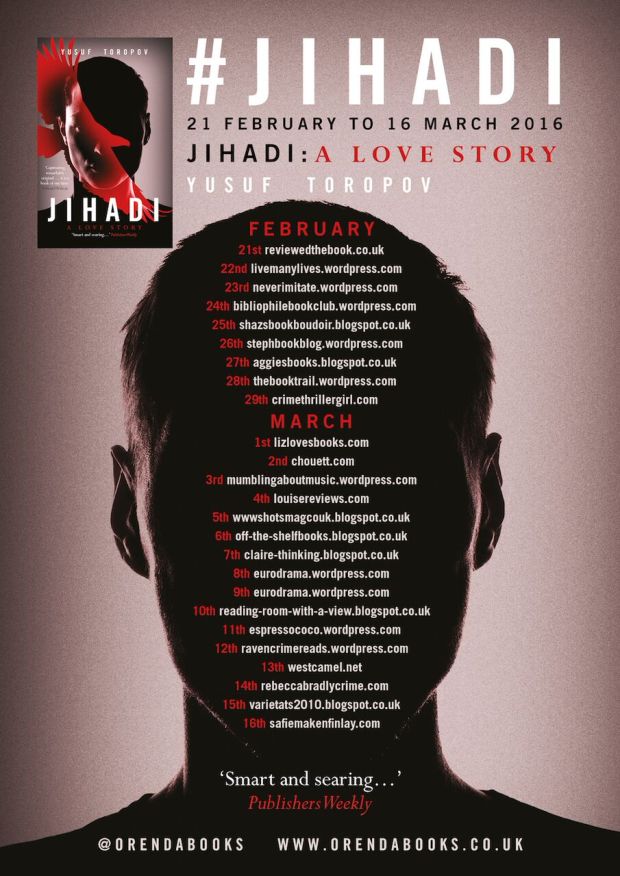
The #JIHADI Blog Tour: PANTSER OR PLOTTER? MY JIHADI BREAKTHROUGH by Yusuf Toropov


unspecified-2

It’s a real pleasure to welcome Yusuf Toropov to the CTG blog. Yusuf is an American Muslim writer, he’s authored and co-authored a number of non-fiction books and has had plays produced off-Broadway. His highly acclaimed debut novel – Jihadi: A Love Story – is published by Orenda Books and is out now.

Today, Yusuf’s kindly agreed to talk about his experience of writing a novel, and whether he’s a pantser or a plotter …

There are, Plot Whisperer author Martha Alderson tells us, two kinds of fiction writers: writers who navigate by the seat of their pants, making stuff up as they go along, often without any clear sense of where a scene might actually belong in the book’s sequence … and writers who delight in plotting out events, conflicts, and resolutions ahead of time before attempting to actually write a scene.

Martha’s right. If you’re a writer, you either want to know where the scene fits in your running order before you start to work on it, or you don’t. You’re one or the other, a Pantser or a Plotter. ‘Yeah but I’m both, yeah but I’m neither, yeah but yeah but yeah but.’ Ssh. It’s true. Now just keep reading. If you write fiction, there’s a breakthrough waiting for you here, the same one Martha made possible for me, and the only way for you to get it is to assume for a moment that you do lean one way or the other. And trust me. You do. This is just the reality of writing stories.

Alderson’s book, which you should read if you are writing a novel or even thinking about doing so, makes two important points about all this. First and foremost, you need to figure out which of the two groups you fall into.

I am a classic Pantser. I’m the guy who stumbles ahead without letting the fact that I haven’t set up much of a plot yet stop me. Even if there is a clear plot structure to a story I’ve been working on for a while, I tend to try to forget about it while I’m writing. I actually prefer the sensation of not having the least clue where a given scene is going. I love accidents, and I get some of my best stuff from noticing when something that I tried came out wrong – but interesting.

Case in point: the character Fatima Adara, from my novel Jihadi: A Love Story. Most people tell me she’s the most memorable thing about the book. Yet I stumbled across her. She was supposed to appear in one scene. I wrote about 50,000 words of the novel before I realized that she was a major character. (They weren’t all good words – I threw about half of them out.)

You read right: 50,000 words. Now, if you’re a Plotter, I suspect you just cannot imagine yourself investing the word counts that I did in a story that hadn’t yet identified all of its major characters. And you know what? You’re right. I probably shouldn’t have. At that point, I was traveling without a map. Which brings us to Alderson’s second big point, and the breakthrough she made possible for me and, maybe, for you.

It is this: Once you know which writing camp you fall into, Pantser or Plotter, you have to make a conscious effort to compensate for certain inherent weaknesses you bring to the table as a writer.

unspecified-3

If you’re a Plotter, Alderson asks you to consider that your likely weaknesses as a writer include the following: Compelling emotion may be lacking from some of your scenes. Ring any bells? Plotters, this is for you. In addition to plotting, you need to push yourself outside your comfort zone. You need to go beyond outlining. You need to find a way to experience, on a personal level, what your protagonist is experiencing. You need to notice what that obstacle she’s encountering feels like, on a sensory level, not just on an analytical level. You need to be there personally and get hurt, fall in love, be terrified, whatever. You need to experience whatever is happening first-hand if you really want to write about it. (This is something that Pantsers usually have no problem with, by the way.) You’ve got to put yourself into the character’s situation, live the scene, and notice what the emotion feels like before you start writing. Otherwise, you may ‘finish’ your book, but you may find that it is filled with scenes that don’t actually engage the reader on a gut level. Ouch.

If you’re a Pantser (like me) your likely weakness looks like this: You may never finish the damn book, because you’re ‘writing’ without a structure – travelling without a map. Pantsers, this is for you (and me): You just don’t like establishing specific plot points and themes ahead of time. You say it ‘handcuffs’ you. If you do ‘finish’ the book, though, you may find that Act Three has little or nothing to do with Acts One and Two. Again: Ouch. This was my big weakness as a writer, and overcoming it was my breakthrough. I really, really did not want to bother with setting up a Plot Planner (Alderson’s primary writing tool) when I began reading her book, but by the time I was done with it, I knew I had to go outside my comfort zone. So I identified the five essential Alderson turning points for my story, and I put them up on the wall, using her Plot Planner tool. On that wall, I started laying out a clear sequence of scenes, in outline. (A first for me.) Doing all this was not my first instinct. It wasn’t how I was used to writing. But it needed to happen.

As a result of going out of my comfort zone, I figured out, not only that Fatima was independent, intelligent, and a devout Muslim, but also what the big decision ended up making in Act Three of my novel was, and how it needed to be set up in Act One. Also how she connected to the novel’s themes. Also what, specifically, she heard in the very first scene she was in that affected my protagonist in Act Two. All that stuff I didn’t know before I completed my Plot Planner, and I have Martha to thank for it.

You can buy Martha Alderson’s indispensable book The Plot Whisperer here. You can buy Jihadi: A Love Story, on which I might still be working if it hadn’t been for Martha’s work, here.

A huge thank you to Yusuf for talking with us today about his writing process and how he wrote his debut novel – Jihadi: A Love Story. As a fellow pantser, I’m heading over to check out The Plot Whisperer right now!

I also highly recommend you check out Jihadi: A Love Story. Here’s the blurb: “A former intelligence agent stands accused of terrorism, held without charge in a secret overseas prison. His memoir is in the hands of a brilliant but erratic psychologist whose annotations paint a much darker picture. As the story unravels, we are forced to assess the truth for ourselves, and decide not only what really happened on one fateful overseas assignment, but who is the real terrorist. Peopled by a diverse and unforgettable cast of characters, whose reliability as narrators is always questioned, and with a multi-layered plot heaving with unexpected and often shocking developments, Jihadi: A Love Story is an intelligent thriller that asks big questions. Complex, intriguing and intricately woven, this is an astonishing debut that explores the nature of good and evil alongside notions of nationalism, terrorism and fidelity, and, above all, the fragility of the human mind.”

The Jihadi: A Love Story Blog Tour is running now. Be sure to pop over to all the wonderful stops …

unspecified

The FEVER CITY Blog Tour: CTG Interviews debut author Tim Baker about FEVER CITY

 41WWhrlTU7L._SX315_BO1,204,203,200_

Today I’m delighted to be hosting a tour stop on Tim Baker’s FEVER CITY Blog Tour. Tim’s dropped by the CTG blog to answer a few questions about this stunning noir thriller …

Welcome, Tim! Your debut novel FEVER CITY was published in January, can you tell us a bit about it?

FEVER CITY is a propulsive, seat-of-your-pants noir thriller set in the 1960s with an important contemporary component set in 2014.

There are three separate narratives, each with its own central mystery. As the novel progresses, these three stories begin to converge then intertwine, dovetailing at the end into a resolution of all three mysteries.

The first narrative features a private investigator, Nick Alston, who is brought in to assist the police in their search for the kidnapped child of America’s richest and most hated man.

The second concerns a professional contract killer, Hastings, who is recruited into an attempt to assassinate President Kennedy and who decides to risk his life to sabotage the hit.

And the third concerns Nick’s son, Lewis Alston, who is in Dallas in 2014 to interview JFK conspiracy nuts for a book he’s doing on the Kennedy Brothers and who stumbles across information that could connect his own father to the assassination of President Kennedy.

I’m a big fan of the noir thriller. Can you tell me about what attracted you to writing this kind of story?

I’m also a huge fan of the noir thriller. What I love most is the moral ambiguity and the elevated dramatic stakes, as well as the power of the genre’s central conceit – which is that we are all prisoners of the mistakes of our past. Noir is always character-based storytelling and so tends to occupy a richer, more emotionally complex terrain than ordinary thrillers; a landscape of nuance, despair and danger.

In FEVER CITY you blend historical facts – like the assassination of JFK – with the fictitious storyline. How did you go about researching the era and places featured?

It was very important for me to get all the background historical elements right – whether they were concerning JFK and the documented events leading up to his assassination, or portraying the real-life figures who appear as secondary characters, such as Howard Hughes, Marilyn Monroe or J Edgar Hoover.

Once I had that historical architecture in place, I set about shaping mood and nuance, often by withholding specifics and implying ambiance instead of trying to build it.

As far as place is concerned, I believe that tone is the best way to capture the kind of rich period atmosphere I was after, rather than merely layering factual details down one upon another.

How would you describe your approach to writing – do you dive right in, or plot everything out in detail first?

Normally I begin with a strong sense of place. I try to write a locale in as rich and as vivid a way as possible, so that I feel as though I have entered that terrain; as though I inhabit it.

Once I’ve accomplished that, a certain tone emerges, and with it a voice.

That’s the pivotal moment for me – when I discover that voice. Sometimes it never arrives, and I have to abandon the story, but when I do manage to find it, I get caught up in the voice and just start writing.

I never plot the story at the beginning. Instead I see myself as embarking on a voyage of discovery, knowing there will be surprises along the way and trying not to anticipate them.

After completing several drafts, I begin to step back and take a look at the plot from the point of view of story structure. This is when I try to sharpen details and ensure that the story is both coherent and structurally sound without being obvious. My editor at Faber, Angus Cargill, taught me an enormously important lesson about the power of keeping your writing implicit.

FEVER CITY is your debut novel. Can you tell us a bit about your route to publication?

It was in 2011 that I came up with the idea to combine a fictitious kidnapping with a momentous historical event, the assassination of JFK.

And I also wanted to layer in a contemporary domestic noir style narrative into the story that would give resonance to one of the themes of FEVER CITY, which was that the forces behind JFK’s assassination are the same forces that nearly destroyed the world economy in the 2008 Financial Crisis.

It was an ambitious and complex project, and the book took three years to write, after which I sent it out to agents on both sides of the Atlantic.

The first offer of representation came from a young agent, Tom Witcomb, at Blake Friedmann, and his offer put all the other agents on alert. Many came back requesting I give them additional time to consider the manuscript.

But in the meantime, Tom was already busy outlining his vision of the book and the kind of edits he would suggest, and I just found his enthusiasm contagious and knew he would be able to transfer that genuine passion to potential publishing houses.

Tom put the manuscript out to auction and less than three days, we were excited beyond words to accept Faber’s pre-empt. When I had seen the list of publishers Tom was sending the book to, the one I really wanted far more than any other was Faber and Angus Cargill. I was my dream choice and I was over the moon to find a home with them.

And, finally, what does the rest of 2016 have in store for you?

I’m just completing a thriller set in Mexico in 2000 about the battle for justice of two women aligned against the forces of corrupt political institutes, vicious sweatshop owners, and narco terrorism. I’m also working on a first contact novel set in 19th Century Australia, and the sequel to FEVER CITY. And if all goes well, one of my screenplays will be going into production in September in Brazil.


A big thank you to Tim Baker for dropping by the CTG blog today and talking about his debut novel FEVER CITY.

Here’s what the blurb says: “Nick Alston, a Los Angeles private investigator, is hired to find the kidnapped son of America’s richest and most hated man. Hastings, a mob hitman in search of redemption, is also on the trail. But both men soon become ensnared by a sinister cabal that spreads from the White House all the way to Dealey Plaza. Decades later in Dallas, Alston’s son stumbles across evidence from JFK conspiracy buffs that just might link his father to the shot heard around the world.”

FEVER CITY by Tim Baker is published by Faber & Faber and out now. You can buy it from Amazon here

Be sure to follow Tim on Twitter @TimBakerWrites

And check out all the other fabulous tour stops on the FEVER CITY Blog Tour …

BT Fever City_zpsjv7v2qsl

The EVIL UNSEEN Blog Tour: CTG Reviews EVIL UNSEEN by Dave Sivers


eBook_Cover

What the blurb says: “EVEN THE DEAD HAVE THEIR SECRETS. A reformed teenage gang leader is gunned down in cold blood and an angry DS Dan Baines, who knew the victim well, reckons he knows who is responsible. But his boss, DI Lizzie Archer, wants to know the identity of the mystery man who died with him – and whether he was intended victim or innocent bystander. When an officer from the National Crime Agency turns up and declares the case off limits to Archer and her team, it’s clear that there is more going on than meets the eye. Several conflicting agendas are in play and the body count is rising. And Archer and Baines realise that the only people they can truly trust are each other.”


When two people are gunned down in the street in the market town of Aylesbury, DS Dan Baines and his boss, DI Lizzie Archer, are determined to find who has brought gun crime to the Buckinghamshire town. But the case is more than just work for DS Baines, he has been something of a mentor to the younger victim, and the loss hits him hard, bringing losses in his past hurtling back into the present and haunting him day and night. DI Lizzie Archer is battling problems of her own, trying to carve out a new life in Aylesbury after relocating from the MET to escape London. As the two detectives piece the evidence together, and the body count continues to rise, they start to suspect that some of those engaging in criminal activity could be amongst their colleagues.

DI Lizzie Archer is a determined and dynamic detective who, having overcome personal injury, is building herself a new life from scratch. DS Dan Baines is a committed detective who is battling the demons of the past that, in this book, are threatening to overcome him. They make for an engaging duo.

It’s not often I get to read a crime book set in a place I know well, so it was a real treat for me to read this and picture exactly where in Aylesbury and the surrounding area the scenes were set.

EVIL UNSEEN is pacey story, with plenty of twists and intrigue to keep the reader guessing until the finale.

Perfect for fans of police procedurals.


EVIL UNSEEN is out now. To buy the book from Amazon click here

To find out more about Dave Sivers hop on over to his website here and be sure to follow him on Twitter @DaveSivers

And be sure to check out all the other fabulous stops on the EVIL UNSEEN Blog Tour …

Blog Tour Flyer 4 JPEG

The Even the Dead Blog Tour: Guest Post by Benjamin Black

Even the Dead cover

I’m delighted to welcome Benjamin Black to the CTG blog for today’s stop on his Even The Dead Blog Tour. Benjamin’s kindly agreed to talk about how Even The Dead came into being.

So, over to Benjamin …

The origins of a novel are deeply mysterious, or at least they are so for me. When I look back at the end of the writing I cannot remember setting out, but seem instead to have been always somehow already on my way, by some kind of rough magic. Nor do I retain any memory of the process of devising the plot: it always just seems to have been there, ready-made and waiting for me to flesh it out. Unlikely, I agree, yet that’s how it is.

I am convinced that the less research a novelist does, the better. This is, I know, a convenient attitude for a writer such as I, who believes in the supreme power of the imagination—and who has not the historian’s tolerance for old, or even new, dry documents. It’s one of the peculiarities of fiction, that what a novelist makes up is always more convincing on the page than what he takes from the actual world. Of course, the ‘actual world’ and the people in it constitute the only material the writer has to work with, or from, unless his métier is science fiction or fantasy: and even then . . .

The imagination, the concentrated act of imagining, gives life to character, plot, setting.

I am lucky in that my Quirke novels are set in the 1950s, when pathology was not the exact and intricately technical science that it is nowadays, with the consequence that my protagonist can get away with being such an amateurish professional.

‘Procedural’ novels bore me, and I would never attempt to write one. Quirke is interesting as a human being who happens to be a pathologist. And as for his old pal the Dublin detective Inspector Hackett, he could no more be a Sherlock Holmes or an Hercules Poirot than Quirke could don the white coat and rubber gloves of Patricia Cornwell’s admirable Dr Kay Scarpetta.

So where did Even the Dead originate? Search me—though the search would not turn up much. I suppose I must have started with the circumstances of a crime, and the idea of a shadowy Dublin fraternity determined to keep that crime hidden. I also had in mind an elderly chap I used to see about the streets of Dublin twenty or thirty years ago. His name was Michael O’Riordan, and he was the leader of the Irish Communist Party—a small party, as one might imagine—who as he passed me by used to roll a hard-boiled eye in my direction, seeming to know who I was. Perhaps he had read something of mine? He was generally reviled and ridiculed—I had an aunt who considered him the Devil incarnate—but I admired his fortitude and tenacity in an age of intolerance.

He it was who gave me the character of Sam Corless, Spanish Civil War veteran, leader of the Socialist Left Alliance Party, and the father of my murder victim. But by then, I was already on my way . . .

Big thanks to Benjamin Black for stopping by the CTG blog today.

EVEN THE DEAD is out on the 28th January 2016. Here’s what the blurb says: “Two victims – one dead, one missing. Even the Dead is a visceral, gritty and cinematic thriller from Benjamin Black. Every web has a spider sitting at the centre of it. Pathologist Quirke is back working in the city morgue, watching over Dublin’s dead. When a body is found in a burnt-out car, Quirke is called in to verify the apparent suicide of an up-and-coming civil servant. But Quirke can’t shake a suspicion of foul play.The only witness has vanished, every trace of her wiped away. Piecing together her disappearance, Quirke finds himself drawn into the shadowy world of Dublin’s elite – secret societies and high church politics, corrupt politicians and men with money to lose. When the trail eventually leads to Quirke’s own family, the past and present collide. But crimes of the past are supposed to stay hidden, and Quirke has shaken the web. Now he must wait to see what comes running out.”

You can pre-order it from Amazon here

To find out more about Benjamin Black hop on over on his website www.benjaminblackbooks.com and follow him on Twitter @BenBlackAuthor

And be sure to check out all the other fabulous tour stops on the EVEN THE DEAD Blog Tour …

Facebook-blog-tour-design