CTG Reviews: SKINJOB by Bruce McCabe

SKINJOB cover image

SKINJOB cover image

What the blurb says: “A bomb goes off in downtown San Francisco. Twelve people are dead. But this is no ordinary target. This target exists on the fault line where sex and money meet. Daniel Madsen is one of a new breed of federal agents armed with a badge, a gun and the Bureau’s latest technological weapon. He’s a fast operator and his instructions are simple: find the bomber – before he strikes again. In order to understand what is at stake, Madsen must plunge into a sleazy, unsettling world where reality and fantasy are indistinguishable, exploitation is business as usual, and the dead hand of corruption reaches all the way to the top. There’s too much money involved for this investigation to stay private …”

Bruce McCabe has created a darkly fascinating future world. It’s similar to the world as we know it, but with many elements taken to technology-enabled extremes. Like the hand-held lie detectors that allow FBI ‘plotters’ to determine the truth of a crime at faster rates than ever before, and the new, utterly lifelike sex dolls – ‘skinjobs’ – that look, feel and act like real people (although, spookily, can’t speak), and the dramatic rise in politically active religions lobbying against their use. It’s a world where secrets are outlawed, and good law officers can lose their jobs at the beep of a device. And, as a result of this new technology, careers and fortunes can be made and lost at an increasingly rapid rate.

‘Plotter’ Daniel Madsen is part of the new world. He’s hard-working to the point of extreme, super-smart, and determined to find the truth and get justice in all the cases he works. When he’s called in to work with the local cops after a bomb goes off in one of the ‘dollhouses’ – a place men can go to have sex with dolls – he approaches the case as he would any other. But this one is different. The forensic evidence doesn’t tie up with the CCTV footage. Under increasing pressure to generate leads and suspects, Daniel works around the clock trying to unravel the truth. But there is more to this case that first appears, and some very powerful people whose reputations (and fortunes) will rise or fall on the outcome.

But the story isn’t just about technology. As well as Daniel’s quest for the truth, what makes the story even more human is the internal conflict of Shari Sanayei, local PD Viddy Ops specialist (video surveillance), who is in charge of analysing the CCTV footage, and has to watch the police officer she was having a secret affair with enter the building where the bomb detonated just moments before it happened. If she declares the relationship, she’ll be removed from the case, and she doesn’t want that. Not only is she the best at viddy ops, she’s also determined to bring her lover’s killer to justice. Even if withholding their affair costs her the job she loves.

This is one of the best techno-thrillers I’ve read. Filled with intrigue and high on action it pulls you into an artfully crafted future world and has you follow Daniel Madsen as he searches for the person responsible for the bombing. With a cast of interesting characters, and the puzzle of evidence that doesn’t make sense, it had me trying to guess the killer’s identity all the way through and still managed to pack a great twist at the end.

Reminiscent of the great Michael Crichton, this is a techno-thriller with heart. A great read, a cracking high-adrenalin story, and a future world to make you think a little more about just where technology might lead us.

Highly recommended.

[Many thanks to Bantam Press for my copy of SKINJOB]


CTG Interviews: Julia Crouch, author of The Long Fall

The Long Fall cover image

The Long Fall cover image

Today I’m delighted to welcome Julia Crouch to the CTG blog.

Famous for her darkly chilling novels of domestic noir, Julia’s latest book – The Long Fall – is published this week in paperback, eBook and as an audio download. 

So, to the questions …

Your latest book – The Long Fall – is out this week. Can you tell us a bit about it?

I started off wondering how someone could continue a life after being guilty of the worst possible transgression.

The story is set in two time frames – 1980 and 2013. The 1980 sections are the diary of 18 year old Emma who is backpacking solo through Europe in her year off. At the end of her journey, something awful happens. The 2013 part is about Kate, a wealthy, high profile charity campaigner, Hedge Fund Manager’s wife and mother to drama student Tilly. When someone turns up from Kate’s past, her superficially perfect life begins to disintegrate around her.

The book takes place in Greece and London, what was it about these particular places that inspired to you to pick them?

I have always loved Greece – I go there whenever I get the opportunity. My first proper visit was as a lone, backpacking eighteen year old. I kept a diary of what I got up to while I was there, and I have mercilessly raided the detail in it for The Long Fall. On the very edge of Europe, Greece is a country of contrasts – of ancient and modern, of East and West, of land and sea. I knew I wanted to set part of the story on an island – as distant, disconnected and isolated as possible – and my son Owen told me about Ikaria, which his Greek girlfriend Eva took him to a couple of years ago. It seemed perfect and, since the novel starts with a fall from a cliff, the idea of the island named after Icarus, the boy who fell when he flew too close to the sun, seemed too perfect to resist.

I had to go and research the island – an arduous task for a Grecophile such as myself – and found to my delight that it was perfect – wind-buffetted with enormous, looming black and grey cliffs, deserted perfect beaches, a jungly interior and a world untouched as yet (touch wood) by mass tourism. Setting is as important to me as my characters and plot, so it was really, really exciting to find Ikaria. I spent a week there, driving a tiny Chevy Matiz over almost impassable mountain roads, exploring mountain villages and isolated bays.

I wanted the contrast of Kate’s world to the Greek scenes to be very stark. A couple of years ago I did a photoshoot for a magazine and they had hired a gorgeous house in a converted school in Battersea. It’s vast – all enormous high ceilings, white walls and wooden floors. The people who own it live in it – although they were away for the day of the shoot – and there’s a big photograph canvas of the family on the kitchen wall. They are beautiful. The impression is one of a perfect life.

I was just beginning to think about The Long Fall at the time, and it seemed to me that this would be the perfect building for Kate to inhabit – gated, turretted luxury. So I’m afraid I ‘stole’ it!

As a trailblazer of the hugely popular Domestic Noir, how would you describe the characteristics of the sub-genre?

Domestic Noir doesn’t necessarily mean a home setting, but it’s often in there somewhere. it’s about the things people do to each other in the name of love. It’s about the levels at which we can deceive ourselves and others, and how we manage to live with our secrets. It can include police and murders, but that’s certainly not essential. The mystery lies in the why – rather than the whodunnit. Because it is rooted in messy old life and relationships, it doesn’t always provide the neat ending of more traditional crime fiction.

Could you tell us a little about your writing process, do you dive right in, or plan the story out first?

Usually, I just dive in and start a story, researching as I go along. I keep writing until I reach the end, even if I know things have to change quite radically in the earlier stages of the novel to support my new discoveries. This I call draft zero, because no one ever sees it except me. Then I go back and rewrite the entire thing, building a firmer structure for the plot, excising loads of guff and putting in hopefully more focussed material. For me, this is the most exciting way to write, because every day you discover something new about your characters and story.

However, it can be difficult to fit this style of working into a publishing schedule. The Long Fall is the first book of a new contract I signed with my publishers Headline, and to secure that I had to put together a pretty clear outline of the story, long before I started. The plot I came up with was quite detailed and so clear that it changed very little in the writing – so I knew what each scene had to do, where the characters had to go. I didn’t know exactly how I was going to structure it, though, so there was still quite a bit of head scratching at the end of draft zero. It is probably a quicker way to finish a novel, but I have to say I have reverted to my old approach for the novel I am currently working on (working title, rather imaginatively, novel #5) and, while it is scarier, I find it more exciting writing, as E L Doctorow put it, “…like driving a car at night. You can only see as far as your headlights, but you can make the whole trip that way.”

What advice would you give to new writers aspiring to publication?

Write the best novel you possibly can, then edit it and make it better. Don’t be in a hurry to submit. Do your homework finding an agent – do they represent authors you like? Do they deal with your genre? See what they say on Twitter. Follow submission guidelines slavishly – they all have different rules, so you will have to work around them, which is a good thing. Be patient. Be polite. Be prepared for rejection, but also be prepared to work on editing suggestions from agents. If you are rejected, there will be a good reason. Try to work out what it is.

If you want to self-publish, pay someone to edit your novel, and try to forget that you are paying so that you listen to their edits. Pay someone to typeset it and design the cover. Learn the business. You have to be aware that you are going into business not only as a writer but also as a publisher. It’s a lot of work.

And lastly, what does the rest of 2014 have in store for you?

Novel #5 will take up the next five months, and we’re beginning to plan Dark & Stormy Brighton 2015 (the crime festival I launched this year with Emlyn Rees and Ray Leek). I’m putting together proposals for three more novels – a process I really enjoy. And something might be happening in Hollywood, although that’s all I’m allowed to say right now. Other than that, I’m promoting The Long Fall all over the shop: I’ll be at Harrogate, Bloody Scotland and Edinburgh Book Festival, as well as many other libraries, bookshops and festivals around the country. Good job I love writing on trains!

Sounds like 2014 is shaping up to be a very busy year!

A huge thank you to Julia Crouch for dropping by and chatting about The Long Fall and her writing process. To find out more about Julia and her books pop on over to http://juliacrouch.co.uk/


And watch this space for our review of The Long Fall – coming soon.

CTG Interviews: Mason Cross author of The Killing Season

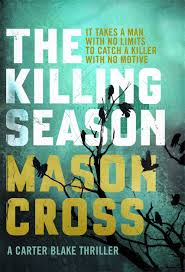
The Killing Season cover image

The Killing Season cover image

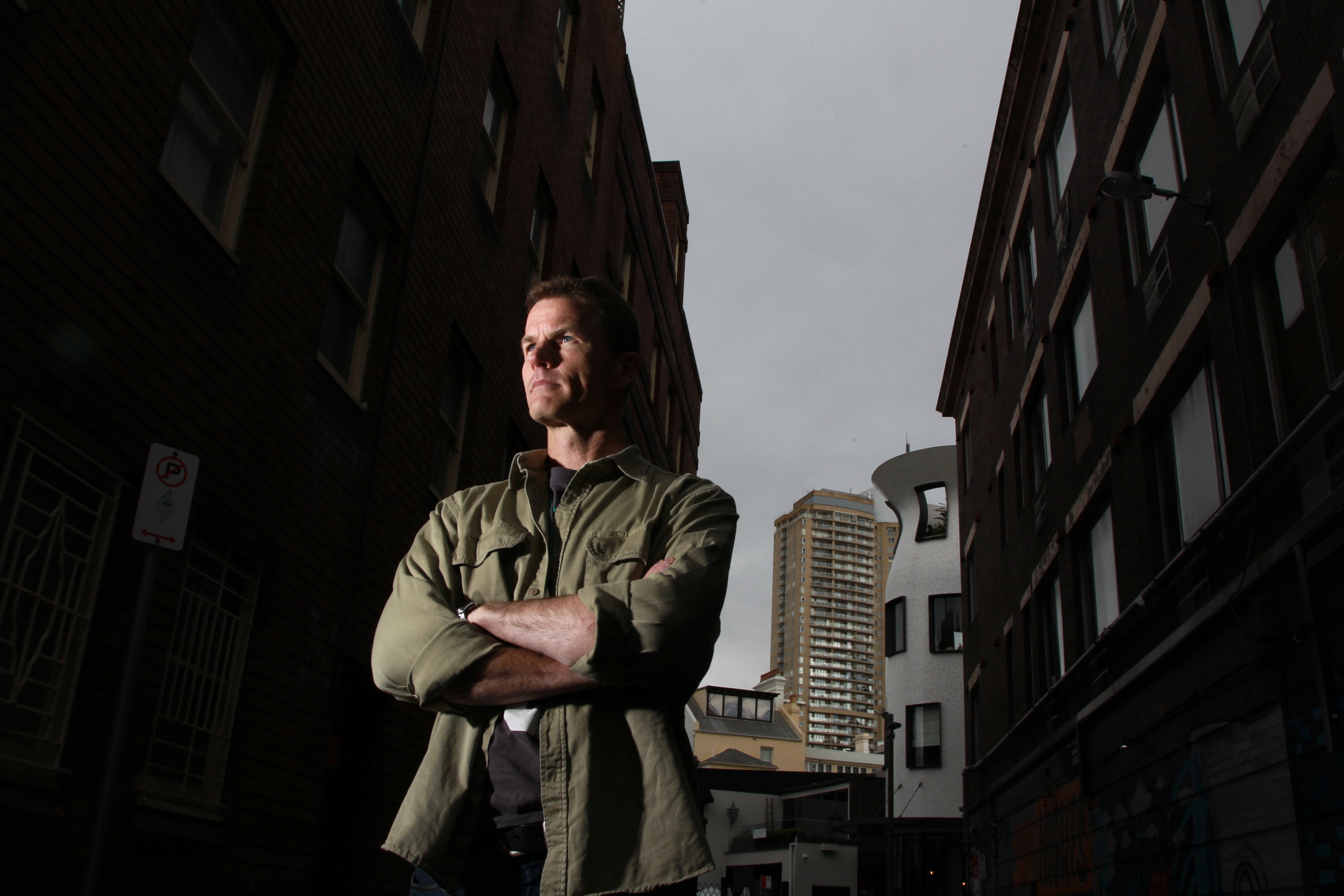
After his Saturday morning panel at CrimeFest, I met up with the charming and rather mysterious Mason Cross – author of The Killing Season.

Over coffee in the rather fancy drawing room of the Bristol College Green Marriott Hotel we chatted about his fabulous debut novel – one of my favourite reads of 2014 so far – his writing process, and geeked-out about our mutual admiration for all things Lee Child and Jack Reacher.

Here’s the interview …

So Mason, firstly, where do you write?

Lots of places. In the house – at my computer surrounded by CDs and a huge pile of washing. I find it’s really important to have a writing space, like Stephen King said, you need a place to go to and close the door. Also, I travel a lot for work. Commuting into Edinburgh on the train is the optimum place for me to write as there’s no distractions just so long as I don’t get WiFi. Having a full-time job I’ve learnt to grab writing time whenever and wherever I can, so I can write in all different places – pubs, cafes, a park bench.

I find it important to write every day, even if it’s only 500 words. Those 500 words will turn into, say, 3000 words in a week, and in a few months a whole lot more.

Are you a planner or a write-by-the-seat-of-your-pantser?

I always feel guilty admitting to plotting! But I do start out with a fairly detailed synopsis, with the key beats outlined. Right now, I’ve got a five page synopsis for the next book, but I know that as I write the plan will change. So I’m flexible, but I have a path to wander from. I use Powerpoint to plan – one slide per chapter – and build up from there. I find it’s a good way to keep track of the action as I write, and also keep track of the different timelines.

And when it comes to writing when are you most productive – are you a lark or an owl?

An owl – I’m better at night, definitely.

So what about research – do you do it, and if so how and how much?

I tend to research while I’m redrafting. It’s mostly internet based research, so for The Killing Season I looked up the FBI website, read books on serial killers and snipers including Public Enemies: America’s Greatest Crime Wave and the Birth of the FBI, which was really helpful on the history of the FBI. And, of course, I read a lot of other thrillers.

Carter Blake is a very mysterious guy. Are you like him and, if so, in what ways?

Like a lot of other thriller writers say about their characters, I think Carter Blake is a cooler, taller, better looking, better in a fight version of me. He tends not to talk about himself, which is something we share, and he’s methodical, which I tend to be too. But the green eyes? They’re completely different!

Actually Banner, the female FBI agent that Carter Blake partners-up with in The Killing Season, is similar to me is some ways too. She has a full-time job, she’s balancing family life, kids alongside – having to sort out a babysitter and get to school play while also doing her job.

Who would play Carter Blake in a movie?

I didn’t really have a person in mind as I wrote. Carter’s still quite a mysterious character even to me!

What authors do you read – who are your inspirations?

I take something from most books I read. My favourites? I guess they’d be Lee Child, Harlan Coben, Robert Crais, Ian Rankin, Denise Mina, John D MacDonald. Oh, and Raymond Chandler – even after all the years since his books were first published they still seem so fresh and the writing is so good.

What’s your favourite all time book?

Must I pick one?! [I said, okay, two then] Well then, The Big Sleep and The Shinning.

What’s your favourite drink?

A Mojito.

And finally, what have you got planned for the rest of 2014/15?

Well, the next book is due out in Spring 2015. It’s called The Samaritan and is set in LA. I’ve also sold a story to Ellery Queen, which I’m really excited about, and it should be out soon. For the rest of 2014 I’ll be promoting The Killing Season.


The coffee was finished. The interview was over. And Mason was off to cram in some more Lee Child facts in preparation for his event the following day – Criminal Mastermind.

A huge thank you to Mason for letting me interrogate him!

To find out more about Mason Cross, Carter Blake and The Killing Season, hop over to this website: http://carterblake.net/

And read our review of The Killing Season click here 

CTG Interviews: Bruce McCabe, author of SKINJOB

SKINJOB cover image

SKINJOB cover image

Today I’m joined by Bruce McCabe whose debut novel – SKINJOB – is coming out with Bantam Press this month.

Welcome to the CTG blog, Bruce.

Your debut novel – SKINJOB – is out this month. Can you tell us a bit about it?

Skinjob is a thriller set in the boardrooms, brothels, churches and alleyways of the near future. It follows the fortunes of Daniel Madsen, a cop trained to deliver rapid results in high-pressure cases where lives are on the line, and Shari Sanayei, an SFPD surveillance officer. The action takes place over just six days. Underneath the surface, the novel takes a provocative look at a series of looming social challenges.

You chose to set the story in the near future, what attracted you to this time period?

I love exploring the big “what if?” and the way we are challenged and changed by technology. Plus I’m privileged, due to my professional background, to talk to the scientists and innovators creating our future in their labs. I find the combination irresistible!

Technology is obviously something you’re very knowledgeable about. Did you need to do any specific research for SKINJOB, and if so how did you go about it?

Most of the research was already done – the book was inspired by a technology demonstrated to me that I found profoundly disturbing, and which stayed with me for years. While writing I spent time in San Francisco and other cities, walking the streets, getting everything just right. I conducted a few interviews too — a special agent I was introduced to was particularly helpful in understanding FBI internal affairs and inter-agency politics!

Bruce McCabe

Bruce McCabe

Could you tell us a little about your writing process, do you dive right in, or plan the story out first?

A mixture. I start with a big “What if?”. After I get a very high level sketch in my head (what I want to say, the characters, the kind of ending I want to arrive at), I dive in and start writing. After two or three chapters I pause and do a basic outline, then it’s back to writing. Over the course of the novel I return and rework that outline perhaps two or three times, each time adding structure and more detail. The plot is always in flux, right up until the last page.

What advice would you give to those aspiring to publication as crime writers?

To me, good crime writing is about the ‘slow reveal’: keep the revelations coming, but don’t give away too much and don’t be in too much of a hurry! Get that pace just right and your readers are bursting by the time they get to whodunit. On writing generally: read and write a lot, and understand that all first drafts look awful; everything good was re-written and polished many times over before it saw the light of day.

And lastly, what does the rest of 2014 have in store for you?

Completing my second novel. It’s getting very close now and I’m both exhausted and excited! Then some downtime and some travel – during which I’ll probably scout locations for the next one!

Sounds great. Many thanks for dropping by the CTG blog and answering our questions.

To find out more about Bruce McCabe, pop over to his website at http://www.brucemccabe.com

SKINJOB is out now, and we’ll be posting our review shortly. In the meantime, here’s what the blurb says: “A bomb goes off in down town San Francisco. Twelve people are dead. But this was no ordinary target. This target exists on the fault line where sex and money meet. Daniel Madsen is one of a new breed of federal agents armed with a badge, a gun and a handheld lie detector. He’s a fast operator and his instructions are simple: find the bomber – and before he strikes again. In order to understand what is at stake, Madsen must plunge into a sleazy, unsettling world where reality and fantasy are indistinguishable, exploitation is business as usual, and the dead hand of corruption reaches all the way to the top. There’s too much money involved for this investigation to stay private …”

Fun at Hay Festival: Cumberbatch, Child and sneaking into the Green Room …

Benedict Cumberbatch reading at Letters Live

Benedict Cumberbatch reading at Letters Live

So on Saturday I drove to Hay-on-Wye to visit the Hay Festival for the very first time. I wasn’t really sure exactly what to expect. I’ve been to music festivals, sure. But an outdoor book festival? I couldn’t really picture it.

The first thing that struck me was the shear size and scale of the thing. On the stretch of road between the town of Hay-on-Wye and the Hay Festival site I passed a lot of people walking: all ages, dressed in the usual festival gear – everything from wellies to flip-flops, dresses to jeans to shorts, wet weather jackets and sunglasses. When I arrived at the parking, the first charity car park I tried was already full, but the guy on the gate looked at my little car and said he thought they could squeeze it in – luckily they did.

Then it was across the road and into the festival. I don’t think I’ve ever seen so many book lovers all crammed into one space before! There was loads to see, not just all the fabulous events, but also the huge bookstore, the BBC radio broadcasts, the various eating places and bars, and also (if you’d brought the kids) a host of children’s play areas.

The first event I went along to was Letters Live in the Tata Tent. This event, in association with The Reading Agency and World Book Night, was a celebration of literary correspondence inspired by To The Letter by Simon Garfield and Letters of Note by Shaun Usher. The letters were read on stage by Benedict Cumberbatch, Louise Brealy, Ian McEwan, Rob Brydon, Antony Grayling, Lisa Dwan and others (with James Rhodes reading a letter by Chopin and then playing a piece of his music on the keyboard set up on stage). It was a fantastic event with the letters, and their performers, both inspiring laughter and reflection at the emotion conveyed in each one and the wonder of the art of letter writing. The highlight of the event for me was the series of letters read by Benedict Cumberbatch and Louise Brealy – the love letters of Chris and Betty whose relationship bloomed by correspondence while Chris was posted during the war (and later a POW).

In line for the Lee Child event

In line for the Lee Child event (CTG squinting into the sun on the right!)

Next I caught up with my friend Steph Roundsmith, who runs the KidsReadWriteReview scheme (http://www.kidsreadwritereview.co.uk/), and Kjartan Poskitt, the fabulous author of many children’s books including the Agatha Parrot series, the Murderous Maths series and his newest series – Borgon the Axeboy (see http://www.kjartan.co.uk/), who’d just finished his event and signing. We (slowly) inched our way through the crowds to the green room where we sat on the very comfortable sofas and chatted over a hot chocolate.

After that, I had time for a little mooch about. One of the things I loved was the Hollow Ash Shepherd’s Huts. These beautiful spaces are just perfect for using as a writing room in the garden. Hollow Ash also offer glamping holidays in a couple of huts situated in a beautiful part of Hereford. Check them out here http://www.hollowash.co.uk


Lee Child with Sarah Crompton

Lee Child with Sarah Crompton

Then it was dinner – potato wedges and hummus did the job – before heading to the Never Go Back – Lee Child talks to Sarah Crompton event. The tent was packed, and Sarah Crompton did at great job of questioning Lee about his route to becoming an author, where the inspiration (and name of Reacher) came from, and what happens in the latest book of the series – Never Go Back. Of course, there were also questions about the film, and Tom Cruise. And a question from the audience about why Reacher has had less sex in recent books – the answer? In Never Go Back there’s plenty! I’ve heard Lee speak a few times before, and he was as witty and entertaining as ever.

And then it was over. As I drove out of the festival site and headed home I reflected that the Hay Festival is a fun place to visit, and that perhaps next year I’d come along for more than one day.

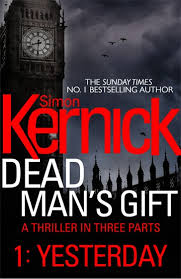
CTG Reviews: Dead Man’s Gift (Parts 1 and 2) by Simon Kernick

Dead Man's Gift cover image

Dead Man’s Gift cover image

Part 1: Yesterday

What the blurb says: “MP Tim Horton arrives home to find his seven year old son has been abducted by a ruthless gang of kidnappers. All they have left behind is the brutally murdered body of the Horton’s nanny. The gang’s demands are simple: Tim must sacrifice his own life in order to save his son’s. It’s the ultimate dead man’s gift.”

Part 2: Last Night

And for the second part, the blurb continues: “MP Tim Horton is waiting to hear from his son’s kidnappers. Knowing he’s being watched, and too scared to go to the police, he contacts the only man who may be able to help him, his brother-in-law: an ex-soldier called Scope who has a reputation for sorting things out and getting things done.”


Released as a three-part series, Dead Man’s Gift hooked me from the first page of part one and pulled me at break-neck speed through the first installment, and on to the second. It left me breathless, and repeatedly pressing the right side of my Kindle to go to the next page even though it told me I’d reached the end of part two! I was horrified to learn that I’d have to wait until 5th June to download the final part.

As the story is still ‘live’ and in progress it doesn’t feel right to write a full review – you know I don’t do spoilers – and, after all, it’d be much more fun for you to download the first two parts and get caught up with the story for yourself.

But, what I will say, is that Simon Kernick has created a chillingly compelling scenario and a great cast of characters. MP Tim Horton has just hours to save his son, enlisting the help of the only person he knows who just might have the skills to do it. If they fail, Tim will be forced to do what his child’s abductors are demanding or his son will die. But the gang are smarter, and better connected, than Tim could ever have imagined. As the clock counts down, and the criminal’s demands are revealed in their horrifying entirety, it seems that Tim will have no choice but to make the ultimate sacrifice.

This is a pulse-pounding, high-action, gripping read, with the suspense made all the more heightened because of the wait until part three is released on 5th June.

If you like thrillers, this will be a real treat. Go download it. Now!


[I bought my Kindle copies of Dead Man’s Gift parts 1 and 2. I’m now waiting with anticipation for part 3 to be ready for download]


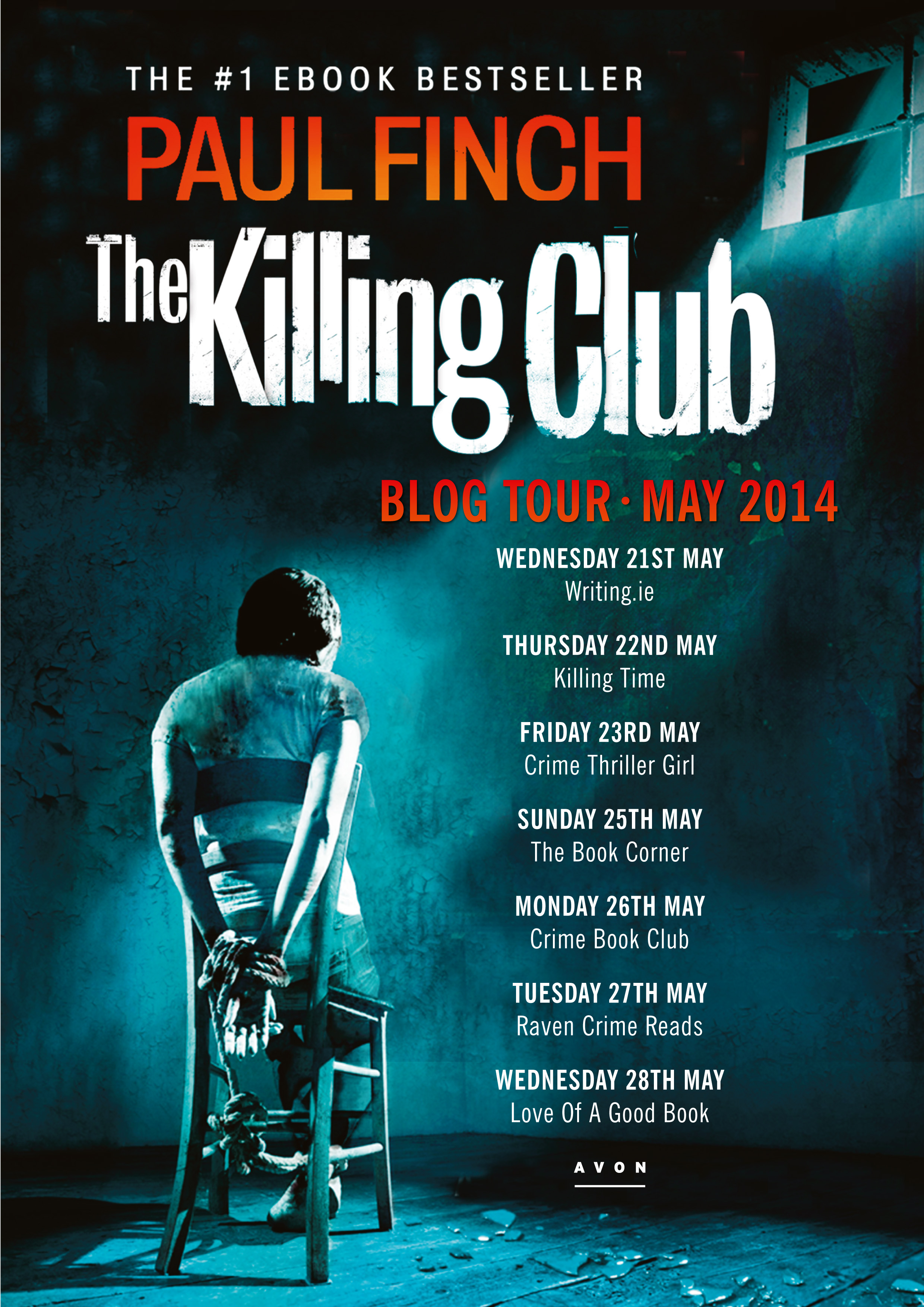
The Killing Club Blog Tour: Guest Post by Paul Finch

KC blog tour poster

KC blog tour poster

I’m delighted to welcome Paul Finch to the CTG blog. His latest novel, The Killing Club, is published this week, and today Paul is taking over the reins (or rather the keyboard) to guest blog about the books he has read that have been most influential on his career.

Over to Paul …

It would be very easy, I suppose, to respond to the question which books have you read that were most influential on your career, and, given that my own most successful novels are intense murder investigations, simply reel off all the great thriller writers.

It would of course be untrue to say that I haven’t been influenced by other thriller novelists. Stuart MacBride, Mark Billingham, Peter James, Kathy Reichs and Katia Lief are all staggeringly high in my estimation. But I don’t just read within my own genre, and I think it would be an interesting exercise to perhaps consider those other types of books that have blown me away, set me on my current career path, whatever you want to call it.

It’s no secret that, before I began writing my DS Heckenburg thrillers, I dabbled widely in the fields of horror and fantasy. And this wasn’t just during my formative years as a writer, my kindergarten if you like; I wrote lots of this kind of stuff, and still do. I also read in this field enormously. But it’s fascinating now, on reflection, how much these apparently unrelated interests have influenced my DS Heckenburg novels.

For example, THE WOLFEN by Whitley Strieber (pub. 1978) presents us with two tired New York detectives, a man and a woman, investigating the murder and apparent cannibalisation of hobos in the city’s underbelly, and soon reaching the conclusion the perpetrators are not humans, but a highly intelligent werewolf pack.

Now, I suppose there are obvious links here with ‘Heck’: a gang of vicious and relentless killers, a lovelorn boy and girl cop team, and so on. But I think it’s the seamy side of the average detective’s working day that most caught my eye about this striking novel. Strieber really takes us to the backside of New York, the subways and ghettos and derelict lots, and peoples them with hookers, winos and druggies. My own experience as a real life cop taught me these are the places you need to go if you want to catch some bad guys, but here we go way beyond the everyday grim, delving into the world of the true urban gothic: it’s a nightmare landscape, beautifully and poetically described, and yet at the same time filled with such palpable menace that even hardboiled detectives are unnerved.

I make a point of never taking my own crime thrillers into such realms of overt fantasy, but I’d be lying if I said I didn’t try to invoke similar feelings of dread and weirdness in the dark heart of the city.

Another relevant horror novel is surely LEGION by William Peter Blatty (pub. 1983). This is a totally different kind of police story. Again, it follows a time-served detective investigating a series of sadistic murders, though in this case he’s dealing with Satanic ritual. It’s a much subtler tale, ripe with a sense of ancient mystery and slow-burning evil (and that would be real evil, of the distinctly inhuman variety). Yet for all this, the point where LEGION really kicks in is the deep assessment the hero, Lt. Kinderman, constantly makes of himself, examining his own beliefs or unbeliefs, puzzling as to why he exposes himself to this depravity time and again, bleeding inside for the victims. Not exactly Heck, who’s never been much of a philosopher, but the longer you work as a homicide cop, the more you’re going to confront yourself with these issues. There is some really deep character work here by Blatty, which you can’t help but admire.

Moving from horror into science fiction and fantasy, there are two other titles I’d like to mention. The first of these contains the most obvious link to those matters I’ve mentioned previously. It is Philip K. Dick’s sci-fi masterwork, DO ANDROIDS DREAM OF ELECTRIC SHEEP (pub. 1968). Most folk will know this as the movie, BLADE RUNNER, but though there are some similarities, the book goes way beyond the limited scope of a Hollywood adaptation. In Rick Deckard, another dogged man-hunter and, thanks to his wife’s depression, a sad loner, working his way through a world gone mad and yet adding to it with his own role, which conflicts him deeply, there is genuine pathos. The movie, of course, had a strong noirish feel – it was almost Chandleresque – which is not prevalent in the book, but the strong central character is still a great blueprint for the fictional lone-wolf detective. For me, heroes always need to be vulnerable: stricken by self-doubt, and with enemies on all sides, some of whom they thought were friends. I’ve never had much time for men of steel, undefeatable icons of hunky machismo, like Superman or Batman. If I took anything from DO ANDROIDS DREAM … it had to be that deep introspection, that guilt, that conscience. It makes our heroes so much more interesting.

On that same subject, the fantasy novel I’d like to nominate is GRENDEL by John Gardner (pub. 1971). I guess we’re all familiar with the tale of Beowulf, the Viking warrior, and his defence of the hall of Heorot against the ravages of the faceless devil, Grendel, who for no reason other than twisted pleasure, came nightly to slaughter the innocent.

As I say, I’m not big on superhero stories. I loved BEOWULF as a kid – it was probably the first spooky tale my late father told me – but as I grew up, I found the monster more interesting. I mean, let’s not kid ourselves, Grendel is the prototype serial killer. So in many ways, GRENDEL the novel takes us to the other end of the crime thriller spectrum, Gardner depicting his antihero first as an abused and lonely child, later showing him suffer rejection by those he sought to befriend, and finally having him retaliate with homicidal fury, which at last introduces him to a lifestyle of his liking – if he can’t have everyone’s love, he’ll have their terror. There isn’t as much Norse myth woven into this novel as you might expect. Instead Gardner gives us philosophy, social commentary and, a decade before the FBI commenced offender profiling, the psychology of the reviled. Talk about streets ahead of the game. Of course, we all know what happens at the end of BEOWULF, and it’s the same in GRENDEL, so don’t expect any surprises – apart from the dark joy this narrative will elicit as it works its way through the tormented mind and hideous satisfactions of a creature driven solely to hate.

It’s a strange thing that we think we know ourselves so well, our thoughts, interests and aspirations. And yet clearly there are many subliminal strata to our thinking. Even as I wrote this blog, it became more apparent to me how relevant to my current writing so many of these themes explored by earlier authors actually are. I won’t go over them again, because I think they speak for themselves – they certainly will, I hope, if you get the chance to read any of my DS Heckenburg thrillers, STALKERS, SACRIFICE or, most recently, THE KILLING CLUB. On which note, I suspect it’s a good time to end this monologue. Whichever way you go, please enjoy your reading and writing. There are no finer pleasures.

Paul Finch

A huge thank you to Paul for spending time here at the CTG blog today and telling us about the books that have most influenced his career.

To find out more about Paul and his books, including his latest book – The Killing Club – hop on over to his website at http://paulfinch-writer.blogspot.co.uk/

And don’t forget to follow him on Twitter @paulfinchauthor
 

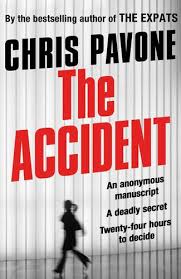
CTG Reviews: The Accident by Chris Pavone

The Accident cover image

The Accident cover image

What the blurb says: “Isabel Reed, one of the most respected and powerful literary agents in New York, is in possession of a time bomb and she’s about to give it to her good friend and trusted editor at one of the top publishing houses in the US. Anyone who begins reading the manuscript is immediately struck by the importance of its contents. They can also see that publishing it could be dangerous, but it could also be the book that every agent, editor and publishing house dreams of … What they don’t realise is that reading it could get them killed.

Veteran CIA Station Chief, Hayden Gray, is a man not to be trifled with. At his beck and call is a vast artillery of CIA personnel and he’s prepared to use every single one of them to stop that manuscript from getting into the public domain. He has twenty-four hours to do so.”

Set in the world of publishing, this book takes what starts out as an everyday occurrence – a new manuscript delivered to literary agent Isabel Read’s office – and turns it into a twist-filled story with danger lurking around every page turn. The book – entitled ‘The Accident’ – is filled with secrets so explosive, about a media tycoon so well-known and influential, that there are people prepared to do anything to stop the book being read.

So Isabel’s day turns into a 24-esque chase, with lots of running, hiding and dodging. As the body count rises, she knows that someone, or some people, are trying to kill her and the manuscript, but she doesn’t know who. So she turns to the one person she’s sure she can trust: Jeff Fielder – her long-time friend, and editor at a major publishing house – to help her get the book published, and to stay alive.

The book alternates between character point-of-views, primarily Isabel, Jeff, Hayden Gray, and the unnamed author of the book. With each character’s narrative you get a glimpse of the history that led to the book being written, and the impact it having been written, allowing you as the reader to piece together the complex web of secrets that have been hidden for so long.

This story has intrigue and mystery in spades. As the plot unfolds, and more about each of the key characters is revealed, you start to understand the complex relationships that connect so many of them.

A gripping read, with an artfully crafted plot and fabulously engaging characters, the story includes some major twists towards the end – several of which I really didn’t see coming. The Accident is an engaging, entertaining, page-turner of a thriller.

Highly Recommended.


[with many thanks to Faber & Faber for my copy of The Accident]


CTG Reviews: The Killing Season by Mason Cross

The Killing Season cover image

The Killing Season cover image

What the blurb says: “When Caleb Wardell, the infamous ‘Chicago Sniper’, escapes from death row two weeks before his execution, the FBI calls on the services of Carter Blake, a man with certain specialised talents whose skills lie in finding those who don’t want to be found. A man to whom Wardell is no stranger.

Along with Elaine Banner, an ambitious special agent juggling life as a single mother with her increasingly high-flying career, Blake must track Wardell down as he cuts a swathe across America, apparently killing at random.

But Blake and Banner soon find themselves sidelined from the case. And as they try desperately to second guess a man who kills purely for the thrill of it, they uncover a hornets’ nest of lies and corruption. Now Blake must break the rules and go head to head with the FBI if he is to stop Wardell and expose a deadly conspiracy that will rock the country.”

First off, I have to say that this is hands-down my favorite read of the year so far. It has everything I love about action thrillers – the intrigue, the danger, the chase and the multi-layered characters. And, it’s Mason Cross’ debut novel, which makes it all the more impressive.

The main character, Carter Blake, is something of an enigma – charismatic, highly skilled, and at the top of his game. But he doesn’t let power and politics get in the way of his investigation, and he makes sure justice is brought, whatever the personal cost. So pairing up with Elaine Banner makes for an interesting working relationship – she’s career-driven and has her eyes on the next promotion, working with a talented maverick like Blake gives her a set of problems she can well do without.

The antagonist – sniper Caleb Wardell – is a smart and cunning adversary, engaging Blake and Banner in a deadly game of cat and mouse. The tension is high from the get-go and just keeps on rising.

So as Banner and Blake pursue Wardell, following the evidence, trying to find a pattern and anticipate his next move, the body count continues to rise. Blake’s the only person who is able to get close, and Banner starts to realise that sometimes the only way to get the job done right is to step away from procedure and follow your instinct.

As Blake and Banner get closer to the truth, they become targets – in the sights of Wardell and someone in the Agency itself – question is, can they get to them both in time, and get out alive?

I cannot sing this novel’s praises highly enough – it’s a joy to read, utterly engaging and kept me hooked right from the first page to the last. There’s high stakes and high tension, and the chemistry between Blake and Banner sizzles off the page.

If you love action thrillers, if you love crime fiction, go and read this book. I’m sure you won’t regret it.

Highly Recommended.


[with thanks to Orion for my copy of The Killing Season]

eBooks by Sainsbury’s May promotion


If you like your books in the eBook format, this could be an offer for you …

eBooks by Sainsbury's logo

eBooks by Sainsbury’s logo

A little bird tells me that during May, lucky Sainsbury’s customers can be in with a chance of winning Nectar points galore, as part of a massive giveaway on the eBooks by Sainsbury’s website.

Throughout the month, prize draws will be take place every day in which up to four customers who’ve bought ebooks from the site will receive 10,000 Nectar points each.

To find out more about eBooks by Sainsburys, the Nector point promotion, and a load more, hop on over to: www.sainsburysebooks.co.uk