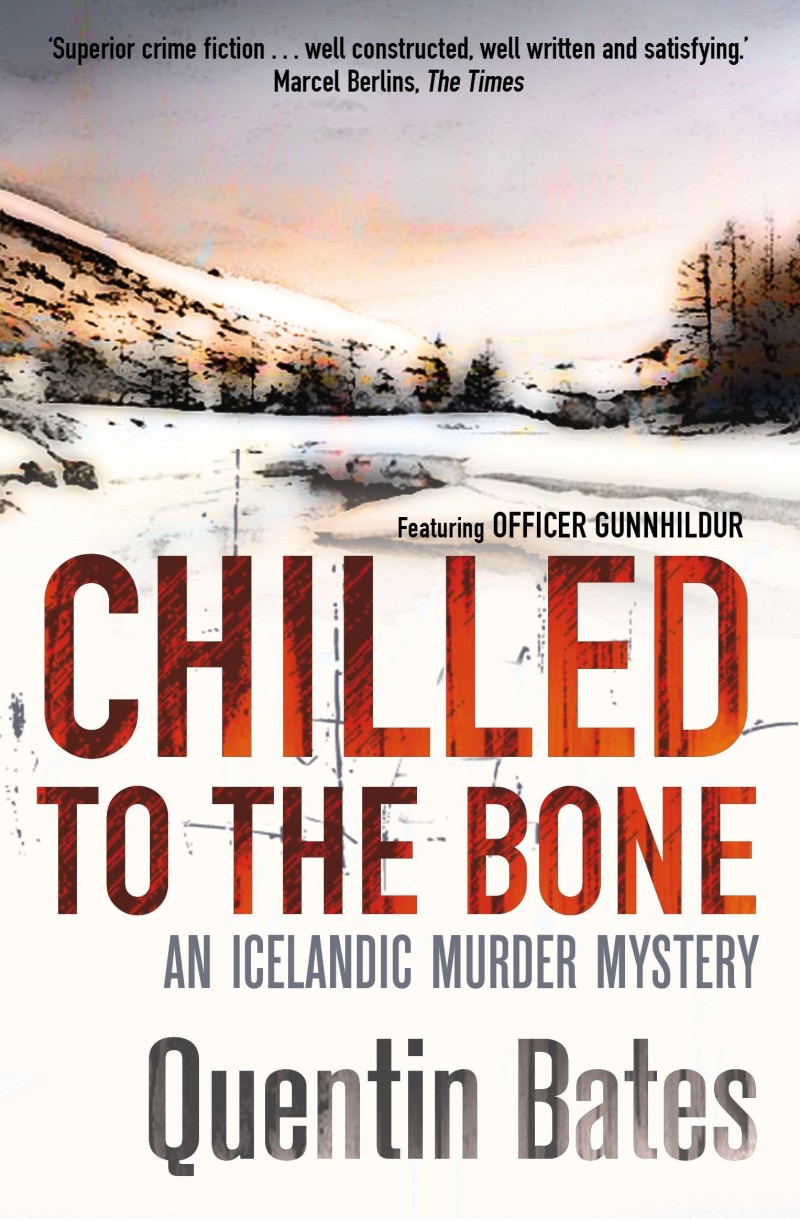
Review: Chilled to the Bone by Quentin Bates

book cover

book cover

What the blurb says: “When a shipowner is found dead, tied to a bed in one of Reykjavik’s smartest hotels, sergeant Gunnhildur “Gunna” Gisladottir of the city police force sees no evidence of foul play, but still suspects things are not as cut and dried as they seem. As she investigates the shipowner’s untimely death, she stumbles across a discreet bondage society whose members are being systematically exploited and blackmailed.

But how does all this connect to a local gangster recently returned to Iceland after many years abroad, and the unfortunate loss of a government laptop containing sensitive data about various members of the ruling party? What begins as a straightforward case for Gunnhildur soon explodes into a dangerous investigation, uncovering secrets that ruthless men are ready to go to violent extremes to keep.”

It’s easy to like Gunna, she’s strong and determined, yet compassionate and giving: a hardworking detective and a dedicated mother juggling the complexities of modern life. As Gunna starts to unravel the threads that bind a set of seemingly unconnected crimes together, she uncovers a secret community that she’d never realised existed. When a witness goes missing, the question is can Gunna find the truth, and the culprits, before the sinister man impersonating a police office does?

Told through several viewpoints, in addition to Gunna’s, over the course of the story we learn how initially unconnected events have brought the main point-of-view characters – Baddo, Hekla and Joel Ingi – to their current situation, and how, even though they may not realise it, they are bound together by the secrets they keep and the choices they have made.

The tension builds steadily throughout the story. Each character is conflicted, some are criminal, but through showing their many facets, and relationships both work and personal, Bates has a way of making each of them empathetic.  I found myself caring about each of them, compelling me to keep turning the pages, hungry to find out what would happen.

I’ve never been to Iceland, but I loved the evocative imagery of this novel, and the chilling sense of cold, that made the setting really come alive for me. At first the Icelandic names took a little bit of getting used to, but they add wonderfully to the authentic feel of the story, and I was soon used to them (although I’m not sure that my pronunciation would be correct!).

This is a beautifully crafted, intricately plotted, atmospheric thriller.

Highly recommended.


[With thanks to C&R Crime for my copy of Chilled to the Bone]

Review: LIKE THIS FOR EVER by S.J. Bolton

cover image

cover image

What the blurb says:

“Bright red. Like petals. Or rubies. Little red droplets.

Barney knows the killer will strike again soon. The victim will be another boy, just like him. He will drain the body of blood, and leave it on a Thames beach. There will be no clues for detectives Dana Tulloch and Mark Joesbury to find.

There will be no warning about who will be next.

There will be no good reason for Lacey Flint to become involved … And no chance that she can stay away.”

It’s hard to write a review of this novel without included spoilers and I don’t want to spoil the story for you. So all I’m saying is that Barney, an eleven-year-old boy with a gift for spotting patterns, is looking for the connections to help him solve the child murders while he’s home alone while his Dad works late. He’s also Lacey Flint’s neighbour.

The story is shown primarily from three perspectives – Barney’s, Lacey’s and Dana’s. This lets you, as the reader, in on a lot more of the facts than any one of the main characters have – a sure-fire recipe for heart-banging moments!

The story is artfully plotted, with many possibilities for who is behind the killings. This, and the multiple twists and turns, create an unputdownable puzzle that kept me reading well into the night.

But it wasn’t just the puzzle that kept me reading. SJ Bolton creates such deeply drawn characters, like the smart, often strong and yet also emotionally fragile heroine, Lacey Flint, that I felt compelled to read on just to stay with them on their journey within the story.

As well as motivation to murder, the story touches on a number of themes including modern-day vampire culture, online stalking and how social media influences, aids and inhibits investigations.

Utterly gripping, tense and suspenseful: this is a real page-turner of a crime novel.

Highly recommended.

[My copy of Like This For Ever was provided by the publisher]

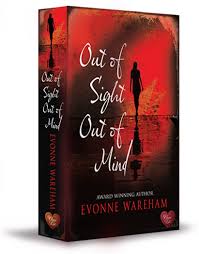
Review: Out of Sight Out of Mind by Evonne Wareham

book cover

book cover

What the blurb says: “Madison Albi is a scientist with a very special talent – for reading minds. When she stumbles across a homeless man with whom she feels an inexplicable connection, she can’t resist the dangerous impulse to use her skills to help him.

J is a non-person – a vagrant who can’t even remember his own name. He’s got no hope, until he meets Madison. Is she the one woman who can restore his past?

Madison agrees to help J recover his memory, but as she delves deeper into his mind, it soon becomes clear that some secrets are better off staying hidden. “

Out of Sight Out of Mind might not be my usual type of read, but I found it really enjoyable.

It doesn’t fit neatly into a sub-genre bracket but, if you wanted to categorise it, I think it would be as romantic suspense with a dash of science fiction.

Told through the point-of-views of Madison, J and the shadowy people at ‘The Organization’, the reader is able to piece together information, alert to the increasing danger that Madison and J are unaware of until much later in the story. This adds an extra level of danger, up-ing the stakes, and keeping the reader on their edge of their seat, hoping that Madison will find out who, or what’s, behind J’s memory loss before it’s too late.

The main suspense in the story comes from the question: who is J? A mysterious (and rather sexy) character, he has no memory of his past, but he can remember how to navigate through London. When Madison tries to help him by reading his mind she encounters a wall that she’s unable to see through. As a research scientist at the top of her game, she throws all she’s got into the challenge of finding out just who J is.

As the relationship between Madison and J develops the reader gets to discover more about Madison’s past, and details about J’s life as he begins to remember things. There’s a lot of sexual tension between the two characters. The ‘will they, won’t they?’ question hangs over them for a large portion of the book as they both resist the attraction they feel for each other. This kept me hooked into the story, but I did, at times, want to scream at Madison to just kiss him and get on with it!

As Madison tries increasingly risky and unproven memory experiments, she manages to get past the wall and discover J’s sinister past. And that’s when the danger really escalates. After a gradual build in tension during the first two-thirds of the book, the final third races along to the action-packed finale.

My verdict: even if science fiction isn’t usually your thing, don’t let it put you off – this is a classy romantic suspense novel that’s definitely worth a read.

[My review copy of this novel was provided by Choc Lit publishers]

BLOG TOUR STOP: Author Alison Morton drops by to talk about INCEPTIO

Blog Tour Logo

Blog Tour Logo

If you like some alternative history with your crime, Alison Morton’s exciting debut novel ‘INCEPTIO’ could be just your type of read. Blending alternative historical and modern settings, the story follows Karen Brown as she searches to uncover the truth behind her connection to the mysterious Roma Nova, and discover (before it’s too late) why government enforcer, Jeffery Renschman, wants her dead.

To learn all about it, I’m pleased to welcome to Alison Morton, author of  ‘INCEPTIO’, who’s joining me today as part of her ‘INCEPTIO’ Blog Tour.

Alison, you’ve said that the idea for your new thriller ‘INCEPTIO’ came from your eleven-year-old self wondering What would have happened if women were in charge of the Romans? What was it that made you decide to write a novel along that theme?

Ever since my clever, ‘senior Roman nut’ father batted that question back at me by replying, “What do you think it would be like?” the idea has bubbled away in my mind. Ancient Rome morphed into a new type of Rome, a small rump state that survived the dissolution of the Western Roman Empire into the 21st century, but retained its Roman identity. And one where the social structure changed; women were going to be leading society. Despite a full range of life events keeping me busy (school, university, career, military, marriage, parenthood, business ownership, move to France), I couldn’t make the story go away.

But what actually started me writing INCEPTIO? One Wednesday I went to the local multiplex cinema with my husband. Thirty minutes into the film, we agreed it was really, really bad. The cinematography was good, but the plot dire and narration uneven.

‘I could do better than that,’ I whispered in the darkened cinema.

‘So why don’t you?’ came my husband’s reply.

The story that had filled my mind for years burst out through my fingers and ninety days later, I’d written 96,000 words, the first draft of INCEPTIO.

Your modern day protagonist, Karen Brown, is certainly up against the odds. What was your inspiration for creating her?

I had experience of living in different cultures and of serving in the military so could draw on both of those to seed some of the background of Karen’s story. But I wanted to take a modern Western young woman and not only make her contend with a nasty piece of work trying to eliminate her, but also unsettle her by having to adapt to a fundamentally different culture. She was going to be forced to change and grow, something I think readers like to see. More than anything, I wanted her to discover the person she was meant to be, something she certainly wasn’t going to do stuck in a city office.

With ‘INCEPTIO’ set in the alternate modern day and in the alternate historical setting of Roma Nova, what research did you do to ensure the two worlds felt so real?

The key to writing alternate history is plausibility. Firstly, it’s essential to know your history up to the point when the new alternate timeline diverges from the one we know. The next step is to work out in a historically logical way how the world would look after that divergence. Roma Nova’s existence couldn’t happen in a vacuum – in the course of sixteen hundred years it would have affected the rest of the world’s history.

New York is an Autonomous City in the Eastern United States (EUS) that the Dutch only left in 1813 and the British in 1865. Roma Nova had protected its New World trade interests in the late 1700s by brokering a political accord between the British colonies and the home government. The New World French states of Louisiane and Québec are ruled by Gouverneurs-Généraux on behalf of Napoléon VI, California and Texas belong to the Spanish Empire and the Western Territories are a protected area for the Indigenous Peoples.

These are only background details – I don’t develop them much further – the New World is only the setting for the first chapters. I only allude to it where necessary – nobody likes a long history lesson or an info dump in the middle of a pacey thriller – but I have it worked out in great detail in my head so I can live within that world while writing.

Secondly, you have to reinforce the settings with anchors to the reader’s own reality. Take a character working in law enforcement. Readers can accept cops being gentle or tough, enthusiastic, intellectual or world-weary. And whether corrupt or clean, they must act like a recognisable form of cop; they catch criminals, arrest and charge them and operate within a judicial system. Legal practicalities can differ significantly from those we know, but they must be consistent with that society while remaining plausible for the reader.

Almost every story hinges upon implausibility. Readers will engage with it and follow as long as the writer keeps their trust. One way to do this is to infuse, but not flood, the story with corroborative detail so that it verifies and reinforces the original setting the writer has introduced.

Even though INCEPTIO is an alternate history thriller set in the 21st century, the Roma Novan characters still allude to their past by saying things like ‘I wouldn’t be in your sandals when he finds out.’  There are honey-coated biscuits (honey was important for the ancient Romans) not chocolate digestives in the squad room. The Roma Novan family in the 21st century still includes not only the blood family but the entire household. This detail is where historic logic meets practical function of the roles the characters are playing.

If ‘INCEPTIO’ were made into a movie, which actors would you like to see playing your main characters?

A while ago, Meg Ryan and Val Kilmer (Carina and Conrad), with Judi Dench (Aurelia) and Alexander Siddig (Daniel). Today, probably Bryce Dallas Howard and Alexander Skarsgård, with Meryl Streep and Ben Barnes.

Tell us a little about your writing process, do you plot out the story events before sitting down to write, or do you drive right in and see where the story takes you?

I’m probably 20% ‘plotter’ and 80% ‘pantser’.  I start with my characters, their values and motivations, then float some story ideas involving them around in my head. I like to interweave a crisis facing Roma Nova with a personal crisis between the characters and in their lives. Nobody comes out of the story in the same state they went in.

By then, I know where the story starts and where it has to finish. Maybe now is the time to confess that only one of the three books I’ve written actually has exactly the ending I first thought of!  Next, structure. I’ve evolved a thirty-line system; Line 1 is the inciting incident, Lines 6, 14 and 22 (or nearabouts) the three crisis points, Line 27 or 28 the ‘black moment’ and Line 30 the resolution. I fill in some of the lines in between with likely scenes, but often leave some blank. It’s a process to imprint the plot on my conscious mind so that the unconscious or creative one has some hooks to hang the story threads on. All the rest in between just swirls around in my head and only emerges as I’m writing.

How do you organise your writing day: do you have a favourite time and place to write?

On a typical day I write most mornings after a short spurt on social media, and do domestic stuff in the afternoons or depending where I am in the book some research. In the evening, I’ll write a few more lines and dip into Facebook and Twitter.

If I’m editing, I tend to work straight through, with a short lunch break as I’m totally immersed. Strange, isn’t it? I can draft in paragraphs, but prefer to edit in long stretches. Proofing is another question – I do that in short bursts because of the concentration needed.

My books centre around a big conflict, dangerous assignment or saving the world story within the Roma Nova environment. Luckily, I’ve breathed in history since I was a kid. I even ‘went back to school’ to take a history masters thirty years after my first degree. So I have enough of a grounding in the aspects of Roman history I want to draw on to start the story. I write the basic dynamics of a scene, then if I need to check a detail, I mark the text up in bright blue which gives me a visual signal to come back and research that item.

What have you learnt through writing this novel that you’d like to pass on to aspiring crime thriller writers?

Keep a really big surprise for the end, but make sure you leave some clues. Readers hate what’s known in SFF as ‘alien space bats’, more properly a deux ex machina where a surprise solution or resolution is parachuted in. Try to nudge the reader into thinking about what’s going on behind the characters’ motivation.  In INCEPTIO, the heroine doesn’t know why Renschman pursues her with such persistence. We know he’s a bad guy, but why is he so vindictive? Read the book and you’ll find out!

Structure and keep track of time so you ensure that the right people know or don’t know about events or vital clues. The mobile phone has ruined many traditional opportunities for suspense and tension so writers have to be more inventive these days.

My last tip is to keep the reader in the loop. I love surprising and disconcerting the reader as the plot twists and turns, but I try hard to ensure the reader knows what’s happening. As a reader myself, I hate not knowing who’s speaking for pages and pages just to make the writing look clever.

And what’s next for you, are you planning your next novel, or already well into the writing of it?

I’m working on book two of the Roma Nova series, PERFIDITAS (Betrayal). I drafted it a little while ago, but it’s been ‘in the drawer’ for several months. It’s a thriller again, this time the whole Roma Novan society faces collapse as well as pushing the heroine to a personal crisis. I’m looking forward to reading it again after many months away!

Thank you, Alison, for dropping by today and for sharing your writing secrets.

For more about Alison Morton and INCEPTIO hop on over to her website at: http://alison-morton.com/

INCEPTIO is the first in a series of exciting alternate history thrillers set in mysterious Roma Nova. Published by SilverWood Books, it is available now in Paperback and eBook.

Classic Favorite: State of Fear by Michael Crichton

cover image

cover image

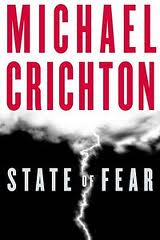
State of Fear by Michael Crichton has to be one of my favorite books.

It’s one of those books that, if I want the guarantee of a great read, I’ll pull down from my book shelves and re-read.

Filled with Crichton’s trademark blend of science and action, its subject is global warming and, more specifically, how it can be used as a weapon. Fast-paced, with intrigue, great characters and a plot that twists and turns across the globe, I’ll fly through the 675 pages in just a few hours.

I’m a real Crichton fan, but this one is definitely my favorite.

Bookish Magic: what does it for you?

magic in the pages image

magic in the pages image

There’s something magical that happens when you’re reading a good book isn’t there?

It’s as if you’ve been transported to another place, into another life, experiencing things that you don’t usually, and piecing together situations that, in real life, might be terrifying, but from between the pages of a book are fascinating.

For me, the thing that always grabs my attention, and my imagination, is a good puzzle. A locked room mystery perhaps, or a really compelling ‘why dunnit’. Once there’s a puzzle to be solved, a puzzle with high stakes and lots of tension, then I can’t help but read on.

What does it for you?

What keeps you reading?

Book to Film News: Wentworth Miller to adapt Scare Me for the screen

cover image: Scare Me

cover image: Scare Me

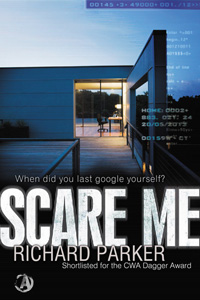
Exciting news just out of Angry Robot: Exhibit A HQ tells me that Relatively Media have acquired the film rights to Richard Parker’s psychological thriller Scare Me and have asked Prison Break actor Wentworth Miller to adapt the novel for the big screen.

Scare Me tells the story of a wealthy businessman who receives a phone call in the middle of the night asking him, ‘When did you last google yourself?’ He does just that, and discovers a website with photos of his own home, along with six other houses he’s never seen before. One photo shows a gruesome murder.

Sounds like it’s going to be a must-watch film.

For more details head over to http://exhibitabooks.com

A sneaky peep at the cover of the next Reacher novel …

Today the Jack Reacher Official Facebook page shared the cover image of Lee Child’s next Reacher book.

If you want to check it out, nip across to Facebook and have a look here: http://www.facebook.com/JackReacherOfficial

The novel is called ‘Never Go Back’, and it’s out on the 29th August in the UK.

I can’t wait!


Review: The Poacher’s Son by Paul Doiron

cover image

cover image

Stunningly atmospheric: an action packed and emotionally powerful thriller

What the blurb says: “Maine game warden Mike Bowditch returns home one evening to find an alarming voice from the past on his answering machine: his father, Jack, a hard-drinking womanizer who makes his living poaching illegal game. An even more frightening call comes the next morning from the police: they are searching for the man who killed an esteemed local cop the night before – and his father is their prime suspect. Jack has escaped from police custody, and only Mike believes that his tormented father might not be guilty.

Now, shunned by colleagues who have no sympathy for the suspected killer, Mike must come to terms with his haunted past. He knows first-hand of his father’s brutality, but is he capable of murder? Desperate and alone, the only way for Mike to save his father is to find the real culprit.”

The Poacher’s Son is Paul Doiron’s debut novel and the first in the Mike Bowditch series. It won the Barry Award and the Strand Critics Award for Best First Novel.

Mike Bowditch stands for everything his father doesn’t: honour, care of the natural world, and the overriding need to ‘do the right thing’. He’s carved out his own niche in the world as a game warden and even when his relationship doesn’t work out the way he’d hoped due to the demands of his work, he’s still determined and passionate about his job.

But, just like years before when Mike was just a kid staying with his father for the summer, his father’s actions pull Mike into a world that he doesn’t want to be involved in. Torn between the loyalty he feels towards a father than never earned it, and the job he loves and colleagues he respects, Mike is forced to make increasingly difficult choices in order to ensure his father gets a fair deal.

As well as a plot thick with twists and turns, this book showcases the forests and natural habitats of Maine so vividly that the setting of the story becomes almost like a character in its own right. What’s great about Paul Doiron’s writing is that you get a terrific sense of place without any slowing of the story.  With a cast of engaging characters, each with their own very particular view on the situation Mike finds himself in, and many with a reason to not be entirely truthful about what happened, I found myself rooting for Mike from the beginning.

Action packed and emotionally powerful, this atmospheric thriller had me gripped.

Highly recommended.


Just finished reading: A Wanted Man by Lee Child

cover of A Wanted Man

cover of A Wanted Man

What the cover says: “When you’re as big and rough as Jack Reacher – and you have a badly set, freshly busted nose, patched with silver duct tape – it isn’t easy to hitch a ride. But Reacher has some unfinished business in Virginia, so he doesn’t quit. And at last he’s picked up by three strangers – two men and a woman.

But within minutes it becomes clear they’re all lying about everything – and then they run into a police roadblock on the highway. There has been an incident, and the cops are looking for the bad guys …

Will they get through because the three are innocent? Or because the three are now four? Is Reacher just a decoy?”


Firstly, I have to confess, that I bought the hardback of this book as a little treat for myself back in the Autumn, and got it signed by Lee Child at the CWA panel event in November.

Since then, it’s sat on my bookcase waiting for me to read it. I promised myself it would be my Christmas treat although, as it turns out, it’s been more of a New Year treat.

But it was totally worth the wait.

It’s a classic Reacher story. Told in Lee Child’s signature style: slick, fast and as gripping as ever.

When Reacher finds himself a pawn in a criminal getaway, and ends up a suspect in a murder, he has to decide what to do – run, or find out who did it.

In true Reacher fashion, he sets out to work out who did it and why. Half suspect, half unofficial partner to Special Agent Julia Sorenson, they work the case. It’s a real ‘why dunnit’ with plenty of twists and turns thrown in to keep the reader on their toes.

I can’t wait for the next one.