CTG Reviews: Down Among the Dead Men by Ed Chatterton

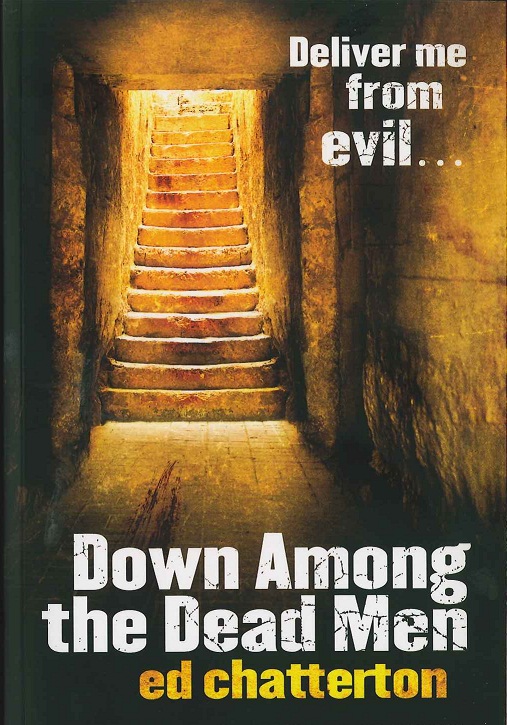
Down Among the Dead Men cover image

Down Among the Dead Men cover image

What the blurb says: “At first glance, to newly-promoted DCI Frank Keane, the horrifically bloody crime scene in suburban Liverpool looks like a straightforward murder-suicide – the husband kills the wife and then himself. Frank and the rest of the Major Incident Team have seen too many cases like it before. But what of their missing teenage son, Nicky? Is he their prime suspect or the third victim?

For script-writer Dean Quinn, the killings are a potential disaster. The film he is working on is everything to him and with new London money and a rising American actor lighting up the set, his vision is almost complete. He’ll do anything to protect it.

Frank knows that time is running out to find the boy. But all too soon the case starts unravelling into one that will test Keane to the limit – and haunt him to his dying day.”

This is the second book in Ed Chatterton’s DCI Frank Keane crime series.

As with the first book, Down Among the Dead Men continues the dark, gritty tone. As unsettlingly atmospheric as the claustrophobic-inducing old tunnel system they’re using as a location for Dean Quinn’s film, this story gives more than a few heart-pounding moments.

First part of the book is set in Liverpool and has all the elements you’d expect from a police procedural. I think this was my favourite part of the book as there’s a high element of mystery, and as the actions and behaviours of each character associated with the murdered couple are revealed, the relationships between them are shown to be far from simple. I loved the complexity, the intrigue, and trying to guess who was responsible for the sinister activities surrounding the ill-fated movie.

The second part of the book ups the pace and becomes more thriller-like as the action shifts to follow Keane’s pursuit of the killer in LA. Fast-paced and dynamic, the chase pulls you along at a relentless speed.

If you’re a fan of gritty, atmospheric crime thrillers, this could be a series well worth checking out.

Ed Chatterton stopped by the CTG blog a few weeks ago. You can read the interview here.


[With thanks to Arrow for my copy of Down Among the Dead Men] 

CTG Interviews: Luca Veste author of DEAD GONE

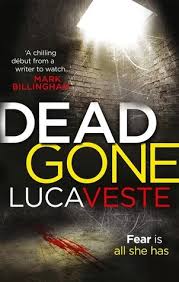
DEAD GONE cover image

DEAD GONE cover image

Today I’m thrilled to welcome Luca Veste, author of DEAD GONE, a fabulous debut that was published by Avon (HarperCollins) last month. 

So, to the questions …

Your debut novel DEAD GONE is out this month. Can you tell us a bit about it?

It would be my pleasure! Dead Gone is a part psychological thriller, part police procedural book, which follows the detective pairing of David Murphy and Laura Rossi as they attempt to stop a serial killer in Liverpool. This killer is using his victims to replicate infamous unethical psychological experiments, taunting the public by leaving a message with each body.

It’s also about life, grief, and death…and how we deal with all three.

What books and authors have inspired you as a reader and writer?

Stephen King, Enid Blyton and Brian Jacques (three names you don’t see put together often!) were a staple of my childhood/teenage reading. As a writer, I’m inspired by the characterisation in Mark Billingham’s books, the bravery of Helen FitzGerald, and the atmosphere created within Steve Mosby’s work. The 50/50 Killer by Steve Mosby was a major influence when I started writing Dead Gone.

Can you tell us a little about your writing process, do you dive right in, or plan out the story first?

For Dead Gone, I planned out about two thirds of the story, using chapter headings. So, I had the bones of the book with various word documents with different titles. Of course, the best laid plans of mice and scouse-italian blokes etc etc… I ended up scrapping most of those chapters and just writing one piece of the story at a time, before the ending came to me after a few abandoned attempts.

The second – as yet untitled – book I’ve just completed was written completely. I knew the end chapter going in. I also knew what happened in the middle few chapters, but that was about it. I also wrote a lot more which didn’t make it into the final version than I did for Dead Gone.

I think I’m still trying to find the way that works best for me!

DEAD GONE is a fabulous debut. What was your route to publication?

Pretty standard, I think. I identified a literary agent I wanted to work with pretty early on in the process, and after being turned down by him a few times, he eventually relented and took me on. We sent the book out to numerous publishers, with most turning it down, but Avon (an imprint of HarperCollins) have been nothing but enthusiastic about the book since the beginning. Going with them was a very easy decision.

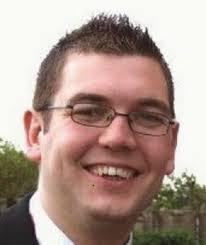
Author Luca Veste

Author Luca Veste

And lastly, what else does 2014 have in store for you?

Starting out with a number of book signings around Merseyside. Lots of lovely independent bookshops to visit, which I’m really looking forward to.

I’ll be finishing my degree at university in June. Four years work done. Hopefully graduate!

I’ve just delivered book two to my editor, so most of the year will be taken up with making that better. I’ll also be visiting a number of festivals this year, as has become the norm for me now. Crimefest in Bristol and Theakstons Crime Festival in Harrogate are now what I plan my year around!

Hopefully sleep at some point.

Oh, and buy a new guitar. I’ve wanted a new one for years, so hopefully I’ll get chance to treat myself to one soon!

Sounds like it’ll be a busy (and fantastic) year! 

A huge thanks to Luca Veste for dropping by the CTG blog. To find out more about Luca and his books pop on over to his wonderful blog at http://lucaveste.com/

DEAD GONE is out now. Watch for our review coming soon …

Event Alert: Get Writing! conference – Saturday 29th March 2014

Get Writing

If you’re writing a crime novel (or any genre of novel, in fact) then the annual Get Writing! conference organised by Verulam Writers Circle is well worth a visit. Taking place this year on Saturday 29th March at the University of Hertfordshire at their de Havilland Campus, there’s a jam-packed schedule aimed at everyone with an interest in writing.

The day is packed with talks, panels and practical workshops on all aspects of the creative process from idea to publication.

There’s also the chance to fast-pitch to agents and editors, or have a longer facetime session with them to discuss your work.

Workshops of special interest to aspiring crime writers are:

M R Hall (best selling crime thriller writer of many books including The Coroner, The Flight) and William Ryan (critically acclaimed author of the Captain Korolev crime series including The Holy Thief, and most recently The Twelfth Department) will be running a workshop on Constructing Character and Plot. [I attended a workshop run by them at Goldsboro Books last year – it was fantastic: practical, thought-provoking and lots of fun!]

Screenwriter and thriller writer Max Kinnings (author of fast-paced thrillers Baptism and, in 2014, Sacrifice) is running a workshop on How Studying Screenwriting can make you a Better Novelist, showing how he uses the script development model to shape a novel.

Also, there’s The Crime Panel with M R Hall, William Ryan, Max Kinnings, and fabulous thriller writer Emlyn Rees (author of action packed thrillers including Hunted, and dark psychological thrillers including That Summer He Died). And the Get Writing organisers are going to let me chair the panel!

To find out more about what promises to be a fantastic event hop on over to the Get Writing website …

Website: http://getwritingday.verulamwriterscircle.org.uk/

CTG Interviews: Author Jessie Keane

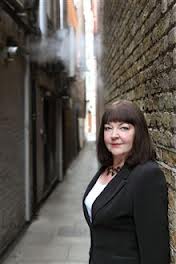
Author Jessie Keane

Author Jessie Keane

Today I’m really excited to be joined by bestselling British author, Jessie Keane, crime writer and creator of several crime series including the Annie Carter crime novels featuring the fabulous strong female lead character Annie Carter. 

So, to the interview …

What inspired you to create Annie Carter?

Annie Carter sort of appeared in my head when I was at a very low ebb. I wanted to write something entirely for my own pleasure – I didn’t care whether it got published or not, this was for me. So I was able to let rip and let aspects of my own personality come to the fore when I created Annie. She’s not so much me, as everything I would really like to be. Forthright, beautiful, a firm friend and a deadly enemy. She’s tough, and I like that. Not perfect, but a real trooper. She dominated Dirty Game, my first crime novel, and she’s been chucking her weight about ever since.

Did you plan the Annie Carter series from the outset?

Emphatically, no. Once I’d written her in Dirty Game, it just seemed a natural progression to continue her story in Black Widow, and then I got excited about her and the Mafia in Scarlet Women, and then Playing Dead, and Ruthless.I would love to do another Annie book, and when I get that crucial idea, I will.

Dive right in, or plan the story first?

I so admire writers who plan everything first! I have friends who do this, and I wish I did too, and I’ve tried … but it just doesn’t work for me. If I try to plan, I find I’m bored with the story before I’ve written even a handful of chapters; whereas in my own style (strictly seat-of-the-pants) I rush up to my study every morning, keen to get started on whatever comes next.

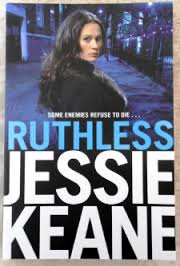
RUTHLESS cover image

RUTHLESS cover image

What advice can you give to new crime writers trying for publication?

Make sure you love writing crime. Always write what you love and what comes easiest to you, what really suits your writer’s ‘voice’. You’ll know it when you find it. And persist! That’s really boring advice, I know, but you’ll get rejection slips (unless you’re very lucky) and some downright rude refusals. Take it on the chin. Keep going.

And, finally, what does 2014 have in store for you?

Publication of LAWLESS, the second Ruby Darke book (sequel to NAMELESS) in July. Lots of interviews and festivals and fun, in between which I’ll be writing a brand new book (my 10th) with a brand new heroine, the deadline for which is November. So it’s going to be a full year, and by the end of it I’ll be starting out on my 11th book, so it’s all go!

Sounds great – and lots to look forward to reading.

Many thanks to Jessie Keane for popping by and answering our questions.

You can find out more about Jessie and her writing over on her website at http://jessiekeane.com/

And check out our review of RUTHLESS, the most recent Annie Carter novel, here

CTG Reviews: SACRIFICE by Max Kinnings

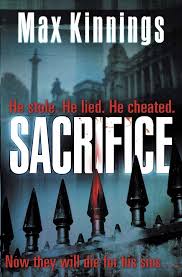
Sacrifice cover image

Sacrifice cover image

What the blurb says: “Disgraced hedge fund manager Graham Poynter hides shamefully in his Belgravia mansion. He lied, he cheated and he stole but the police and legal authorities are the least of his worries. Poynter and his family have come to the attention of a new style of hacktivist. The Adversary – or Advo – believes that non-violence only works up to a point and as Thomas Jefferson said, “Sometimes the tree of liberty must be watered with the blood of patriots and tyrants.” Jefferson might have added, “and bankers” …

Advo intends to make an example of Poynter as a warning to others in the banking industry who might think they can behave as he has done. The only person who stands between Poynter and his grisly destiny is blind hostage negotiator, Ed Malloy, who must negotiate with a faceless adversary who is hell-bent on exacting retribution on a minority which has gone unpunished for too long.”

Ed Malloy is having a bad day when he’s called to lead the negotiation at Graham Poynter’s Belgravia mansion. But things are about to get a whole lot worse, the situation is unlike any other Ed has faced. The hostage taker doesn’t fit the usual profile or follow the pattern of behaviour Ed would have expected. They make no demands, remain calm, and seem to be waiting for something. Ed is convinced there is another person manipulating events. But as tensions rise both at Graham Poynter’s mansion and inside the negotiating team, Ed struggles to find an approach that will bring the situation to a successful conclusion.

This book has a high concept, contemporary feel, with the story played out against a backdrop of underhanded banking practices, and the rise of a new style of ‘hacktivist’. If anything I’d have liked for the ‘hacktivist’ aspect of the plot to be explored in more detail, although I suspect that a future book in the Ed Malloy series may do just that.

And the story doesn’t hang around. It’s a fast paced, cinematic thriller. The tension starts high and doesn’t wane as the story unfolds. Through rotating point-of-view characters, including Graham Poynter’s daughter, Lily, his business partner, Bob Rushwood, and the hostage taker, more information is revealed to the reader than Ed is aware of. This adds an extra layer of tension and increases the suspense.

A non-stop rollercoaster ride from start to finish.

Highly recommended.


[With many thanks to Quercus for my copy of SACRIFICE]

CTG Interviews: Ed Chatterton author of DOWN AMONG THE DEAD MEN

Author Ed Chatterton

Author Ed Chatterton

Today I’m excited to welcome Ed Chatterton to the CTG blog. As well as having writing over twenty children’s novels (published under the name Martin Chatterton), Ed is the author of the recently published crime novel, Down Among the Dead Men, the second book in the DCI Frank Keane series, published by Arrow.

And so, to the questions …

Before you starting writing crime fiction you’d already written over twenty highly successful children’s books. What fresh challenge did writing fiction for an adult crime reader audience bring?

‘Highly successful’ might be overstating it: I’d been doing pretty well with some books and less so with others, just like most writers. The books I write for children are largely comedies – surreal farces, often with big themes like ‘death’ or ‘the physical universe’ or ‘nose-picking’. There were, particularly in some of the more recent children’s books, crime elements in there too. Two books – ‘The Brain Finds A Leg’ and ‘The Brain Full of Holes’ – were full blown detective fiction, albeit with a comic twist. So the transition into adult crime fiction was less challenging than it might have been for a debut author. The main change I found was that my characters can swear (and some of them do, a lot), can have sex, and can be more violent. From a technical point of view, adult crime writing requires more precision in terms of plot and, given that my books are complex, requires me to use my rapidly shrinking brain more often. In my children’s books if I got to a difficult plot point I would usually insert a T-rex or a time machine. That’s less easy with gritty adult fiction, as most crime readers tend to notice things like that.

Your recent crime novel, Down Among the Dead Men, is set in Liverpool, Los Angeles and Australia. What was it about these particular settings that inspired to you to pick them?

Liverpool featured because the story is a continuation (in terms of some of the characters) of the first book, A Dark Place To Die. In that first book Frank Keane is one of a number of characters. In Down Among the Dead Men I wanted to focus on Frank and see how far I could push him. Frank’s a Liverpool cop who gets pulled into a case that starts relatively small (an apparent  domestic murder-suicide) but quickly gets darker and widens out into something much larger in scale. I picked Los Angeles for two reasons: the first is that I’ve been there a number of times and there were locations I wanted to use. The high desert near Palm Springs and Twentynine Palms is a very evocative landscape (the working title for Down Among the Dead Men was Twentynine Palms). The second is so that I could continue to open out the stories from a single location. I’m not a huge fan of every case in a series being located in exactly the same place. I’d make an exception for George Pelecanos with his Washington-based novels, but single location books too often end up becoming sterile or repetitive. I used to live in the US so I am fond of the place and enjoy writing American characters. The Aussie connection dates back to A Dark Place To Die. Two of the characters from that book, Menno Koopman and Warren Eckhardt, make a re-appearance. Koopman, I think, will become a character who I might develop more as a stand alone. If he lives through Down Among the Dead Men that is . . .

Could you tell us a little about your writing process, do you dive right in, or plan the story out first?

Raymond Chandler said that a good story isn’t devised, it is distilled and I think that’s a pretty good description of my approach. I start with a basic idea, or set of ideas and then I let them go wherever they take me. I often have a rough ‘destination’ in mind with a skeleton narrative and a very strong sense of the kind of story I want to tell, but the fine details are worked out in writing. This usually means that I am constantly redrafting and editing – which is fortunately something I love doing – and I find this approach prevents the books being formulaic. My thinking is that if I don’t know exactly where the story is going then that makes it doubly interesting for the reader. I think you can overplan, just the same way that you can over-write. In my stories, I honestly don’t think the reader can guess what way the story is going.

Down Among the Dead Men cover image

Down Among the Dead Men cover image

Your books have been likened to those of Peter James and Ian Rankin. Which crime writers’ novels do you most like to read?

I try to avoid British crime books as I get very jealous and envious and bitter and twisted if they are any good. I’m flattered to be compared to either Peter James and Ian Rankin and, weirdly enough, I met both of them recently although, since I was several continents off being described as sober, they may not look back on the meeting quite as fondly as I do. From what I can remember, they are both lovely blokes but far too successful for my liking. In truth, American crime writers are more my taste and, since they are further away, don’t seem as threatening. I already mentioned Pelecanos who I think is just a little bit special, but I also love Elmore Leonard, Richard Price, Joe Lansdale, Carl Hiassen. One of my favourite books is the one-off, Blackburn by Bradley Denton. I do have a real soft spot for Patricia Highsmith’s stuff too. Some of the Scandi crime is good but I’m a bit sick of the adulation doled out to anyone vaguely Nordic who so much as writes a shopping list at the moment. Of the Scandinavians I like Asa Larsson best. At one point, when I knew my crime series was coming out, I seriously considered adopting a Nordic-sounding pseudonym. In my bleaker 3am moments, I regret not doing so. I reckon I’d have scooped at least three awards by now.

What advice would you give to new writers aspiring to publication?

All the usual gubbins: make sure you have something to say, make sure you keep reading, make sure you keep writing. Don’t think that publication is the ‘win’: publication is just the ticket into the gladiator ring. Maybe this too: don’t listen to too much prescriptive crap about the mechanics of story-telling, plot points, ‘arcs’, use of semi-colons, use of italics, whatever it is. If Stephen King tells stories a certain way that doesn’t mean that you need to do that. Elmore Leonard’s famous ‘ten rules’ of writing, including that ‘don’t start with the weather’ nonsense applies only if you are Elmore Leonard. Despite my healthy man-crush on Leonard, I always thought that was too restrictive. I actually began a kids book with ‘It was a dark and stormy night’ once just to prove a point. And never, ever, do anything Neil Gaiman tells you to unless it relates to hair.

And lastly, what does the rest of 2014 have in store for you?

I’m just about to complete the third in this series which takes place in Liverpool, Berlin and Western Scotland and has the rise of neo-Nazism as a backdrop. I’m continuing to write The Last Slave Ship which is a dual narrative novel about the final slave trading voyage from Liverpool and a contemporary race-hate crime which erupts into riots. This book is part of my PhD which just goes to show one of two things. Either (a) crime writers aren’t as dumb as we look or (b) they’ll let just about anyone do a PhD these days. I’m continuing to illustrate children’s books and will be drawing pictures for a book by Jonathan Emmett. I’ll be keeping my fingers crossed that my‘Mort’ kids series, which has just been bought for development as an animated series by Southern Star, makes it past the pilot stage and into production. Lastly, I’ll be working with a UK TV/film company on bringing Frank Keane to the screen in one way or another. Should keep me busy.

Sounds like it’ll be a hectic year!

A massive thanks to Ed Chatterton for dropping by the blog and allowing us to question him. Watch out for our review of Down Among the Dead Men next week …

Competition Alert: WIN a copy of The Tournament by Matthew Reilly

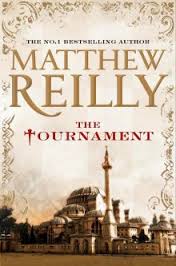
The Tournament cover image

The Tournament cover image

It’s Monday morning. What better time to launch a new giveaway!

Those lovely folks at Orion Books have given me ten copies of the fabulous historical thriller The Tournament by Matthew Reilly to give away as prizes for today’s competition.

THIS COMPETITION HAS NOW CLOSED.

How to enter

For a chance to win one of the copies of The Tournament by Matthew Reilly all you need to do is send a tweet to @crimethrillgirl Your tweet must include the answer to this question: Where is the chess tournament in The Tournament held? [hint, check out the prize description below!] Your tweet should also include the hashtag #CTGORION. [You’ll also need to follow us on Twitter, so that we can send you a direct message should you win].

If you’re not on Twitter don’t worry. You can also enter by emailing crimethrillergirl[at]gmail.com. Give your email the header CTGORION and be sure to include the answer to the question: Where is the chess tournament in The Tournament held? [hint, check out the prize description below!]

Rules
(1) One entry per reader (2) UK residents only – due to postage costs – sorry! (3) We will draw the ten winners at random from the entries containing the correct answer (4) No cash alternative (5) The competition closes for entries at 10pm GMT on Friday 7th February 2014 (6) The judge’s decision is final and no correspondence will be entered into.

The prize: The Tournament by Matthew Reilly

What the blurb says: “England, 1546: a young Princess Elizabeth is surrounded by uncertainty. She is not currently in line for the throne but remains a threat to her older sister and brother. Roger Ascham, Elizabeth’s teacher and mentor in the art of power and politics, is determined to keep her out of harm’s way. When an unprecedented invitation arrives from the Sultan of Constantinople, to an assembly of the finest players of chess from the whole civilised world, Ascham resolves to take Elizabeth with him.

But once in Constantinople for the chess tournament, the two find more danger than they left behind. There’s a killer on the loose and a Catholic cardinal has already been found mutilated. Ascham is asked by the Sultan to investigate the crime. But as he and Elizabeth delve deeper, they find dark secrets, horrible crimes and unheard-of depravity. Things that mark the young princess for life and define the queen she will become …”

You can find out more about Matthew Reilly and The Tournament pop over to the Orion website here: https://www.orionbooks.co.uk/books/detail.page?isbn=9781409134220

And click here to check out my review of The Tournament.

CTG Reviews: The Tournament by Matthew Reilly

The Tournament cover image

The Tournament cover image

What the blurb says: “England, 1546: a young Princess Elizabeth is surrounded by uncertainty. She is not currently in line for the throne but remains a threat to her older sister and brother. Roger Ascham, Elizabeth’s teacher and mentor in the art of power and politics, is determined to keep her out of harm’s way. When an unprecedented invitation arrives from the Sultan of Constantinople, to an assembly of the finest players of chess from the whole civilised world, Ascham resolves to take Elizabeth with him.

But once there, the two find more danger than they left behind. There’s a killer on the loose and a Catholic cardinal has already been found mutilated. Ascham is asked by the Sultan to investigate the crime. But as he and Elizabeth delve deeper, they find dark secrets, horrible crimes and unheard-of depravity. Things that mark the young princess for life and define the queen she will become …”

It’s not often that a historical thriller, or any thriller for that matter, comes with an adult content warning on the front page. But this one does, and for good reason.

Although the story focuses on the thirteen year old Princess Elizabeth, it is introduced by her lifelong friend, Gwinny, as she tells the reader about a tale told to her by Elizabeth when she was on her deathbed. From thereon until the last chapter the story is told in Elizabeth’s words, telling of the wonders and horrors she witnessed on the trip she took with her tutor Roger Ascham.

The first hint of foul play comes as the group from England – Roger Ascham, the king’s chess player – Mr Giles, Elizabeth and her friend, Elsie, and Elizabeth’s chaperones – Mr & Mrs Ponsonby – near the city of Constantinople. Mrs Ponsonby falls ill from poison, confining her to bed and her husband to her side. Ascham, Giles, Elizabeth and Elsie continue into the city, but at the palace they find more danger. A serial killer has been terrorising the city, and at the opening ceremony for the tournament a cardinal is found mutilated. The Sultan asks Ascham to investigate the crime. He agrees, allowing Elizabeth to work with him. But as they start to uncover the secrets behind the murders they find evidence of shocking depravity and more people start to die.

As you might expect from a novel centring round a chess tournament, strategy, logic and power are strong themes throughout the story. There is also a lot of sex, and this is where the adult content warning comes in, as some of these scenes involve underage children and highlight how they are used and discarded by some characters at the palace.

Ascham is a smart and likable character, with more than a touch of Sherlock Holmes about him. Elizabeth is a curious and intelligent narrator with echoes of Dr Watson. She’s bold and courageous, but not driven to reckless fancy like her friend and companion on the trip, Elsie. Elsie is a fun-loving, but ultimately tragic character, who freely engages in the orgies held by the Crown Prince, not understanding the politics and power at play until it is too late.

This is the fastest paced historical novel I’ve ever read. There are numerous twists and turns throughout the story, and although the settings are clearly drawn and atmospheric there are no lengthy descriptions holding up the action.

I especially loved the tie-in between the quoted passages from ‘ Chess in the Middle Ages’ about the different chess pieces, and the chapters (and central characters) that followed, for example the references to the origins of the chess piece ‘The Bishop’ tying in with the action involving the cardinals.

A must-read for historical crime fiction fans and for all those who love a good mystery.

Highly Recommended.

[Many thanks to Orion for my copy of The Tournament]

CTG Interviews: Koethi Zan author of THE NEVER LIST

Koethi Zan (c) Pieter M van Hattem

Koethi Zan (c) Pieter M van Hattem

Today I’m delighted to welcome Koethi Zan, author of the fabulous psychological thriller, THE NEVER LIST, to the CTG blog.

I found THE NEVER LIST both spellbinding and chilling. Through Sarah (Caroline) the reader experiences the horror, and impact, of her ordeal in a way that feels very authentic. How did you go about researching the book?

I researched the book by reading essentially everything available about the experiences of women who have been abducted: their memoirs, trial transcripts, psychology textbooks, third party accounts and newspaper articles. I was quite submerged in it, which was a very dark and scary place to be for so long a time.  Of course, I can never know what that experience is truly like, but I feel I have developed a particular empathy for those victims, and I hope what I’ve learned comes across in the book.

For the BDSM parts of the book, I read books on the topic, but also spent a lot of time going down the internet rabbit hole of that culture.  I found myself on many shocking chat boards, websites, and blogs. At a certain point, I’d read so many disturbing accounts that I started to believe I could never be surprised by anything.  But there was always that one more site, one more story, one more image.

The idea of Sarah and Jennifer, after experiencing loss and trauma while still at school, creating their never list is fascinating. How did you get the idea for the never list, and would you call yourself a list person?

The relationship between Sarah and Jennifer is loosely based on my own relationship with my best friend.  She and I never had a formal, written list of ‘don’ts,’ but we did have a set of rules we’d follow because we were both slightly paranoid.  Perhaps not as much as my characters, but there are many shared themes in their lives and ours.

I am definitely a list person, and always have been.  I keep multiple to do lists at all times, each with different time horizons.  Otherwise the world would be too overwhelming.

What books and authors have inspired you as a reader and writer? 

Two crime fiction writers who influenced my book are quite different from one another: Patricia Highsmith, whose pacing is slow and menacing, her technique literary and psychological, and Steig Larsson, who is all action, action, action, with complex and dramatic storylines.

I started reading Highsmith years ago, and though I would not dare compare myself to her, she sparked my interest in crime fiction.  I love how she follows the progression of the criminal mind, usually making the reader complicit with the perpetrator, living out the story from his or her point of view.  For my book, I wanted to flip her formula on its head and give the victim’s perspective, so the reader would be intimately involved with the crime and its impact on the psyche, not just trying to solve the who, where and what of it.

Only in retrospect did I realize that Stieg Larsson’s Millennium trilogy had such a huge impact on my book.  On the one hand, I love his fast action and over-the-top plotting.  Anything can happen in his books as long as it propels the story along, and that’s liberating for a writer.  On the other hand, I think my approach to violence is in stark contrast to his.  I read (and love) a lot of Scandinavian fiction, and as with Larsson’s, the violence is often explicit and raw.  I believe in uncovering this dark side of humanity—I think that’s a healthy way to cope with it—but I prefer to use suggestion rather than elaborate, graphic detail.  I think that technique can be quite effective because the reader personalizes the terror, drawing on his or her own worst nightmares to fill in the blanks.

Can you tell us a little about your writing process, do you dive right in, or plan out the story first?

I knew from early on how the book would begin, how it would end, and generally how the characters would develop.  Those elements formed the outline of the book for me, and the rest fell into place as I wrote it. I never wrote an outline.

My actual writing process was driven by necessity. When I was writing The Never List, I had one hour a day to write, from 5 am to 6 am.  After that, I had to get the kids to school and go to work.  I set myself a minimum word count of 500 a day, five days a week.  And I had an incentive plan:  if I hit 10,000 words in any calendar month, I could take the rest of the month off.  I kept finishing earlier an earlier each month.

Now that I’m writing full-time, I still stick to my early morning writing routine and the word count requirements.  I’m conditioned to write in the early mornings now, and I love starting my day with my word count done.
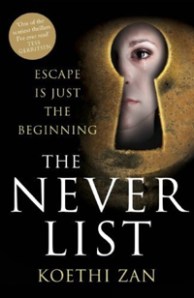
THE NEVER LIST cover image

THE NEVER LIST cover image

THE NEVER LIST was an outstanding debut, and one of my favourite reads of 2013. What was your route to publication?

I was quite lucky. My husband is a writer and so when I’d finished a draft of the book, he mentioned it to his agent. I wasn’t quite ready to show it to anyone—no one had read a word of it yet, but his agent wanted to see it and I didn’t want to lose the opportunity.  It turned out that they liked it at the agency, so I was pretty over the moon about that.  They gave me some notes and we worked on it a bit, and then we took it to publishers. The day we sold it was certainly one of the happiest of my life. There were plenty of tears and celebrations in my house for at least a week.  I’m still pinching myself.

And lastly, what does the rest of 2014 have in store for you?

I am writing a second book now–not a sequel, but a different stand-alone book.  I continue to be interested in the same themes:  power, psychological disturbances, dealing with a dark past.  My goal is to write a book that builds suspense but also deals with complex issues.  I hope to finish it up this spring.


That’s definitely a book I’m  looking forward to reading.

A huge thank you to Koethi Zan for popping by the CTG blog.

THE NEVER LIST is out on 30th January in paperback. You can read our review of it here: http://crimethrillergirl.com/2014/01/27/ctg-reviews-the-never-list-by-koethi-zan/
CTG Reviews: The Never List by Koethi Zan

THE NEVER LIST cover image

THE NEVER LIST cover image

I first read The Never List when it came out in hardback last year. It was one of the standout books of 2013 for me. It’s now available in paperback, and to celebrate I’ve reposted my review …

What the blurb says: “For years, best friends Sarah and Jennifer kept what they called the ‘Never List’: a list of actions to be avoided, for safety’s sake, at all costs. But one night, they failed to follow their own rules. Sarah has spent ten years trying to forget her ordeal. But now the FBI has news that forces her to revisit her memories, and finally attempt to find justice for Jennifer. If she is to keep her captor behind bars, Sarah needs to work with the other women who shared her nightmare. But they won’t be happy to hear from her. Because down there in the dark, Sarah wasn’t just a victim.”

From the very first page, no, the very first paragraph, this story had me hooked. I don’t know if it was the terrifying premise – three women imprisoned in a cellar by a man they thought that they could trust; the unwavering loyalty to her friend Jennifer that the protagonist, Sarah, maintains despite the danger that in puts her in; or the three women’s determination, against all odds and all that had happened to them, to succeed in their quest for justice and uncover the shocking truth. Whatever it was, I just couldn’t put it down.

One of the things that, for me, made the story seem so real was the voice of Sarah. A prisoner in her own home at the start of the book, she has to face her fears (and there are so very many of them) just to be able to leave her own building. She knows that she has allowed herself to be governed by fear, and that it’s far from normal, yet she has engineered a life for herself that allows her to work, to eat the food she likes and see her physiatrist without ever leaving the safety of her apartment. She is still a prisoner, only now it’s within her own home. And she is still receiving letters from the man who abducted her.

Then she gets a call from the FBI telling her that the man responsible for her imprisonment, and her friend Jennifer’s death, is coming up for parole. The news spurs Sarah into action, setting her on a quest to not only keep her abuser in jail, but also to get justice for Jennifer by finding her body. It’s hard to go into any more detail without spoilers, all I’ll say is that Jennifer manages to reunite with Tracey and Christine, the other two survivors from the cellar, and re-enter the world inhabited by her abductor to seek out the clues, and the people, that the FBI failed to find.

For their ‘Never List’ Sarah and Jennifer had imagined every terrible thing that could happen, and made a list of actions to prevent against them. At the creepy and heart-wrenchingly scary climax of the book, Sarah learns that sometimes the truth is even worse than the terrors in her imagination.

A chilling, page-turner of a psychological thriller: a real must-read for all fans of the genre.

Highly Recommended.

[Many thanks to Harvill Secker for my copy of THE NEVER LIST]

ps. pop back on Wednesday when I’ll be interviewing Koethi Zan about writing The Never List, her writing process and all things bookish …