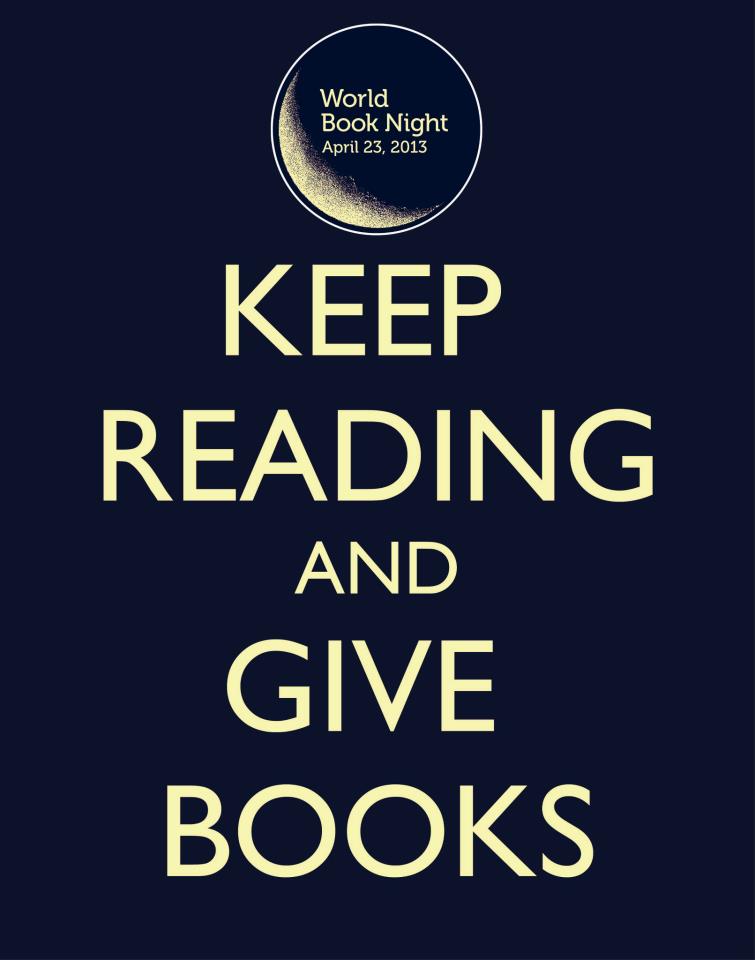
world book night’s picture (from Facebook)
Last night was World Book Night.
So, what did you get up to?
world book night’s picture (from Facebook)
Last night was World Book Night.
So, what did you get up to?
cover image
What the blurb says:
“Bright red. Like petals. Or rubies. Little red droplets.
Barney knows the killer will strike again soon. The victim will be another boy, just like him. He will drain the body of blood, and leave it on a Thames beach. There will be no clues for detectives Dana Tulloch and Mark Joesbury to find.
There will be no warning about who will be next.
There will be no good reason for Lacey Flint to become involved … And no chance that she can stay away.”
It’s hard to write a review of this novel without included spoilers and I don’t want to spoil the story for you. So all I’m saying is that Barney, an eleven-year-old boy with a gift for spotting patterns, is looking for the connections to help him solve the child murders while he’s home alone while his Dad works late. He’s also Lacey Flint’s neighbour.
The story is shown primarily from three perspectives – Barney’s, Lacey’s and Dana’s. This lets you, as the reader, in on a lot more of the facts than any one of the main characters have – a sure-fire recipe for heart-banging moments!
The story is artfully plotted, with many possibilities for who is behind the killings. This, and the multiple twists and turns, create an unputdownable puzzle that kept me reading well into the night.
But it wasn’t just the puzzle that kept me reading. SJ Bolton creates such deeply drawn characters, like the smart, often strong and yet also emotionally fragile heroine, Lacey Flint, that I felt compelled to read on just to stay with them on their journey within the story.
As well as motivation to murder, the story touches on a number of themes including modern-day vampire culture, online stalking and how social media influences, aids and inhibits investigations.
Utterly gripping, tense and suspenseful: this is a real page-turner of a crime novel.
Highly recommended.
[My copy of Like This For Ever was provided by the publisher]

I love books (Photo credit: jamarmstrong)
I love reading, but what with my day job, my Creative Writing MA studies, drafting my novel, and all the usual day-to-day stuff to fit in, it can be tough to grab much time to read.
I’m lucky that I’m a fast reader, especially if the story grips me from the outset and carries me along, but I reckon that it’s only around an hour a day that I manage to read for in the week, and that’s split into short bursts – a couple of minutes as I drink my first morning coffee, a few minutes at lunchtime, a little longer if I’m soaking in the bath. I usually get to read for longer at the weekends, although it never seems like long enough!
What about you?
Do you read every day, or just at the weekends?
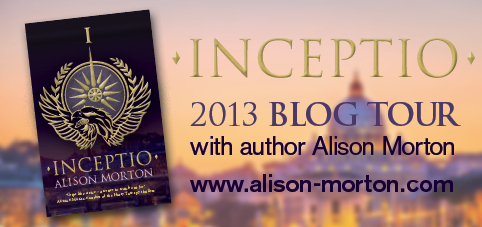
Blog Tour Logo
If you like some alternative history with your crime, Alison Morton’s exciting debut novel ‘INCEPTIO’ could be just your type of read. Blending alternative historical and modern settings, the story follows Karen Brown as she searches to uncover the truth behind her connection to the mysterious Roma Nova, and discover (before it’s too late) why government enforcer, Jeffery Renschman, wants her dead.
To learn all about it, I’m pleased to welcome to Alison Morton, author of ‘INCEPTIO’, who’s joining me today as part of her ‘INCEPTIO’ Blog Tour.
Alison, you’ve said that the idea for your new thriller ‘INCEPTIO’ came from your eleven-year-old self wondering What would have happened if women were in charge of the Romans? What was it that made you decide to write a novel along that theme?
Ever since my clever, ‘senior Roman nut’ father batted that question back at me by replying, “What do you think it would be like?” the idea has bubbled away in my mind. Ancient Rome morphed into a new type of Rome, a small rump state that survived the dissolution of the Western Roman Empire into the 21st century, but retained its Roman identity. And one where the social structure changed; women were going to be leading society. Despite a full range of life events keeping me busy (school, university, career, military, marriage, parenthood, business ownership, move to France), I couldn’t make the story go away.
But what actually started me writing INCEPTIO? One Wednesday I went to the local multiplex cinema with my husband. Thirty minutes into the film, we agreed it was really, really bad. The cinematography was good, but the plot dire and narration uneven.
‘I could do better than that,’ I whispered in the darkened cinema.
‘So why don’t you?’ came my husband’s reply.
The story that had filled my mind for years burst out through my fingers and ninety days later, I’d written 96,000 words, the first draft of INCEPTIO.
Your modern day protagonist, Karen Brown, is certainly up against the odds. What was your inspiration for creating her?
I had experience of living in different cultures and of serving in the military so could draw on both of those to seed some of the background of Karen’s story. But I wanted to take a modern Western young woman and not only make her contend with a nasty piece of work trying to eliminate her, but also unsettle her by having to adapt to a fundamentally different culture. She was going to be forced to change and grow, something I think readers like to see. More than anything, I wanted her to discover the person she was meant to be, something she certainly wasn’t going to do stuck in a city office.
With ‘INCEPTIO’ set in the alternate modern day and in the alternate historical setting of Roma Nova, what research did you do to ensure the two worlds felt so real?
The key to writing alternate history is plausibility. Firstly, it’s essential to know your history up to the point when the new alternate timeline diverges from the one we know. The next step is to work out in a historically logical way how the world would look after that divergence. Roma Nova’s existence couldn’t happen in a vacuum – in the course of sixteen hundred years it would have affected the rest of the world’s history.
New York is an Autonomous City in the Eastern United States (EUS) that the Dutch only left in 1813 and the British in 1865. Roma Nova had protected its New World trade interests in the late 1700s by brokering a political accord between the British colonies and the home government. The New World French states of Louisiane and Québec are ruled by Gouverneurs-Généraux on behalf of Napoléon VI, California and Texas belong to the Spanish Empire and the Western Territories are a protected area for the Indigenous Peoples.
These are only background details – I don’t develop them much further – the New World is only the setting for the first chapters. I only allude to it where necessary – nobody likes a long history lesson or an info dump in the middle of a pacey thriller – but I have it worked out in great detail in my head so I can live within that world while writing.
Secondly, you have to reinforce the settings with anchors to the reader’s own reality. Take a character working in law enforcement. Readers can accept cops being gentle or tough, enthusiastic, intellectual or world-weary. And whether corrupt or clean, they must act like a recognisable form of cop; they catch criminals, arrest and charge them and operate within a judicial system. Legal practicalities can differ significantly from those we know, but they must be consistent with that society while remaining plausible for the reader.
Almost every story hinges upon implausibility. Readers will engage with it and follow as long as the writer keeps their trust. One way to do this is to infuse, but not flood, the story with corroborative detail so that it verifies and reinforces the original setting the writer has introduced.
Even though INCEPTIO is an alternate history thriller set in the 21st century, the Roma Novan characters still allude to their past by saying things like ‘I wouldn’t be in your sandals when he finds out.’ There are honey-coated biscuits (honey was important for the ancient Romans) not chocolate digestives in the squad room. The Roma Novan family in the 21st century still includes not only the blood family but the entire household. This detail is where historic logic meets practical function of the roles the characters are playing.
If ‘INCEPTIO’ were made into a movie, which actors would you like to see playing your main characters?
A while ago, Meg Ryan and Val Kilmer (Carina and Conrad), with Judi Dench (Aurelia) and Alexander Siddig (Daniel). Today, probably Bryce Dallas Howard and Alexander Skarsgård, with Meryl Streep and Ben Barnes.
Tell us a little about your writing process, do you plot out the story events before sitting down to write, or do you drive right in and see where the story takes you?
I’m probably 20% ‘plotter’ and 80% ‘pantser’. I start with my characters, their values and motivations, then float some story ideas involving them around in my head. I like to interweave a crisis facing Roma Nova with a personal crisis between the characters and in their lives. Nobody comes out of the story in the same state they went in.
By then, I know where the story starts and where it has to finish. Maybe now is the time to confess that only one of the three books I’ve written actually has exactly the ending I first thought of! Next, structure. I’ve evolved a thirty-line system; Line 1 is the inciting incident, Lines 6, 14 and 22 (or nearabouts) the three crisis points, Line 27 or 28 the ‘black moment’ and Line 30 the resolution. I fill in some of the lines in between with likely scenes, but often leave some blank. It’s a process to imprint the plot on my conscious mind so that the unconscious or creative one has some hooks to hang the story threads on. All the rest in between just swirls around in my head and only emerges as I’m writing.
How do you organise your writing day: do you have a favourite time and place to write?
On a typical day I write most mornings after a short spurt on social media, and do domestic stuff in the afternoons or depending where I am in the book some research. In the evening, I’ll write a few more lines and dip into Facebook and Twitter.
If I’m editing, I tend to work straight through, with a short lunch break as I’m totally immersed. Strange, isn’t it? I can draft in paragraphs, but prefer to edit in long stretches. Proofing is another question – I do that in short bursts because of the concentration needed.
My books centre around a big conflict, dangerous assignment or saving the world story within the Roma Nova environment. Luckily, I’ve breathed in history since I was a kid. I even ‘went back to school’ to take a history masters thirty years after my first degree. So I have enough of a grounding in the aspects of Roman history I want to draw on to start the story. I write the basic dynamics of a scene, then if I need to check a detail, I mark the text up in bright blue which gives me a visual signal to come back and research that item.
What have you learnt through writing this novel that you’d like to pass on to aspiring crime thriller writers?
Keep a really big surprise for the end, but make sure you leave some clues. Readers hate what’s known in SFF as ‘alien space bats’, more properly a deux ex machina where a surprise solution or resolution is parachuted in. Try to nudge the reader into thinking about what’s going on behind the characters’ motivation. In INCEPTIO, the heroine doesn’t know why Renschman pursues her with such persistence. We know he’s a bad guy, but why is he so vindictive? Read the book and you’ll find out!
Structure and keep track of time so you ensure that the right people know or don’t know about events or vital clues. The mobile phone has ruined many traditional opportunities for suspense and tension so writers have to be more inventive these days.
My last tip is to keep the reader in the loop. I love surprising and disconcerting the reader as the plot twists and turns, but I try hard to ensure the reader knows what’s happening. As a reader myself, I hate not knowing who’s speaking for pages and pages just to make the writing look clever.
And what’s next for you, are you planning your next novel, or already well into the writing of it?
I’m working on book two of the Roma Nova series, PERFIDITAS (Betrayal). I drafted it a little while ago, but it’s been ‘in the drawer’ for several months. It’s a thriller again, this time the whole Roma Novan society faces collapse as well as pushing the heroine to a personal crisis. I’m looking forward to reading it again after many months away!
Thank you, Alison, for dropping by today and for sharing your writing secrets.
For more about Alison Morton and INCEPTIO hop on over to her website at: http://alison-morton.com/
INCEPTIO is the first in a series of exciting alternate history thrillers set in mysterious Roma Nova. Published by SilverWood Books, it is available now in Paperback and eBook.

magic in the pages image
There’s something magical that happens when you’re reading a good book isn’t there?
It’s as if you’ve been transported to another place, into another life, experiencing things that you don’t usually, and piecing together situations that, in real life, might be terrifying, but from between the pages of a book are fascinating.
For me, the thing that always grabs my attention, and my imagination, is a good puzzle. A locked room mystery perhaps, or a really compelling ‘why dunnit’. Once there’s a puzzle to be solved, a puzzle with high stakes and lots of tension, then I can’t help but read on.
What does it for you?
What keeps you reading?
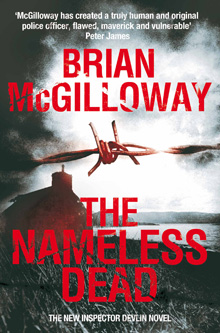
cover image
A high-action, atmospheric procedural with plenty of twists and turns
What the blurb says: “Declan Cleary’s body has never been found, but everyone believes he was killed for informing on a friend over thirty years ago. Now the Commission for the Location of Victims’ Remains is following a tip-off that he was buried on the small isle of Islandmore, in the middle of the River Foyle.
Instead, the dig uncovers a baby’s skeleton, and it doesn’t look like death by natural causes. But evidence revealed by the Commission’s activities cannot lead to prosecution. Inspector Devlin is torn. He has no desire to resurrect the violent divisions of the recent past. Neither can he let a suspected murderer go unpunished.
Now the secret is out, more deaths follow. Devlin must trust his conscience – even when that puts those closest to him at terrible risk.”
Compared to the majority of police procedurals that I read, what struck me most about this story was the action-packed, fast paced style. Despite the tip-off that Inspector Devlin is following being about a murder conducted over thirty years previously, the story feels immediate and pacy right from the start. As the plot unfolds, and Devlin starts to uncover the many activities – both within and outside of the law – that Declan Cleary was connected to, he realises that this was not the straight-forward revenge killing that he had originally believed it to be.
The isle of Islandmore, or Isle of Bones as it has come to be known locally, is an atmospheric setting that adds to the brooding tone of the novel. That Islandmore is also the site of a ‘cillin’ – an unofficial burial site for unbaptized babies – adds to the sense of sadness and loss. As the story progresses, Devlin discovers that what took place at Islandmore all those years ago, still has a huge impact on the local community.
The subject matter covered in the story is evocative and main all the more chilling and heartbreaking by its closeness to real life events. When the bodies of seven children are uncovered as part of the dig for Declan Cleary’s body, Devlin wrestles with the action he believes to be right – to investigate their deaths, versus the constraints of the law by which he is bound – that no bodies found as part of a Commission’s dig can be investigated. This personal struggle shows the human, family man that Devlin is, as well as his strong commitment to the community and personal values.
This is the first of the Devlin novels that I’ve read – The Nameless Dead is the fifth in the series – but I’ll certainly be looking out for the others.
Highly recommended.
The Nameless Dead by Brian McGilloway is available now, published by Pan Books.
Check out this and other great reviews over on the Mean Streets Crime Fiction Blog at http://www.writersworkshop.co.uk/crimefiction/
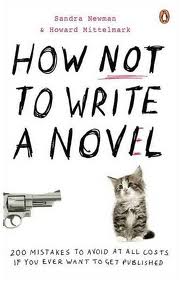
How Not to Write A Novel cover image
For those of us aspiring to write a published novel, ‘how to’ books that help us learn the craft can be a great resource, but how do you choose which ones to buy from all the many available?
Well here’s one with a difference.
Rather than focusing on ‘how to’, Sandra Newman and Howard Mittelmark focus instead on ‘how not to’. The result is this hilarious and entertaining book, that also drives home 200 different things to avoid in your work-in-progress.
It has sections covering plot, character, style, world-building, and also how (not) to approach agents.
With examples of each type of mistake clearly shown, this book is both fun to read and also really educational.
If you’re an aspiring author it’s well worth checking out.
festival logo
I’ve just heard that bookings are now open for the Theakstons Old Peculier Crime Writing Festival’s creative writing course for aspiring writers – Creative Thursday. Held on Thursday 18th July 2013, and running from 9am to 6pm, it’s a fabulous opportunity for those interested in writing crime.
This day-long programme of workshops and seminars gives aspiring crime and thriller writers access to bestselling crime writers, publishing industry professionals and real-life crime experts.
The workshop will cover topics including:
In addition, a lucky few Creative Thursday participants with a completed concept for a crime novel will get the opportunity to pitch their book to two agents
The Creative Thursday workshop costs £99.
To find out more, pop over to the Festival website here: http://harrogateinternationalfestivals.com/crime/creative-thursday/
Or to book your place, contact the festival office on 01423 562 303 or email crime@harrogate-festival.org.uk
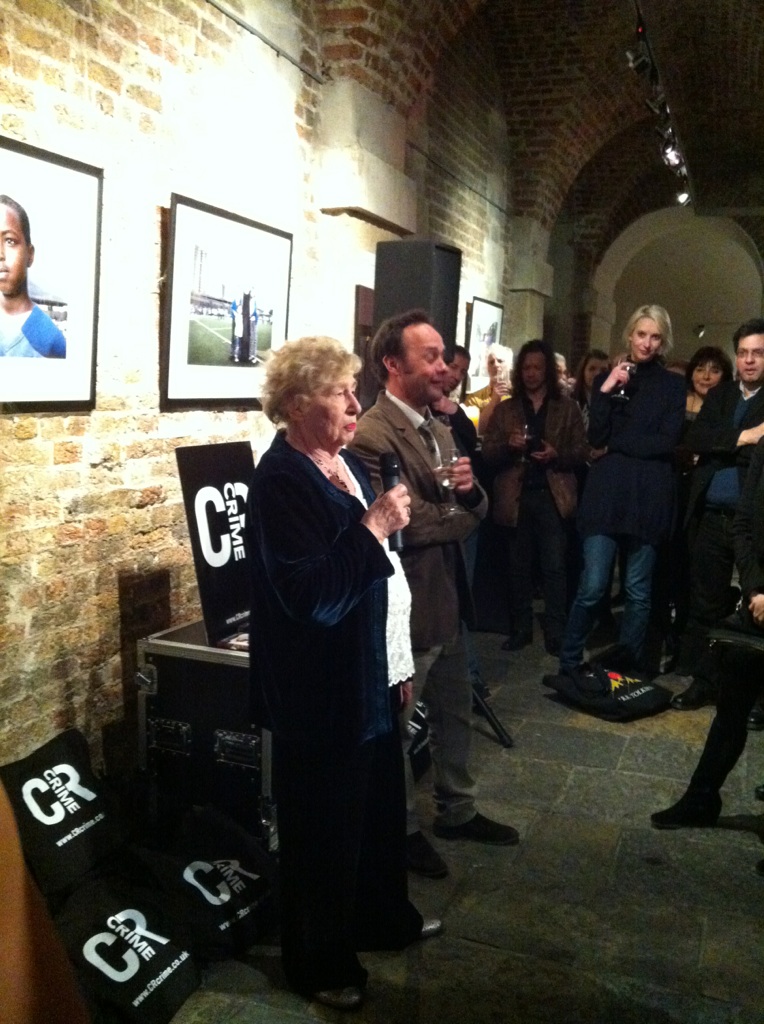
C&R Crime launch
Wonderful publishers Constable & Robinson launched their new consolidated crime imprint C&R CRIME on the 28th February.
I was really excited to be invited to the launch party, held at the fabulous location ‘The Crypt’ just off Trafalgar Square, London. It was a fabulous evening with loads of authors, the C&R Crime team, book bloggers and reviewers all mingling and chatting.
M.C. Beaton gave a speech in honour of the occasion, and it was revealed that she is just about to have her 106th novel published – a simply amazing feat.
C&R Crime have got some great books out at the moment including The Poacher’s Son by Paul Doiron (reviewed on this blog in February) and The Circus by James Craig (which I’m currently reading).
I’m also really looking forward to Quentin Bates’ new novel that’s coming out in April.
To find out more about C&R Crime head over to their website at http://www.crcrime.co.uk/
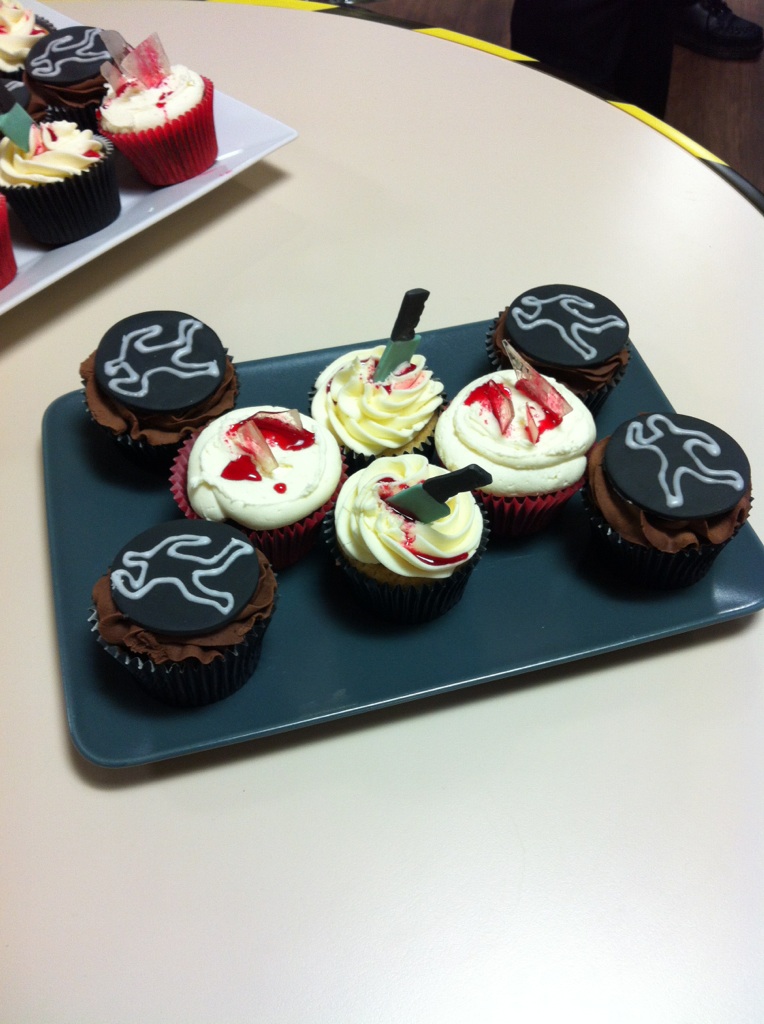
Deadly Cupcakes!
Aren’t these cupcakes simply fabulous?
I spotted them at the Transworld Crime Scene event that I attended earlier this week, and managed to take a quick photo before they disappeared.
I especially love the ‘dagger cake’, although I’m not entirely sure how would be best to eat it!
 Steph Broadribb