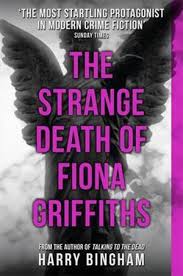
CTG Reviews: The Strange Death of Fiona Griffiths by Harry Bingham

cover image

cover image

What the blurb says: “When DC Fiona Griffiths says ‘yes’ to her policeman boyfriend, it’s an affirmation that she wants to finally put her psychological breakdown behind her, and become a resident of ‘Planet Normal’ like everybody else. But she still can’t resist the challenge of an undercover policing course and, finding it remarkably easy to assume a new identity, she comes top of the class. So when an ingenious payroll fraud starts to look like the tip of a huge criminal iceberg, Fiona is selected to infiltrate the fraudsters’ operation. Posing as a cleaner, Fiona Griffiths becomes Fiona Grey, hoping the criminals will try and recruit her – knowing that if they discover her real identity, she’s dead meat. But as Fiona penetrates deeper into their operation, coming closer to identifying the mastermind behind it, she faces another, even more frightening danger – that her always fragile grip on her sense of self has now been lost and she may never find her way back.”

The Strange Death of Fiona Griffiths is published this week. It’s the third novel in the series featuring Harry Bingham’s quirky, unpredictable protagonist Fiona Griffiths.

This novel picks up where the second book – Love Story with Murders – ended, and sees Cardiff based DC Fiona Griffiths train as an undercover detective. She passes with flying colours, and is soon offered an assignment that requires her to assume the identity of Fiona Grey. She assimilates into the role easily, becoming first a cleaner and then a payroll clerk in order to infiltrate the criminal gang. She’s the perfect undercover officer – where her unpredictable nature and lack of regard for orders is usually a problem, while undercover her quick thinking and improvisation are the things that keep her alive.

But as she gets deeper undercover, the boundaries between her true self and her undercover ‘legend’ begin to blur. She finds herself taking bigger and bigger risks, both with the operation and with her personal relationships as she gets closer to her criminal colleagues. As the criminal ring get closer to pulling off the largest payroll fraud in history, only Fiona has the access and the knowledge to bring them down. Question is, will she?

This is a police procedural with a twist. Quirky, gripping and, rather like its lead character, utterly unconventional. That’s what makes it such a delight to read.

Highly recommended.

[many thanks to Orion Books for my copy of The Strange Death of Fiona Griffiths]

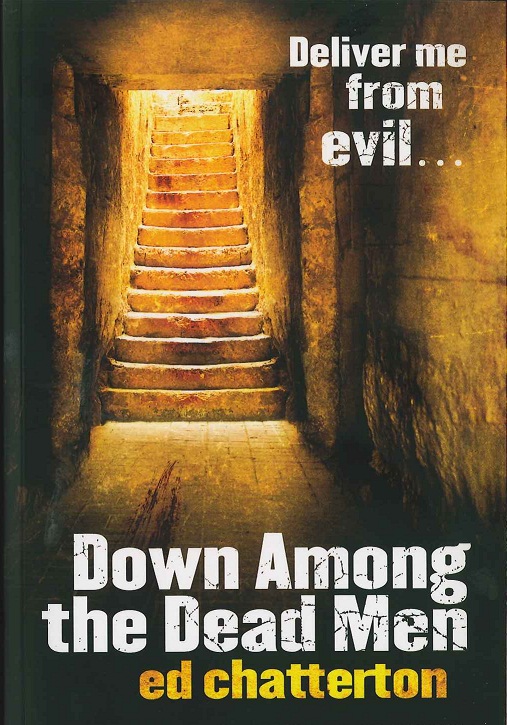
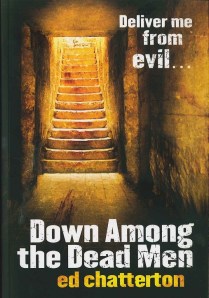
CTG Reviews: Down Among the Dead Men by Ed Chatterton

Down Among the Dead Men cover image

Down Among the Dead Men cover image

What the blurb says: “At first glance, to newly-promoted DCI Frank Keane, the horrifically bloody crime scene in suburban Liverpool looks like a straightforward murder-suicide – the husband kills the wife and then himself. Frank and the rest of the Major Incident Team have seen too many cases like it before. But what of their missing teenage son, Nicky? Is he their prime suspect or the third victim?

For script-writer Dean Quinn, the killings are a potential disaster. The film he is working on is everything to him and with new London money and a rising American actor lighting up the set, his vision is almost complete. He’ll do anything to protect it.

Frank knows that time is running out to find the boy. But all too soon the case starts unravelling into one that will test Keane to the limit – and haunt him to his dying day.”

This is the second book in Ed Chatterton’s DCI Frank Keane crime series.

As with the first book, Down Among the Dead Men continues the dark, gritty tone. As unsettlingly atmospheric as the claustrophobic-inducing old tunnel system they’re using as a location for Dean Quinn’s film, this story gives more than a few heart-pounding moments.

First part of the book is set in Liverpool and has all the elements you’d expect from a police procedural. I think this was my favourite part of the book as there’s a high element of mystery, and as the actions and behaviours of each character associated with the murdered couple are revealed, the relationships between them are shown to be far from simple. I loved the complexity, the intrigue, and trying to guess who was responsible for the sinister activities surrounding the ill-fated movie.

The second part of the book ups the pace and becomes more thriller-like as the action shifts to follow Keane’s pursuit of the killer in LA. Fast-paced and dynamic, the chase pulls you along at a relentless speed.

If you’re a fan of gritty, atmospheric crime thrillers, this could be a series well worth checking out.

Ed Chatterton stopped by the CTG blog a few weeks ago. You can read the interview here.


[With thanks to Arrow for my copy of Down Among the Dead Men] 

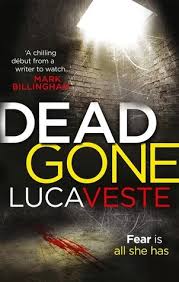
CTG Interviews: Luca Veste author of DEAD GONE

DEAD GONE cover image

DEAD GONE cover image

Today I’m thrilled to welcome Luca Veste, author of DEAD GONE, a fabulous debut that was published by Avon (HarperCollins) last month. 

So, to the questions …

Your debut novel DEAD GONE is out this month. Can you tell us a bit about it?

It would be my pleasure! Dead Gone is a part psychological thriller, part police procedural book, which follows the detective pairing of David Murphy and Laura Rossi as they attempt to stop a serial killer in Liverpool. This killer is using his victims to replicate infamous unethical psychological experiments, taunting the public by leaving a message with each body.

It’s also about life, grief, and death…and how we deal with all three.

What books and authors have inspired you as a reader and writer?

Stephen King, Enid Blyton and Brian Jacques (three names you don’t see put together often!) were a staple of my childhood/teenage reading. As a writer, I’m inspired by the characterisation in Mark Billingham’s books, the bravery of Helen FitzGerald, and the atmosphere created within Steve Mosby’s work. The 50/50 Killer by Steve Mosby was a major influence when I started writing Dead Gone.

Can you tell us a little about your writing process, do you dive right in, or plan out the story first?

For Dead Gone, I planned out about two thirds of the story, using chapter headings. So, I had the bones of the book with various word documents with different titles. Of course, the best laid plans of mice and scouse-italian blokes etc etc… I ended up scrapping most of those chapters and just writing one piece of the story at a time, before the ending came to me after a few abandoned attempts.

The second – as yet untitled – book I’ve just completed was written completely. I knew the end chapter going in. I also knew what happened in the middle few chapters, but that was about it. I also wrote a lot more which didn’t make it into the final version than I did for Dead Gone.

I think I’m still trying to find the way that works best for me!

DEAD GONE is a fabulous debut. What was your route to publication?

Pretty standard, I think. I identified a literary agent I wanted to work with pretty early on in the process, and after being turned down by him a few times, he eventually relented and took me on. We sent the book out to numerous publishers, with most turning it down, but Avon (an imprint of HarperCollins) have been nothing but enthusiastic about the book since the beginning. Going with them was a very easy decision.

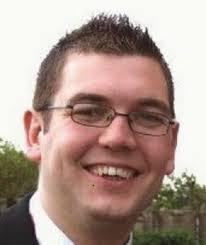
Author Luca Veste

Author Luca Veste

And lastly, what else does 2014 have in store for you?

Starting out with a number of book signings around Merseyside. Lots of lovely independent bookshops to visit, which I’m really looking forward to.

I’ll be finishing my degree at university in June. Four years work done. Hopefully graduate!

I’ve just delivered book two to my editor, so most of the year will be taken up with making that better. I’ll also be visiting a number of festivals this year, as has become the norm for me now. Crimefest in Bristol and Theakstons Crime Festival in Harrogate are now what I plan my year around!

Hopefully sleep at some point.

Oh, and buy a new guitar. I’ve wanted a new one for years, so hopefully I’ll get chance to treat myself to one soon!

Sounds like it’ll be a busy (and fantastic) year! 

A huge thanks to Luca Veste for dropping by the CTG blog. To find out more about Luca and his books pop on over to his wonderful blog at http://lucaveste.com/

DEAD GONE is out now. Watch for our review coming soon …

CTG Interviews: Ed Chatterton author of DOWN AMONG THE DEAD MEN

Author Ed Chatterton

Author Ed Chatterton

Today I’m excited to welcome Ed Chatterton to the CTG blog. As well as having writing over twenty children’s novels (published under the name Martin Chatterton), Ed is the author of the recently published crime novel, Down Among the Dead Men, the second book in the DCI Frank Keane series, published by Arrow.

And so, to the questions …

Before you starting writing crime fiction you’d already written over twenty highly successful children’s books. What fresh challenge did writing fiction for an adult crime reader audience bring?

‘Highly successful’ might be overstating it: I’d been doing pretty well with some books and less so with others, just like most writers. The books I write for children are largely comedies – surreal farces, often with big themes like ‘death’ or ‘the physical universe’ or ‘nose-picking’. There were, particularly in some of the more recent children’s books, crime elements in there too. Two books – ‘The Brain Finds A Leg’ and ‘The Brain Full of Holes’ – were full blown detective fiction, albeit with a comic twist. So the transition into adult crime fiction was less challenging than it might have been for a debut author. The main change I found was that my characters can swear (and some of them do, a lot), can have sex, and can be more violent. From a technical point of view, adult crime writing requires more precision in terms of plot and, given that my books are complex, requires me to use my rapidly shrinking brain more often. In my children’s books if I got to a difficult plot point I would usually insert a T-rex or a time machine. That’s less easy with gritty adult fiction, as most crime readers tend to notice things like that.

Your recent crime novel, Down Among the Dead Men, is set in Liverpool, Los Angeles and Australia. What was it about these particular settings that inspired to you to pick them?

Liverpool featured because the story is a continuation (in terms of some of the characters) of the first book, A Dark Place To Die. In that first book Frank Keane is one of a number of characters. In Down Among the Dead Men I wanted to focus on Frank and see how far I could push him. Frank’s a Liverpool cop who gets pulled into a case that starts relatively small (an apparent  domestic murder-suicide) but quickly gets darker and widens out into something much larger in scale. I picked Los Angeles for two reasons: the first is that I’ve been there a number of times and there were locations I wanted to use. The high desert near Palm Springs and Twentynine Palms is a very evocative landscape (the working title for Down Among the Dead Men was Twentynine Palms). The second is so that I could continue to open out the stories from a single location. I’m not a huge fan of every case in a series being located in exactly the same place. I’d make an exception for George Pelecanos with his Washington-based novels, but single location books too often end up becoming sterile or repetitive. I used to live in the US so I am fond of the place and enjoy writing American characters. The Aussie connection dates back to A Dark Place To Die. Two of the characters from that book, Menno Koopman and Warren Eckhardt, make a re-appearance. Koopman, I think, will become a character who I might develop more as a stand alone. If he lives through Down Among the Dead Men that is . . .

Could you tell us a little about your writing process, do you dive right in, or plan the story out first?

Raymond Chandler said that a good story isn’t devised, it is distilled and I think that’s a pretty good description of my approach. I start with a basic idea, or set of ideas and then I let them go wherever they take me. I often have a rough ‘destination’ in mind with a skeleton narrative and a very strong sense of the kind of story I want to tell, but the fine details are worked out in writing. This usually means that I am constantly redrafting and editing – which is fortunately something I love doing – and I find this approach prevents the books being formulaic. My thinking is that if I don’t know exactly where the story is going then that makes it doubly interesting for the reader. I think you can overplan, just the same way that you can over-write. In my stories, I honestly don’t think the reader can guess what way the story is going.
Down Among the Dead Men cover image

Down Among the Dead Men cover image

Your books have been likened to those of Peter James and Ian Rankin. Which crime writers’ novels do you most like to read?

I try to avoid British crime books as I get very jealous and envious and bitter and twisted if they are any good. I’m flattered to be compared to either Peter James and Ian Rankin and, weirdly enough, I met both of them recently although, since I was several continents off being described as sober, they may not look back on the meeting quite as fondly as I do. From what I can remember, they are both lovely blokes but far too successful for my liking. In truth, American crime writers are more my taste and, since they are further away, don’t seem as threatening. I already mentioned Pelecanos who I think is just a little bit special, but I also love Elmore Leonard, Richard Price, Joe Lansdale, Carl Hiassen. One of my favourite books is the one-off, Blackburn by Bradley Denton. I do have a real soft spot for Patricia Highsmith’s stuff too. Some of the Scandi crime is good but I’m a bit sick of the adulation doled out to anyone vaguely Nordic who so much as writes a shopping list at the moment. Of the Scandinavians I like Asa Larsson best. At one point, when I knew my crime series was coming out, I seriously considered adopting a Nordic-sounding pseudonym. In my bleaker 3am moments, I regret not doing so. I reckon I’d have scooped at least three awards by now.

What advice would you give to new writers aspiring to publication?

All the usual gubbins: make sure you have something to say, make sure you keep reading, make sure you keep writing. Don’t think that publication is the ‘win’: publication is just the ticket into the gladiator ring. Maybe this too: don’t listen to too much prescriptive crap about the mechanics of story-telling, plot points, ‘arcs’, use of semi-colons, use of italics, whatever it is. If Stephen King tells stories a certain way that doesn’t mean that you need to do that. Elmore Leonard’s famous ‘ten rules’ of writing, including that ‘don’t start with the weather’ nonsense applies only if you are Elmore Leonard. Despite my healthy man-crush on Leonard, I always thought that was too restrictive. I actually began a kids book with ‘It was a dark and stormy night’ once just to prove a point. And never, ever, do anything Neil Gaiman tells you to unless it relates to hair.

And lastly, what does the rest of 2014 have in store for you?

I’m just about to complete the third in this series which takes place in Liverpool, Berlin and Western Scotland and has the rise of neo-Nazism as a backdrop. I’m continuing to write The Last Slave Ship which is a dual narrative novel about the final slave trading voyage from Liverpool and a contemporary race-hate crime which erupts into riots. This book is part of my PhD which just goes to show one of two things. Either (a) crime writers aren’t as dumb as we look or (b) they’ll let just about anyone do a PhD these days. I’m continuing to illustrate children’s books and will be drawing pictures for a book by Jonathan Emmett. I’ll be keeping my fingers crossed that my‘Mort’ kids series, which has just been bought for development as an animated series by Southern Star, makes it past the pilot stage and into production. Lastly, I’ll be working with a UK TV/film company on bringing Frank Keane to the screen in one way or another. Should keep me busy.

Sounds like it’ll be a hectic year!

A massive thanks to Ed Chatterton for dropping by the blog and allowing us to question him. Watch out for our review of Down Among the Dead Men next week …
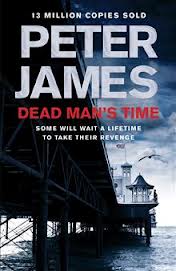
CTG Reviews: Dead Man’s Time by Peter James

cover image

cover image

What the blurb says: “A vicious robbery at a secluded Brighton mansion leaves its elderly occupant dying. Millions of pounds’ worth of valuables have been stolen.

But as Detective Superintendent Roy Grace, heading the enquiry, rapidly learns, there is one priceless item of sentimental value that her powerful family cherish above all else. And they are fully prepared to take the law into their own hands, and will do anything – absolutely anything – to get it back.

Within days, Grace is racing against the clock, following a murderous trail that leads him from the shady antiques world of Brighton, across Europe, and all the way back to the New York waterfront gang struggles of 1922, chasing a killer driver by the force of one man’s greed and another man’s fury.”

The ninth novel in Peter James’ award-winning Roy Grace series finds Detective Superintendent Grace juggling his job with the challenges of being a new parent. Sleep deprived and wishing that he could spend more time at home with Cleo and their baby son, Noah, instead Grace finds himself heading up the investigation into the robbery and violent assault of an elderly widow.

This story has all the hallmarks of a classic Peter James novel – tight plotting, lots of twists and turns, great attention to detail. It also combines the present-day crime with a past mystery which begins in Brooklyn, 1922, when a young boy witnesses the murder of his mother and the abduction of his father.

As Grace and his team investigate the present day crime, the two stories begin to intertwine through factors common to both – Gavin Daly, an elderly multi-millionaire with an unfulfilled promise, and a stolen broken pocketwatch.

As Grace pieces the evidence together it becomes clear that his team are not the only people hunting for the killer. With several leads eliminated, he follows the trail of stolen goods first to Spain and then to New York. The only problem is, his dedication to the case may well have blinded him to a threat much closer to home.

The theme of family is strong in this book. Peter James artfully interweaves the past and present crime stories, making the powerful and, at times ruthless, Gavin Daly a compelling and empathetic character. It’s also a fascinating glimpse into the world of New York gangs in the 1920s and the darker side of the UK antiques trade.

With fast-paced action, great characters and a pair of intriguing and emotive crimes to solve, Dead Man’s Time is a real page-turner.

Highly Recommended.

[With thanks to Pan MacMillan and Midas PR for my copy of Dead Man’s Time]

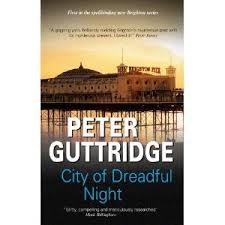
CTG Reviews: City of Dreadful Night by Peter Guttridge

cover image

cover image

What the blurb says: “July 1934. A woman’s torso is found in a trunk at Brighton railway station’s left luggage office. Her legs and feet are found in a suitcase at King’s Cross. Her head is never found, her identity never established, her killer never caught. But someone is keeping a diary. July 2009. A massacre in Milldean, Brighton’s notorious no-go area. An armed police operation gone badly wrong. As the rioting begins, highflying Chief Constable Robert Watts makes a decision that will cost him his career. Meanwhile, with the aid of newly discovered police files, ambitious young radio journalist Kate Simpson hopes to solve the notorious Brighton Trunk Murder of 1934, and enlists the help of ex-Chief Constable Robert Watts. But it’s only a matter of time before past and present collide …”

I love a good puzzle, and that’s exactly what this first book in Peter Guttridge’s Brighton series gives you. Twice over.

The mysterious cold case of the Brighton Trunk Murderer (an actual case) is twistingly intertwined with the investigation of the modern day Milldean shooting case. And both are giving Robert Watts a headache.

An excellent investigator, Watts loses his job as Chief Constable in the political fallout from an armed police raid gone bad. With his marriage falling apart, and the job he lived for gone, he’s at a loss of what to do. So when Kate Simpson, a young radio journalist and the daughter of an old friend, asks him for his help he agrees.

But Kate’s not the only one seeking his help. When Sarah Gilchrist, a member of the ill-fated armed operation, returns to work she can’t let the unanswered questions about what really happened go unanswered any longer. As she digs deeper it seems that the bungled raid wasn’t quite the accident it first appeared. That’s when she decides to call on Watts.

As Watts gets drawn into both cases he discovers links to people he knows and implications that have affected him, and his career, without his knowledge. But someone isn’t happy that their secrets are being uncovered, and as more police officers from the raid turn up dead, and threats to Watts, Kate, Sarah and those helping them are made, it seems both the cases are anything but cold.

This isn’t your average police procedural. The quirky narrative style, fresh characters and witty observations kept me turning the pages, keen to find out where Watts, Kate and Sarah’s rather unusual and distinctly unofficial investigations would lead them.

An intriguing journey through the darker side of Brighton, and a great introduction to a new series – I’ve already bought the next book ‘The Last King of Brighton’.

Recommended.


[With thanks to Peter Guttridge for my copy of the book]

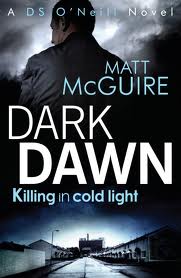
Review: Dark Dawn by Matt McGuire

cover image

cover image

What the blurb says: “Acting Detective Sergeant John O’Neill stands over the body of a dead teenager. The corpse was discovered on the building site of a luxury development overlooking the River Lagan. Kneecapped, then killed, the body bears the hallmarks of a punishment beating. But this is the new Northern Ireland – the Celtic Tiger purrs, the Troubles are over, the paramilitaries are gone. So who is the boy and who wanted him dead?

O’Neill quickly realises that no one else seems to care about this kid’s identity – his colleagues, the politicians, the press – making this case one of his toughest yet. O’Neill needs to crack this one, his first job as Principle Investigator, or risk ending up back in uniform. Disliked by the Chief Inspector and with his current rank yet to be ratified, O’Neill is in a precarious position …”

McGuire’s debut is slick and fast paced.

A police procedural told from several point-of-views, it shows not only the world DS O’Neill inhabits, but also that of the old and new generations and the changing face and frictions within the crime world.

The story grabbed me right from the opening chapter. O’Neill, a man with an unhappy past and a Chief Inspector out for his blood, is given the lead on a case which no one seems to care about, to solve the murder of a person who they can’t identify. With characteristic commitment to his job, O’Neill sets about solving the mystery, investigating leads that take him high into the political circles of the city and out into the criminal underworld, and in the process makes himself a target with a price on his head.

The stories of two young upstarts in the drug world – Marty and Petesy – and Lynch, recently released from prison and trying not to get drawn into the underworld, add to the gritty setting and show the tension on the streets. The way the different point-of-view characters’ stories weave together is artfully done and sets up a cracking finale.

Fast paced, and with plenty of twists and turns, I think this is a must-read for fans of police procedurals.

Highly recommended.

[Many thanks to C&R Crime for my copy of Dark Dawn]

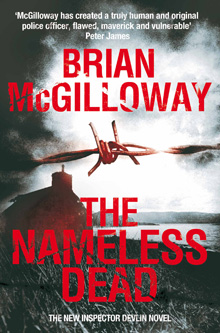
My Guest Review for the Mean Streets blog: The Nameless Dead by Brian McGilloway

cover image

cover image

A high-action, atmospheric procedural with plenty of twists and turns

What the blurb says: “Declan Cleary’s body has never been found, but everyone believes he was killed for informing on a friend over thirty years ago. Now the Commission for the Location of Victims’ Remains is following a tip-off that he was buried on the small isle of Islandmore, in the middle of the River Foyle.

Instead, the dig uncovers a baby’s skeleton, and it doesn’t look like death by natural causes. But evidence revealed by the Commission’s activities cannot lead to prosecution. Inspector Devlin is torn. He has no desire to resurrect the violent divisions of the recent past. Neither can he let a suspected murderer go unpunished.

Now the secret is out, more deaths follow. Devlin must trust his conscience – even when that puts those closest to him at terrible risk.”

Compared to the majority of police procedurals that I read, what struck me most about this story was the action-packed, fast paced style. Despite the tip-off that Inspector Devlin is following being about a murder conducted over thirty years previously, the story feels immediate and pacy right from the start. As the plot unfolds, and Devlin starts to uncover the many activities – both within and outside of the law – that Declan Cleary was connected to, he realises that this was not the straight-forward revenge killing that he had originally believed it to be.

The isle of Islandmore, or Isle of Bones as it has come to be known locally, is an atmospheric setting that adds to the brooding tone of the novel. That Islandmore is also the site of a ‘cillin’ – an unofficial burial site for unbaptized babies – adds to the sense of sadness and loss. As the story progresses, Devlin discovers that what took place at Islandmore all those years ago, still has a huge impact on the local community.

The subject matter covered in the story is evocative and main all the more chilling and heartbreaking by its closeness to real life events. When the bodies of seven children are uncovered as part of the dig for Declan Cleary’s body, Devlin wrestles with the action he believes to be right – to investigate their deaths, versus the constraints of the law by which he is bound – that no bodies found as part of a Commission’s dig can be investigated. This personal struggle shows the human, family man that Devlin is, as well as his strong commitment to the community and personal values.

This is the first of the Devlin novels that I’ve read – The Nameless Dead is the fifth in the series – but I’ll certainly be looking out for the others.

Highly recommended.


The Nameless Dead by Brian McGilloway is available now, published by Pan Books.

Check out this and other great reviews over on the Mean Streets Crime Fiction Blog at http://www.writersworkshop.co.uk/crimefiction/

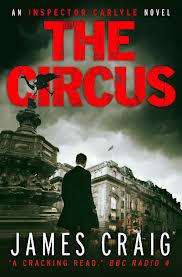
Review: The Circus by James Craig

The Circus cover image

The Circus cover image

What the blurb says: “When the body of journalist Duncan Brown is found in the back of a rubbish truck, Inspector John Carlyle is thrown into the middle of a scandal that threatens to expose the corrupt links between the police, the political establishment and the hugely powerful Zenger media group.

Hunting down Brown’s killer, Carlyle finds himself going head-to-head with his nemesis, Trevor Miller. A former police officer turned security advisor to the Prime Minister, Miller has dirty money in his pockets and other people’s blood on his hands. Untouchable until now, he is prepared to kill again to protect his position, and having failed once already to dispose of Carlyle, he is not prepared to slip up again …”

I couldn’t help but warm to Inspector Carlyle. He’s a good bloke, battling a heavy workload in order to do a good job and solve his cases. And he’s got a lot on his plate, a targeted bomb that kills a teenager, a missing girl, and the murder of journalist Duncan Brown.

As Carlyle digs deeper into each case, he discovers a web of crime and corruption that stretches far into the halls of power in London. What made the story seem especially realistic for me is that it covers a number of themes that mirror much of what has happened in recent times, like phone hacking, and doesn’t shy away from showing a rather seedy side to journalism, politics and police work.

This is the fourth book in the bestselling Inspector Carlyle series. It’s a gritty story, set in a sinister London, and one that will have the reader trying to puzzle out both who did it and why did it.

I think fans of police procedurals will certainly enjoy this one.


The Circus by James Craig is out now, published by C&R Crime.


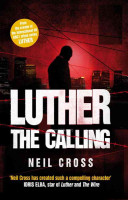
Just finished reading: The Calling (a John Luther novel) by Neil Cross

books

What the blurb says: “Meet Detective Inspector John Luther. He’s brilliant; he’s intense. He’s obsessional. He’s dangerous.

John Luther has an extraordinary clearance rate. He commands outstanding loyalty. And yet he seethes with a hidden fury that at times he can barely control. Sometimes it sends him to the brink of madness, making him do things he shouldn’t; things way beyond the limits of the law.

This is the story of the case that tore Luther’s personal and professional relationships apart and propelled him over the precipice. Beyond fury, beyond vegeance. All the way to murder.”

I’m a big fan of the BBC series LUTHER (in which Idris Elba plays the title role) and couldn’t wait to read this book, the first novel in the John Luther series written by the show’s creator and writer Neil Cross.

Like the series, it’s a gritty and often shockingly brutal glimpse into the work of Detective Inspector John Luther. Rather than continue from the end of the second series, it takes the reader back to the time just before the first series begin and follows John as he works the case of the horrific murder of a man and his pregnant wife in their London home. As Luther and the killer become entangled in a deadly game of cat and mouse, Luther’s relationship with Zoe, his wife, begins to unravel. It’s a story that, just like its main character, is as intense as it is compelling.

If you’re a fan of the TV series, or a fan of gritty police procedurals, then this book is well worth a read.