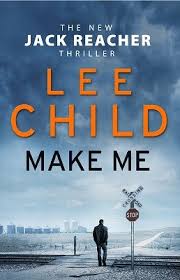
CTG Reviews: MAKE ME by Lee Child

Unknown

What the blurb says: “Jack Reacher has no place to go, and all the time in the world to get there, so a remote railroad stop on the prairie with the curious name of Mother’s Rest seems perfect for an aimless one-day stopover. He expects to find a lonely pioneer tombstone in a sea of nearly-ripe wheat … but instead there is a woman waiting for a missing colleague, a cryptic note about two hundred deaths, and a small town full of silent, watchful people. Reacher’s one-day stopover becomes an open-ended quest … into the heart of darkness.”

As you’ll know if you’re a regular follower of the CTG blog, I’m a big Jack Reacher fan. Make Me is the twentieth book in this iconic series and so what can fans of the series (and readers new to it) expect from this latest book …

Well, it’s classic Reacher, as you’d expect. He’s picked Mother’s Rest as a place to visit because he’s curious about the name of the town and in finding out the history behind it. But Mother’s Rest has far greater secrets hidden within it, as Reacher is soon to discover.

On the railroad platform he meets Ex-FBI Special Agent, Michelle Chang. She’s looking for her colleague – a fellow investigator who’s gone missing while looking into a hobby case. Her data has led her to Mother’s Rest, but the trail has gone cold.

While the residents of Mother’s Rest seem initially friendly, Reacher starts to suspect that he’s being followed and checked up on. When he tests his theory he’s proved right. Suspicious, he decides to help Michelle Chang find her colleague.

With little more to go on than a scrap of paper with a phone number and a reference to two hundred deaths, Reacher and Chang dig deeper to try to find Chang’s colleague and the client that got him interested in the case. And as they get closer to the truth, and the people that want it to stay hidden, the stakes and the danger ramps up higher and higher.

As ever, this latest book in the series is a thrilling read; rapid-paced and packed with action it follows Chang and Reacher’s investigation as they hunt for the truth and overcome the (many) challenges in their way.

Fans of the series will, I think, find the Chang and Reacher relationship an interesting one. Reacher, ever the loner, seems to develop a stronger bond with Chang than with some of the other women who’ve come into (and out of) his life in the past. It’s a physical thing, sure, but he seems to be having thoughts about a future for their relationship after the immediate puzzle is solved and the danger past. Is Reacher ready to settle down? It’s an interesting question – but you’ll have to read the book to see how things turn out [no spoilers here – sorry!].

MAKE ME is out in paperback today. It’s an absolute must-read for Jack Reacher fans, and for fans of the thriller genre, from a writer at the very top of their game.

To find out more about Lee Child and the Jack Reacher series hop over to www.leechild.com and follow Team Reacher on Twitter @LeeChildReacher

You can buy MAKE ME from Waterstones here or from Amazon here


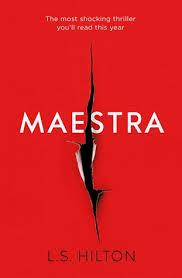
CTG Reviews: MAESTRA by L. S. Hilton

Unknown

What the blurb says: “Judith Rashleigh works as an assistant in a prestigious London auction house but her dreams of breaking into the art world have been gradually dulled by the blunt forces of snobbery and corruption. To make ends meet she moonlights as a hostess in one of the West End’s less salubrious bars – although her work there pales against her activities on nights off.

When she stumbles across a conspiracy at her auction house, she ends up in a battle for her life. Alone and in danger, from the French Riviera, to Rome and Paris, all Judith has to rely on is her consummate ability to fake it amongst the rich and famous …”

This book has been compared to The Talented Mr Ripley and Gone Girl, and although I can see echoes of these books in the style of MAESTRA it doesn’t follow an established path, but rather beats its own rather original way into the genre.

Judith is not an especially likable character, but she certainly is interesting. When she discovers some shady practices going on in the auction house she works at, and gets fired for refusing to overlook them, she sees her carefully constructed life on the edge of the wealthiest social circles start to crumble. But when a client at the hostess bar she moonlights at offers her a weekend away, she starts to see potential for clawing her way back in. Things don’t go as planned though, and a chain of events are set in motion that transform Judith from a scheming social climber to a cold blooded murderer who will do whatever it takes, to whomever it takes, to get what she wants.

What I liked about this story is the unpredictable nature of the main character. She’s ruthless and cold bloodied, yet loyal and fiercely attached to any true friends she has. She’s also driven and smart – a flawless chameleon with a flair for reinvention – and takes risks so big and dramatic that it has you holding your breath.

Well written and fast paced, and with a scandalous peep into the world of art dealing and a liberal amount of sex, MAESTRA is a fun and enjoyable read.


MAESTRA is out now. To buy the book from Waterstones click here, or to buy it from Amazon click here

CTG’s Friday Sneaky Peep: KILL ME AGAIN by Rachel Abbott

KMA_FINAL (1)

Today I’m delighted to be featuring an extract of best selling crime writer Rachel Abbott’s latest book – KILL ME AGAIN. 

What the blurb says: “KILL ME AGAIN follows solicitor Maggie Taylor, who returns from work to find her husband gone without a trace, leaving her two young children abandoned in their remote home. When a body is found bearing a striking resemblance to Maggie and her son reveals that his father may have known the dead woman, Maggie starts to fear that she may be the killer’s next intended victim and her husband could be involved in something he can no longer control. Quickly embroiled in a 12-year-old cold case, ritualistic style murders, and a fantasy-killing site on the dark web, Maggie finds herself investigating the one person she thought she really knew …”


KILL ME AGAIN: An extract

12 years ago – May 7th

Sonia Beecham almost didn’t recognise the eyes staring back at her in the mirror. They were still pale blue, of course, but the pupils were slightly dilated with excitement, and the eyelashes were tinted with grey mascara – an unusual indulgence, but she wanted to look her best because today was special. In fact Sonia thought it was her best day since starting at Manchester University six months previously. She had always found it difficult to make friends, and the eagerness on her parents’ faces when she came home each night was painful to watch as they waited to hear whether she had met new people. She knew it was out of love for her, but they didn’t understand the pressure it put her under.

She was shy. Painfully, embarrassingly shy. If anybody spoke to her, she blushed bright red. It was an instant reaction, and one that made her turn away. Never in her wildest dreams could she imagine starting a conversation with anybody. She would rather stick her head in a vat of boiling oil, if the truth were known.

She had heard her parents talking once, a few years ago. They wanted to know what they had done wrong – why their daughter had grown up the way she had. So now she had that guilt to bear as well. If only she could make some friends so they would know they had done nothing – nothing, that is, except love her and shelter her from anything and everything that would be considered by most people to be a normal experience.

Now, though, things were changing. Her mum had been so concerned that she’d persuaded Sonia’s father to stump up for some counselling. Sonia had been horrified. The idea of sitting in a chair telling a complete stranger how embarrassed she was to open her mouth in company made her legs go weak. She had resisted for months, but after Christmas not only had her mum arranged the counselling sessions, she had insisted on going with Sonia for the first few meetings to be sure that Sonia was over her initial embarrassment and was happy to carry on alone.

Sonia had hated it to start with, but gradually her counsellor had given her some tools to help build her confidence. The best of these was the name of a website designed for people like her. She had heard of chat rooms but never been in one. Within a month she had realised that she had plenty to say as long as she could keep it anonymous and nobody could see her face. The best of it was, people wanted to listen. She didn’t have her own computer to access the site, but there were plenty she could use at the university, and that was better because nobody would know what she was doing. If she had had a personal computer at home her mother would forever have been looking over her shoulder.

What she hadn’t told a soul – because he had asked her not to – was that she had met somebody online who was as crippled with shyness as she was. He had told her he was surprised he could even type without stuttering, and that had made her laugh. That was his issue, the burden he had to bear. He couldn’t get a whole sentence out without this dreadful stammer halting him in his tracks. They had been talking online now for a couple of weeks, and he said that he thought he might possibly be able to speak to her. They had agreed that if she went red, or if he stuttered, it wouldn’t matter. They were both in the same boat. And tonight she was meeting him for the first time.

She had lied to her parents. She had never done that before, but Sonia had known what her mum would say: ‘Bring him home, first, love. Let me and your dad meet him – do it properly.’ Her mother didn’t seem to have any concept of how things were done now. Not that Sonia wanted to behave like some of the girls on campus, but having to be vetted before he could even go for a drink with her was a sure way to frighten a man off – especially one as shy as Sam.

Sam was a good name. Solid-sounding, reassuring. He had said it wasn’t a good idea to meet anywhere too public. Having other people around was sure to make them clam up and not be natural with each other. So she was going to meet him in a little park just off the Bridgewater Canal towpath. He said it would be okay there, because there would be people on the other side of the canal at the cafés and bars, but nobody would be able to hear if they made complete fools of themselves.

Sam had even told her which tram to get and where to get off. She had followed his instructions to the letter. The walk along the canal was fine to start with. It was quite pretty, and she thought it was wonderful the way places like this were being brought back to life. But as she walked further on it all changed. There was a lot of redevelopment of old mills, their blank windows facing onto the canal. There were no cafés and bars. And no people.

Sonia hurried along the towpath, ducking to walk through a long, low tunnel. She was nearly at the meeting place. As she neared the end of the tunnel, a tall figure stepped out onto the path and for a moment Sonia felt a jolt of fear, but he gave her a little wave so she carried on walking. She knew who he was. He was taller than she expected, and as she got closer, she could see him smiling at her.

‘Hi, Sonia,’ he said. ‘I’m Sam.’

He didn’t stutter once.


To find out more about Rachel Abbott and her books hop on over to her website here and follow her on Twitter @RachelAbbott

You can buy KILL ME AGAIN from Amazon here


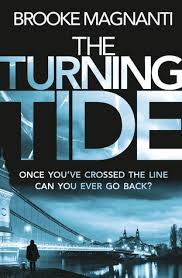
CTG Reviews: THE TURNING TIDE by Brooke Magnanti

Unknown

What the blurb says: “Erykah Macdonald has a nice life – the kind of life you’re meant to want. But on her twentieth wedding anniversary, she’s about to cross a line. Several hundred miles away in the shallow waters of a Hebridean island, a body is found. It’s been in the water long enough to make identification tricky but it’s clear this is no accidental death. Erykah knows she’s about to make a choice you can’t reverse – but she’s lived with secrets most of her life – she thinks she’s ready. The trouble is, there are far worse secrets than her own about to emerge. From the gurney of a morgue in the Highlands, to the media circus of the national press, and from the seemingly calm suburbs of London to the powerplays in Westminster, a net is tightening. And those that find themselves caught are willing to kill to get out with reputations intact. Erykah must work out what she’s capable of if she’s going to keep her head above water – she must leave behind her comfortable life and start breaking rules. She knows she should be scared … but sometimes, stepping over the line is the first step to freedom …”

Erykah Macdonald has spent over twenty years hiding from her past. She wears the right clothes, says the right things, and moves in the right social circles to hide in plain sight; but it isn’t enough. Her outwardly perfect life, and outwardly perfect husband, are not at all what they seem. Erykah feels trapped and has plans to break free, but on the day she decides to put her plan into action something unexpected happens, plunging her into a dangerous world of fraud, politics and murder.

What’s great about Erykah is that whereas a lot of people would have given up in the terrifying situation she finds herself in, she decides to use it as an opportunity. Smart and determined, she sets out to discover exactly what her husband has got them caught up in. As she digs further, she finds connections between her situation, the dead body washed up on a Hebridean island, and a wider political agenda.

Erykah is a great female anti-hero – she’s resourceful, determined and dynamic, and I couldn’t help but root for her.

Fast paced, with some fabulously witty observations, this is a gripping first thriller from Brooke Magnanti. Gritty and well researched, it touches on the 24 hour news culture, the trend around hounding and ‘outing’ people on social media and, through a vibrant cast of characters, explores just how far people will go to get what they want.

Packed with conspiracy, intrigue and political shenanigans THE TURNING TIDE is a cracking read and perfect for thriller fans.


THE TURNING TIDE is out now. You can buy it from Waterstones here and from Amazon here

To find out more about Brooke Magnanti hop on over to her website at www.brookemagnanti.com and follow her on Twitter @belledejour_uk 


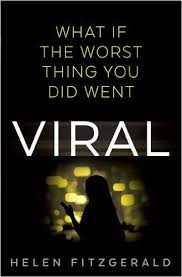
CTG Reviews: VIRAL by Helen Fitzgerald

Unknown

What the blurb says: “Leah and her adopted sister Su are almost the same age – but have always been opposites. Leah is wild and often angry, whereas Su is successful and swotty. When they go on holiday together to Magaluf to celebrate their exam results, it is Leah that their mother worries about – but it’s Su who doesn’t come home.

Su is on the run, humiliated and afraid: there is an online video of her, drunkenly performing multiple sex acts in a nightclub. And everyone has seen it.

Their mother Ruth, a successful court judge, is furious. How could this have happened? What role has Leah played in all this? How can she bring justice to these men who took advantage of her daughter? And can Ruth bring Su back home when Su doesn’t want to be found?”

This book has one hell of an opening line. It demands the reader’s attention, and once it has it, it keeps it, as the revelations just keep on coming throughout this fabulously twisty-turny thriller.

What I especially enjoyed about this book was the complex relationships between the characters. Leah and Su used to be close when they were little, but as they’ve grown into teenagers they’ve grown apart, with Leah becoming increasingly more hostile towards her adopted sister. At the same time, Ruth’s relationship with Leah has disintegrated and she feels a stronger bond with Su. When Su disappears, all these emotions reach boiling point, threatening to rip the family apart. Ruth is determined to get Su back at any cost – whether it’s to her job, her family or both.

Ruth devises a plan to find Su. She pulls strings, uses her police and court contacts to find out what she can, and tasks family members with tracking Su both online and in Magaluf. But as things go from bad to worse, and Ruth’s plan doesn’t play out the way she’d intended, and it appears that Su may have ideas of her own about what she wants to happen next.

This is a story where good people take bad decisions and where all actions have consequences, some of which reach much wider and are far more devastating than they could ever have imagined.

It’s a story about love, loss, simmering resentment and grief. It’s about needing to find who you are, what’s important to you, and carving out your own place in the world.

It’s also one hell of a rollercoaster ride thriller!


[With thanks to Faber for my copy of VIRAL]

Guest Post by crime writer SJI Holliday: The Long and Short of It

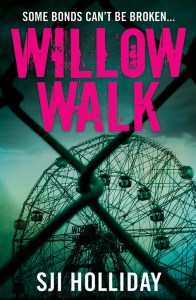
Willow Walk cover - medium

Today I’m handing over the reins at CTG HQ to my fabulous crime writer pal, SJI Holliday.

Over to you, Susi …

I’ve always been a big fan of short stories, writing hundreds of them before finally completing my first novel. There are pros and cons of starting with short stories when you’re beginning your new life as a writer. They help you edit, and stop you from overwriting – when a piece has word count of 1000, 2000, 3000 words, you can’t afford to waste them – you need the whole story to be told in that space so there’s no room for flabby prose. Also, entering competitions gets you used to dealing with deadlines, and the publications that ask for things to be sent in specific formats, gets you ready or working with an editor. Sort of. On the downside, when the longest thing you’ve written is 5000 words, a novel of 75k or more can be daunting. It took me a while to make the transition, and now, sadly, I have less time to write shorts, and I while I used to be brimming with ideas for short, snappy pieces, now I think of all my ideas as novels…

Anyway, the last proper short story I wrote was the one I sent to the very first CWA Margery Allingham comp in 2014 – quite a big deal, with a huge cash prize and the winner announced at CrimeFest. The brief was to write to Margery’s specification…

The Mystery remains box-shaped, at once a prison and a refuge. Its four walls are, roughly, a Crime, a Mystery, an Enquiry and a Conclusion with an Element of Satisfaction in it.’

My first novel, Black Wood, was out on submission, and I wasn’t ready to write another one yet, so I wrote a story about what my main character, Sergeant Davie Gray, got up to after the book ended… before he got embroiled in the next one. I sent him on holiday to Brighton for a week in the sun… some much needed relaxation after the terrible events that had recently befallen his home town. Only it didn’t work out like that. He barely had time to breathe in some refreshing sea air when before he got mixed up in a murder case that he could really do without. It was originally titled ‘Home from Home’ and it was shortlisted in the completion – an achievement I am still very proud of. It’s very hard to get noticed in the short story world, so if you write them, keep going – you’ll get there.

So I thought that now was a good time to release the story into the world – to whet your appetite before Willow Walk comes out in May. Poor Davie. I do make life hard for him. Wrack Line is a subscriber only short story – you give me your email, I send it to you on 18th March – along with an exclusive preview of Willow Walk. That’s it. Oh, and if you’re not sure what a ‘wrack line’ is – you’ll find out in the story…

Click here to sign up to receive the short story and preview – I don’t send out many newsletters, but when I do, they include book giveaways and lots of other cool bookish things – chocolate, notebooks, signed postcards… even jewellery! I’ll soon be announcing a draw for a signed copy of Willow Walk too…


Be sure to sign up for Susi’s newsletter because, trust me, you’ll not want to miss the chance to read Wrack Line. Sign up for it here – http://eepurl.com/beHpez

You can find out more about Susi and her books by hopping over to her website at http://www.sjiholliday.com/ following her on Twitter @SJIHolliday, and checking out her Facebook page at https://www.facebook.com/SjiHolliday/

To buy Black Wood from Amazon click here – http://amzn.to/1nCxIuV

To pre-order Willow Walk click here – http://amzn.to/1nCxQL9 (pre-order for kindle will appear on 18th March)


The #ThinIce Blog Tour: Icelandic Noir crime writer Quentin Bates talks rough justice

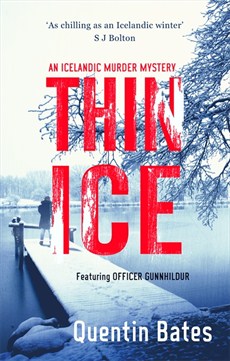
isbn9781472121509-detail

Today I’m delighted to welcome the charming Icelandic Noir crime writer Quentin Bates to the CTG blog as part of his THIN ICE Blog Tour. For this stop on his marathon tour, Quentin’s talking about the process of writing Thin Ice and rough justice.

Over to Quentin …

It’s not easy to write about Thin Ice. it was started so long ago, also finished so long ago that now I’m deep into another book and the details are starting to get hazy.

Thin Ice was started with the first couple of chapters written and then put aside while I finished something else (Summerchill, the novella that was published last year) and the Thin Ice characters gradually began to take shape in the background. Normally any time I had a long drive is when they’d start to come to life, with details scribbled down at motorway cafés.

It hinged on with Magni, the good-natured, burly, practically-minded former trawlerman down on his luck and lured into making a quick buck as hired muscle for a real criminal. That’s Össur, the wannabe crime kingpin who has the ruthless lack of scruples the role needs but not the brains, which is why he has always been angrily in the shadow of smarter criminals.

The other key characters, Erna and Tinna Lind, the two women Össur and Magni carjack when their escape to the sun goes so badly wrong, took a while to come together and there were a few false starts until the relationships between the four of them, stranded in a closed-for-winter upcountry hotel, started to gel. The alliances and animosities crystallised as hidden talents for survival appeared and the tensions ramped up over a large bag of stolen cash and the knowledge that the underworld as well as the police would be searching high and low for Össur and Magni.

I had written half the book and had no firm idea of how it would all come together before I started writing the police side of the tale. A good copper needs a respectable adversary, and once I had the bad guys in place, the parts played by Gunna and her two sidekicks, Helgi and Eiríkur, slotted in around the willing and unwilling fugitives, right up to the last fifty pages where things start to go badly wrong, or right, depending on your point of view.

I do like a good villain, but a decent villain can’t be entirely bad. There has to be something in there that you can sympathise with, as one-hundred-per-cent evil people with no redeeming features don’t exist. Or do they? Or are they just extremely rare?

Magni’s no genuine bad guy, just someone who agrees to do something stupid after a run of bad luck and a few beers. Össur really is bad, but with a past like his and the old trauma that makes him sweat with fear every time he sits in a car, the reader gets an insight into why he’s as screwed up as he is.

The bad guys are the ones who are fun to write. They can range from outright evil to mildly flawed, with every kind of variation between the two extremes and can go off on odd tangents, while the sleuths need to be fairly sensible – well, most of the time. That’s not to say I’m not deeply fond of my rotund heroine (even though I give her a rough time of it) and her colleagues and family, because I am. But a good villain and a crime is what sets the ball rolling.

I also like a villain who gets away with it. That’s the way things happen in real life as criminals all too frequently get away with the goods and live happily ever after, especially if they can afford good lawyers. I know that’s not to everyone’s taste and a majority of readers like to see justice being done. So while I also like to dish out justice, the form it takes might take you by surprise.

So is there justice in Thin Ice? Do the bad guys get off scot-free or does Gunna get her man? Let’s just say there’s some justice done, but it’s not what you might expect.

THIN ICE is published now. Here’s the blurb: “Snowed in with a couple of psychopaths for the winter … When two small-time crooks rob Reykjavik’s premier drugs dealer, hoping for a quick escape to the sun, their plans start to unravel after their getaway driver fails to show. Tensions mount between the pair and the two women they have grabbed as hostages when they find themselves holed upcountry in an isolated hotel that has been mothballed for the season. Back in the capital, Gunnhildur, Eirikur and Helgi find themselves at a dead end investigating what appear to be the unrelated disappearance of a mother, her daughter and their car during a day’s shopping, and the death of a thief in a house fire. Gunna and her team are faced with a set of riddles but as more people are quizzed it begins to emerge that all these unrelated incidents are in fact linked. And at the same time, two increasingly desperate lowlifes have no choice but to make some big decisions on how to get rid of their accident hostages …”

To find out more about Quentin Bates and his books pop on over to his website at www.graskeggur.com and follow him on Twitter @graskeggur

You can buy THIN ICE from Waterstones here, or from Amazon here

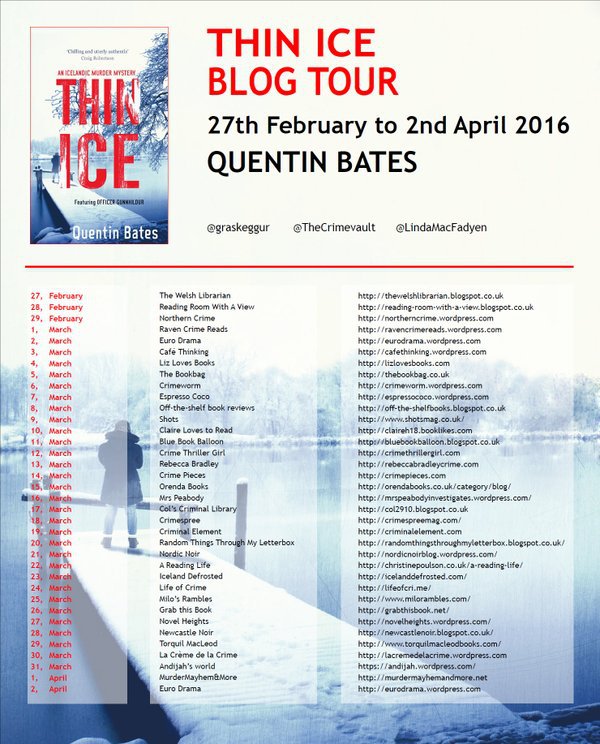
And be sure to check out all the fabulous stops on the THIN ICE Blog Tour …

thin-ice

CTG Reviews: Time of Death by Mark Billingham

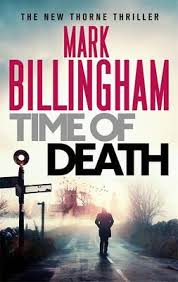
Unknown

To celebrate TIME OF DEATH being published in paperback today I thought I’d re-run my review …

What the blurb says: “The Missing: Two schoolgirls are abducted in the small, dying Warwickshire town of Polesford, driving a knife into the heart of the community where police officer Helen Weeks grew up, and from which she long escaped. But this is a place full of secrets, where dangerous truths lie buried.

The Accused: When it’s splashed all over the press that family man Stephen Bates has been arrested, Helen and her partner Tom Thorne head to the flooded town to support Bates’ wife – an old school friend of Helen’s – who is living under siege with two teenage children and convinced of her husband’s innocence.

The Dead: As residents and media bay for Bates’ blood, a decomposing body is found. The police believe that they have their murderer in custody, but one man believes otherwise. With a girl still missing, Thorne sets himself on a collision course with local police, townsfolk – and a merciless killer.”

So, declarations first, I have to confess that I’m a huge fan of Mark Billingham’s Tom Thorne series and so I couldn’t wait to read this book when it came out in hardback.

This story takes Tom out of his usual city surroundings on a visit to the countryside for a romantic break with his partner Helen Weeks. But it doesn’t stay a relaxing holiday for long. When Helen recognises the wife of the man accused of the abduction of two schoolgirls from a small Warwickshire community, their holiday is cut short as they head to Polesford for Helen to support her old school friend who is in the grips of a suffocating media presence, and whose community, and social media, is vilifying her and her family.

With Helen preoccupied with her friend and acting increasing distant, Tom does what fans of the series might anticipate – he starts to look at the facts of the case, at first piquing the interest of the local police, and then (as he spots the holes in their evidence and theories) becoming an irritant. Once he realises the investigation isn’t as thorough, and the case as well proven, as the locals are saying, he’d determined to find out the truth behind the abductions and get to the remaining missing girl before it’s too late.

Taking Thorne out of his London comfort zone is genius move. He hates the countryside, especially the thought of antiquing and walking, but through the course of his (unofficial) investigation he has to embrace everything the area has to throw at him – floods, pigs, a lot of characterful locals, and the kind of claustrophobic environment where everyone knows each other’s business.

Being the outsider, and not officially involved in the case, he’s able to follow his instincts unchecked, and starts to find he’s actually rather enjoying his holiday. He even manages to entice his friend, and talented Pathologist, Phil Hendricks, out from the city to help him. They still haven’t really spoken about what happened on Bardsey Island (in the previous book The Bones Beneath) and the personal cost to Phil (and Thorne) that resulted, but their friendship is a strong as ever and their banter is, as always, a joy to read.

TIME OF DEATH is filled with mystery and intrigue from the abduction case Tom is investigating, it also layers on a growing sense of unease that coming back to the place she grew up has unearthed some deeply buried secrets that Helen has kept well hidden. The consequences of both will have ramifications for Helen and Tom.

Masterfully written, this is another fabulous instalment in what I think is the best police procedural series around today.

This was one of my top reads of 2015, and is an absolute must read for crime fiction fans.


You can find out more about Mark Billingham by hopping over to his website at www.markbillingham.com and be sure to follow him on Twitter @MarkBillingham

TIME OF DEATH is out now in paperback. You can buy it from Waterstones here, or from Amazon here


[with thanks to Sphere for my copy of Time of Death]

CTG Interviews: Sanjida Kay about BONE by BONE

Image 01-02-2016 at 12.17 (1)

Today I’m delighted to welcome writer and broadcaster Sanjida Kay to the CTG blog to talk about her book BONE BY BONE, her writing process and why she loves crime fiction.

Her debut psychological thriller BONE BY BONE is out now. Here’s the blurb: “How far would you go to protect your child? When her daughter is bullied, Laura makes a terrible mistake… Laura is making a fresh start. Recently divorced and relocated to Bristol, she’s carving a new life for herself and her nine-year-old daughter, Autumn. But things aren’t going as well as she’d hoped. Autumn’s sweet nature and artistic bent are making her a target for bullies. When Autumn fails to return home from school one day Laura goes looking for her and finds a crowd of older children taunting her little girl. In the heat of the moment, Laura is overcome with rage and makes one terrible mistake. A mistake that will have devastating consequences for her and her daughter…”

Now, to the interview …

What is your favourite genre to read?

Psychological thrillers! Although I do like the odd classic and work of literary fiction too!

Who is the biggest influence on your writing?

The writer that has most influenced me is Emily Brontë and, in particular, her novel, Wuthering Heights. I’m haunted by the relationship between Heathcliff, Cathy and Edgar Linton; the Gothic savage beauty of the moors and the undercurrents of class, racism and misogyny.

Margaret Atwood is another great influence because of the way she weaves science and politics into her work. I prefer her later books, Oryx and Crake and Year of the Flood, for their creativity, environmental themes and because her writing has a lightness of touch it lacked when she was younger. Cormac McCarthy is one of my favourite novelists; he writes about the landscape and nature in such an elemental way, as if human nature were allied to it. And Henry James, especially The Golden Bowl, for his understanding and subtle portrayal of how people think about what others are thinking about them.

What inspired you to write Bone by Bone?

Just after I had my own daughter, I used to take her out in the buggy to get her to go to sleep. I felt incredibly vulnerable – recovering from the birth, on my own and now responsible for a tiny, fragile newborn.

I started to imagine a character who has a much older daughter than mine, but feels vulnerable, isolated, lacking in confidence all the time. And I imagined what would happen if that person found out that her daughter was being bullied. She would want to protect her child with all her heart – like any parent – but she might not have the resources – particularly if there’s nothing the bully won’t do to her child.

What were some of the challenges you faced whilst writing this novel?

It’s incredibly upsetting to write about bullying, both from the point of view of a parent and a child. Every time I read through a draft of my novel, I would cry. From a technical perspective, it was challenging to put myself in the head of a nine-year-old, especially as it’s a long time since I was nine!

You’re Bristol-based – how does the city inspire your work?

I’ve always been inspired by landscape and the natural world and it features heavily in my fiction. When I came to write Bone by Bone, I thought I’d aim for a gritty urban landscape, graffiti-ridden and litter-strewn, in Bristol, where I live.

What actually happened was that I ended up placing most of the action in a tiny urban nature reserve!

The lines began to sing, a shrill, electric song, and then the cacophony of the train roared out of the darkness. The carriages were almost empty and painfully bright as they hurtled along the tracks to the heart of the city. In the fleeting light she saw the meadow, dotted with stunted hawthorns, their twisted limbs dense with red berries, and then a shape: achingly familiar, child-sized, shockingly still.

Bone by Bone is set in a mad mixture of two areas in Bristol: Montpelier and St Werburghs. For those who know Bristol intimately, it’ll be obvious that some of my descriptions are realistic but that I’ve shunted whole sections of the landscape around to make my plot work!

IMG_2315

Do you feel that multiculturalism is sufficiently represented in the current literary climate?

I think it’s lacking. I’m mixed race and I rarely see my experience portrayed in the books I’m reading. In psychological thrillers, which are very middle-class, the majority of authors and characters within them are white. I include racial diversity and prejudice in my novels as standard – rather than writing stories that are solely about race.

Bone by Bone places the parent’s perspective at the forefront of the narrative. Did you feel it was important to represent Laura’s point of view?

It’s hard for any parent to see their child being hurt, whether it’s because they’re picked on at school or they fall and hurt their knee. On the one hand, we want to protect our children, and on the other, we want them to grow in courage, independence and confidence so they can survive the bumps and bruises the world throws at them. It’s a difficult balancing act, for parents and children.

Do you feel that the public is suitably aware of the continual issue of bullying? Do you think that children are provided with adequate support?

I’m delighted to announce that I’m donating a percentage of the profits from my thriller, Bone by Bone, to the anti-bullying charity, Kidscape. The NSPCC says that almost half of all children are bullied. I don’t think parents are aware the figures are so high – nor do most people know what to do about cyber-bullying, which is increasing. Kidscape has some fantastic resources for schools, carers, parents, children and young people.

How would you describe a typical working day?

I start my writing day by exercising – writing is such a sedentary job, I need a bit of a buzz and some movement before I begin! Then I have a strong coffee and start! I aim to write at least 1,000 words a day during the writing period. I have set hours for writing – I love it but I treat it like a job. I spend at least three days a week working on my novels. Usually I write in my office, which is lovely. It’s all white with botanical prints and an oak desk. It looks out over the allotments that feature in Bone by Bone. I need peace and serenity to help me write. Sometimes I’ll go to a cafe and write too – if they do good coffee and cake! It’s a welcome contrast to the monastic stillness of my office. If I get stuck, I grit my teeth and force myself to sit in front of my computer screen. When I need to think big or wrangle with a knotty plot problem, I’ll go for a long walk.

What are some of your favourite contemporary thrillers?

Gone Girl has an incredible plot, the characters are chillingly Machiavellian and the prose is pitch-perfect for this kind of thriller. Flynn’s previous novel, Sharp Objects, doesn’t have such a rollercoaster plot, but it’s much edgier with a searing twist; perfect Southern gothic-noir. I loved Peter Swanson’s The Kind Worth Killing, Maggie Mitchell’s Pretty Is and The Black-Eyed Susans by Julia Heaberlin. The prose in Jane Shemilt’s, Daughter and The Drowning Lesson is beautiful. On my bedside table is Holly Seddon’s Try not to Breathe.

A big thank you to Sanjida Kay for talking to us all about BONE BY BONE and her own writing process.

To find out more about Sanjida check out her website at www.sanjida.co.uk and follow her on Twitter @SanjidaOConnell

BONE BY BONE is out now. You can order it from Waterstones here, or from Amazon here.
 

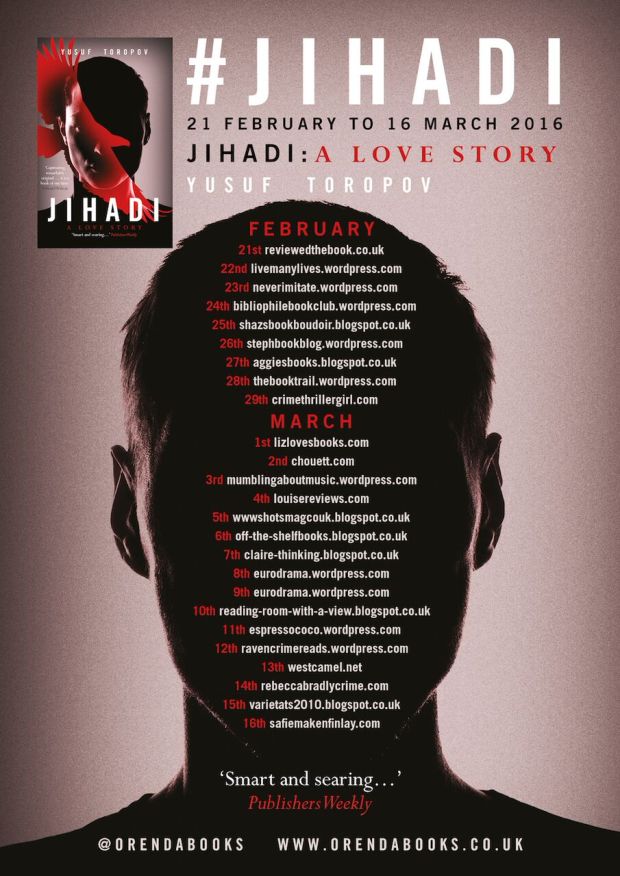
The #JIHADI Blog Tour: PANTSER OR PLOTTER? MY JIHADI BREAKTHROUGH by Yusuf Toropov


unspecified-2

It’s a real pleasure to welcome Yusuf Toropov to the CTG blog. Yusuf is an American Muslim writer, he’s authored and co-authored a number of non-fiction books and has had plays produced off-Broadway. His highly acclaimed debut novel – Jihadi: A Love Story – is published by Orenda Books and is out now.

Today, Yusuf’s kindly agreed to talk about his experience of writing a novel, and whether he’s a pantser or a plotter …

There are, Plot Whisperer author Martha Alderson tells us, two kinds of fiction writers: writers who navigate by the seat of their pants, making stuff up as they go along, often without any clear sense of where a scene might actually belong in the book’s sequence … and writers who delight in plotting out events, conflicts, and resolutions ahead of time before attempting to actually write a scene.

Martha’s right. If you’re a writer, you either want to know where the scene fits in your running order before you start to work on it, or you don’t. You’re one or the other, a Pantser or a Plotter. ‘Yeah but I’m both, yeah but I’m neither, yeah but yeah but yeah but.’ Ssh. It’s true. Now just keep reading. If you write fiction, there’s a breakthrough waiting for you here, the same one Martha made possible for me, and the only way for you to get it is to assume for a moment that you do lean one way or the other. And trust me. You do. This is just the reality of writing stories.

Alderson’s book, which you should read if you are writing a novel or even thinking about doing so, makes two important points about all this. First and foremost, you need to figure out which of the two groups you fall into.

I am a classic Pantser. I’m the guy who stumbles ahead without letting the fact that I haven’t set up much of a plot yet stop me. Even if there is a clear plot structure to a story I’ve been working on for a while, I tend to try to forget about it while I’m writing. I actually prefer the sensation of not having the least clue where a given scene is going. I love accidents, and I get some of my best stuff from noticing when something that I tried came out wrong – but interesting.

Case in point: the character Fatima Adara, from my novel Jihadi: A Love Story. Most people tell me she’s the most memorable thing about the book. Yet I stumbled across her. She was supposed to appear in one scene. I wrote about 50,000 words of the novel before I realized that she was a major character. (They weren’t all good words – I threw about half of them out.)

You read right: 50,000 words. Now, if you’re a Plotter, I suspect you just cannot imagine yourself investing the word counts that I did in a story that hadn’t yet identified all of its major characters. And you know what? You’re right. I probably shouldn’t have. At that point, I was traveling without a map. Which brings us to Alderson’s second big point, and the breakthrough she made possible for me and, maybe, for you.

It is this: Once you know which writing camp you fall into, Pantser or Plotter, you have to make a conscious effort to compensate for certain inherent weaknesses you bring to the table as a writer.

unspecified-3

If you’re a Plotter, Alderson asks you to consider that your likely weaknesses as a writer include the following: Compelling emotion may be lacking from some of your scenes. Ring any bells? Plotters, this is for you. In addition to plotting, you need to push yourself outside your comfort zone. You need to go beyond outlining. You need to find a way to experience, on a personal level, what your protagonist is experiencing. You need to notice what that obstacle she’s encountering feels like, on a sensory level, not just on an analytical level. You need to be there personally and get hurt, fall in love, be terrified, whatever. You need to experience whatever is happening first-hand if you really want to write about it. (This is something that Pantsers usually have no problem with, by the way.) You’ve got to put yourself into the character’s situation, live the scene, and notice what the emotion feels like before you start writing. Otherwise, you may ‘finish’ your book, but you may find that it is filled with scenes that don’t actually engage the reader on a gut level. Ouch.

If you’re a Pantser (like me) your likely weakness looks like this: You may never finish the damn book, because you’re ‘writing’ without a structure – travelling without a map. Pantsers, this is for you (and me): You just don’t like establishing specific plot points and themes ahead of time. You say it ‘handcuffs’ you. If you do ‘finish’ the book, though, you may find that Act Three has little or nothing to do with Acts One and Two. Again: Ouch. This was my big weakness as a writer, and overcoming it was my breakthrough. I really, really did not want to bother with setting up a Plot Planner (Alderson’s primary writing tool) when I began reading her book, but by the time I was done with it, I knew I had to go outside my comfort zone. So I identified the five essential Alderson turning points for my story, and I put them up on the wall, using her Plot Planner tool. On that wall, I started laying out a clear sequence of scenes, in outline. (A first for me.) Doing all this was not my first instinct. It wasn’t how I was used to writing. But it needed to happen.

As a result of going out of my comfort zone, I figured out, not only that Fatima was independent, intelligent, and a devout Muslim, but also what the big decision ended up making in Act Three of my novel was, and how it needed to be set up in Act One. Also how she connected to the novel’s themes. Also what, specifically, she heard in the very first scene she was in that affected my protagonist in Act Two. All that stuff I didn’t know before I completed my Plot Planner, and I have Martha to thank for it.

You can buy Martha Alderson’s indispensable book The Plot Whisperer here. You can buy Jihadi: A Love Story, on which I might still be working if it hadn’t been for Martha’s work, here.

A huge thank you to Yusuf for talking with us today about his writing process and how he wrote his debut novel – Jihadi: A Love Story. As a fellow pantser, I’m heading over to check out The Plot Whisperer right now!

I also highly recommend you check out Jihadi: A Love Story. Here’s the blurb: “A former intelligence agent stands accused of terrorism, held without charge in a secret overseas prison. His memoir is in the hands of a brilliant but erratic psychologist whose annotations paint a much darker picture. As the story unravels, we are forced to assess the truth for ourselves, and decide not only what really happened on one fateful overseas assignment, but who is the real terrorist. Peopled by a diverse and unforgettable cast of characters, whose reliability as narrators is always questioned, and with a multi-layered plot heaving with unexpected and often shocking developments, Jihadi: A Love Story is an intelligent thriller that asks big questions. Complex, intriguing and intricately woven, this is an astonishing debut that explores the nature of good and evil alongside notions of nationalism, terrorism and fidelity, and, above all, the fragility of the human mind.”

The Jihadi: A Love Story Blog Tour is running now. Be sure to pop over to all the wonderful stops …

unspecified