The #EpiphanyJones Blog Tour: Michael Grothaus talks about The Importance of Dissatisfaction In Writing Well

unspecified-3

Today I’m delighted to be hosting a stop on The Epiphany Jones Blog Tour, and am handing over the hot seat here at CTG HQ to  Michael Grothaus to talk about why dissatisfaction is important in writing well.

Michael is a novelist and journalist who spent years researching sex trafficking, research which is put to use in his debut novel EPIPHANY JONES. Born in Saint Louis, Missouri, he has a degree in filmmaking, and as a journalist writes about creativity, tech, subcultures, sex and pornography, and the effects of mass media on our psyches.

Over to Michael …

The Importance of Dissatisfaction In Writing Well

In my novel EPIPHANY JONES there are two main characters. There’s Epiphany, for whom the book is named after, and then there’s Jerry Dresden. As you’ll soon discover when you start to read the book, Jerry isn’t in a good place when the story begins. He suffers from a horrible psychological affliction where he sees people who don’t really exist and he can interact with them—having conversations, even being able to “feel” them when he “touches” them—as easily as you or I can interact with each other.

But perhaps what’s worse is Jerry is also an addict, but instead of the usual addictions novelists write about—booze, drugs—Jerry has a porn addiction. But as with most addictions, Jerry’s addiction to porn comes from trying to dull the pain of past tragedy. Because of his psychological afflictions and addiction Jerry can be a pretty cynical, dissatisfied, angry guy.

When people finish reading the book, I’m not really surprised to hear them say “I started off not wanting to hang out with Jerry, but by the end of the book I loved him.” What does surprise me is more than a handful of people have added “You seem like such a nice, happy guy, Michael; I had no idea you had that much anger in you.” And some even then add “So, were you addicted to porn?”

unspecified-5


Now for the record: no, I’ve never had a porn addiction. But, hey, you write a first person story about a guy who has a porn addiction and some readers are just going to think it’s autobiographical. I get that. I do.

But what those same readers are right about is the anger. That dissatisfaction Jerry feels? That comes from me—at least part of it. And that dissatisfaction, I believe, is essential to being a good writer. Why? Because I’ve never met anyone who was completely satisfied, content, and happy who could write well.

I know people who want to “be writers” (whatever that means) who are wealthy, or privileged and never wanted for anything, or have never had a health problem, or never experienced significant loss—and none of them can write well. I know people who don’t care about politics, or the environment, or poverty, of the suffering that goes on around the world—and none of them can write well.

These people are not bad or stupid or foolish—indeed, they are all very fortunate (or lucky). Yet because of this rare good fortune they lack dissatisfaction, which is the single most important resource that writers have—if they use it wisely. Dissatisfaction spurs anger and anger can be used productively. Productively, it’s what gets you in front of your keyboard to write a story holding a mirror up to society so it can see itself as it really is. It’s what spurs you to write characters that challenge readers’ assumptions about why people are the way they are. It’s what allows you to create worlds as which you wish ours would be (or warn against what ours may become).

We would not have the masterpiece 1984 if George Orwell was not dissatisfied with the imperialism of his own government and the totalitarianism of other governments. We would not have THE GLASS BEAD GAME had Hermann Hesse not been dissatisfied with the lack of individualism among intellectual elites. And we would not have THE GREAT GATSBY had Scott Fitzgerald not been dissatisfied with the failure of the American dream.

As for me, I’m dissatisfied with things in life: our obsession with celebrities when there are real issues to pay attention to; the prevalence of sex trafficking that goes mostly unnoticed; the hypocrisy of those who condemn people with addictions but have their own vices securely locked away from prying eyes.

And yes, I’m happy too. But I’m also happy to be dissatisfied where dissatisfaction is justified. Dissatisfaction is a powerful tool for creativity and you can’t write well without it.


Big thanks to Michael for chatting to us on the CTG blog today.

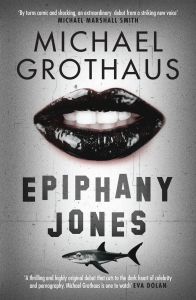
Michael’s debut novel EPIPHANY JONES is out this month. Here’s what the blurb says: “A man with a consuming addiction. A woman who talks to God. And the secret connection that could destroy them both … Jerry has a traumatic past that leaves him subject to psychotic hallucinations and depressive episodes. When he stands accused of stealing a priceless Van Gogh painting, he goes underground, where he develops an unwilling relationship with a woman who believes that the voices she hears are from God. Involuntarily entangled in the illicit world of sex-trafficking amongst the Hollywood elite, and on a mission to find redemption for a haunting series of events from the past, Jerry is thrust into a genuinely shocking and outrageously funny quest to uncover the truth and atone for historical sins. 

A complex, page-turning psychological thriller, riddled with twists and turns, Epiphany Jones is also a superb dark comedy with a powerful emotional core. You’ll laugh when you know you shouldn’t, be moved when you least expect it and, most importantly, never look at Hollywood, celebrity or sex in the same way again.”

To find out more about Michael Grothaus visit his website here and follow him on Twitter @michaelgrothaus

You can buy EPIPHANY JONES by clicking the link here to go to Waterstones or click here to go to Amazon

And be sure to check out all the other great stops on the blog tour:

unspecified-4

#MyGirl Blog Tour: a sneak peep at Chapter One of MY GIRL by Jack Jordan

CknFWlEW0AAsX9N

Today I’m joined on the CTG blog by Jack Jordan, bestselling author of Anything for Her and My Girl. To celebrate the worldwide release of his second thriller My Girl on 4th July, he’s letting CTG blog readers into a sneak peep and sharing the first chapter with us here at Crime Thriller Girl. 

To get you in the mood, here’s the blurb:

“Paige Dawson: the mother of a murdered child and wife to a dead man. 

She has nothing left to live for… until she finds her husband’s handgun hidden in their house.

Why did Ryan need a gun? What did he know about their daughter’s death?

Desperate for the truth, Paige begins to unearth her husband’s secrets.

But she has no idea who she is up against, or that her life isn’t hers to gamble – she belongs to me.

From the bestselling author of Anything for Her, Jack Jordan’s My Girl is the new chilling thriller that you won’t want to miss.”


And now, the first chapter …

1

For the first few seconds after she woke, Paige Dawson lived in a world where her husband Ryan was snoring lightly beside her, and her daughter Chloe was sleeping peacefully in the next room. When reality slowly trickled in, she instantly wanted to return to sleep – to forget they were dead – to stop the tears from rolling down her cheeks.

As her eyes adjusted to the room, she coughed violently. Stale smoke sat in the air. Worn clothes lay crumpled on the living room floor, smelling of damp and old sweat. Cigarette ash had been trodden into the carpet. A photo frame faced the ceiling. Ryan smiled from behind the cracked glass; a time when he was happy – before he slashed his wrists.

Get up. You need to get up.

She reached down to the carpet and patted around the mess in the dark until she found the tray of tablets. It shook in her hands as she popped each pill through the foil: one, two, three. She placed them on her dry tongue, picked up the half-empty wine bottle from the floor and took a swig. The wine was warm, but it did the job. The diazepam would kick in soon.

As she sat up, pain exploded in her temples. She lit a cigarette, cringed with the first toke, and stared at the daylight creeping from behind the closed curtains. The real world was taunting her: you can’t hide away from me forever.

The smell of sick filled the house. How long it had been in the house with her: a night? A week? She wondered if there would be blood in it again.

What would Chloe think if she saw me like this?         
Chloe would have been twenty-four years old by now. Her severed arm had been found in the river, her fourteen-year-old fingertips breaking through the surface. They never found the rest of her body, nor did they find the person who killed her. The forensics team had tested her blood: she had been alive when her murderer began chopping her up.

The diazepam wasn’t working fast enough. She could still feel the painful void in her chest; she could still see her husband’s blood swirling around in the bathwater. If she closed her eyes, Ryan’s lifeless eyes flashed in front of hers.

She snatched the packet of codeine from the side table and swallowed two tablets with more wine.

When she lifted the cigarette to her lips, she found it wasn’t there. She peered over the edge of the sofa and saw the cigarette burning a black hole into the carpet.

Maybe the diazepam is working.

She picked up the cigarette, spat on the blackened carpet, and gave it a rub with her finger, as though she had kissed a child’s plastered graze. There. All better.

She spotted Ryan watching her from the mess on the ground, his lips frozen in an eternal smile.

However hard she tried, she couldn’t remember the last time she kissed those lips. She couldn’t remember when the kisses stopped, or when the distance started.

She shook the thought from her head and stumbled into the kitchen.

The bin was bulging with weeks of waste. Empty wine bottles lined the wall by the back door. Loud, languid flies buzzed around in hopeless circles. An uneaten meal sat in a pan on the stove, discoloured and congealed. She couldn’t even remember cooking it, let alone forgetting to eat it.

The last time she had looked into Ryan’s eyes while he was alive, he had been pinning her to the floor with his body as he forced a slice of bread into her mouth. His frustrated tears fell onto her face as he begged her to eat. He only stopped when the bread lodged in her throat. He had freed the blockage with fingers bent like a fishhook and then, as she gasped for air, he had sobbed from where he lay on the carpet, with bits of bread and saliva coating his fingers.

She wasn’t starving herself – she just forgot to eat.

The sound of the key turning in the lock made her jolt. Her mother-in-law gasped. Shame turned in Paige’s gut.

Greta stood in the doorway with her eyes on the mess.

‘Paige, this is…’

‘I was about to clean up,’ she replied as she returned to the living room.

Greta placed her bags by the door. She looked reluctant to close it, to say goodbye to the fresh air, but when she did, it slammed.

‘How could you let it get this bad?’

Greta threw open the curtains. Paige squinted as daylight burst into the room.

‘Are those burns on the carpet?’

As Greta rifled through the mess, Paige wondered how the woman before her held herself together. Her hair had been set at the salon, her make-up was perfect, her clothes were ironed and fresh. No one would have known that her only son had committed suicide just two months before.

‘I expected better from you, Paige.’

Paige glanced at herself in the mirror above the fireplace and saw greasy auburn hair, streaks of mascara hardened on her cheeks, the stained nightgown stuck to her body with sweat. She looked older than her forty-two years.

‘I don’t know why, but I had a feeling you might have changed the locks.’

‘I wouldn’t do that.’

Greta spotted the photo of Ryan, hidden beneath the cracks in the glass. She sighed and took it in her hands. For a moment her frown disappeared, and she looked almost beautiful. She stood the photo frame on the coffee table and looked back to Paige. The frown immediately returned.

‘Not up to cleaning yet?’ Greta asked, as she picked up her bags and carried them into the kitchen.

‘I’ve got other things on my mind,’ Paige replied, following her into the kitchen.

‘Shall I? I’ve done your food shopping, so I might as well do your cleaning.’

Paige held her resentment back. ‘I was just heading out.’

‘Presumably after you’ve showered.’

She looked Paige up and down again.

‘Obviously.’

‘I will clean while you’re out, then.’

‘If that would please you, Greta.’

‘It would. Ryan would want me to look out for you.’

‘Thanks.’

Greta looked around the mess for other aspects to criticise. Paige waited patiently, longing to be alone.

‘Are you sleeping on the sofa?’

‘For now.’

‘Imagine if one of your neighbours should walk past and see you.’

Greta went into the living room to stare at the mess again, lost at where to start. Paige followed behind her.

‘I don’t care what people think of me.’

‘Clearly. I can’t remember the last time I saw you clean and dressed.’

 ‘That’s the thing with being a widow, you focus on the death of your partner, rather than what people think of you.’

‘Well, if I were you—’

‘But you aren’t, Greta.’

They stared at each other, like two cats about to fight. They stood in silence for a while, their eyes locked.

‘You said you were off out?’

‘Doctor’s appointment.’

‘Who is it you see?’

‘Dr Abdullah.’

‘Ah yes, the Muslim fellow. I prefer Dr Phillips. She’s Christian.’

‘Dr Abdullah is a Christian, too, I believe.’

‘Really? Still, I prefer Sally. She has a kind air about her, and presents herself well.’ Greta looked her up and down as she spoke.

‘Well, I’ll leave you to it.’

‘Yes. I’d better start cleaning, before this place becomes infested with rats.’ Greta picked up an ashtray from the coffee table. ‘Must you really smoke in the house? Ryan would have never allowed it.’

‘Well Ryan’s dead now, isn’t he? So I’ll smoke in my house if I want to.’

Greta flinched, but held her tongue.

‘Thanks for the food,’ Paige said, and made for the stairs.

The moment she got upstairs, she turned on the shower and retrieved the bottle of wine she had hidden under her bed. She certainly wasn’t going to step out into the real world without help.

Paige returned to the bathroom and locked the door behind her. She peeled off the nightgown that stuck to her like a second skin, sat on the toilet and drank wine straight from the bottle as steam filled the room. She stared at the bath and saw Ryan’s lifeless body lying in the red water, his vacant eyes locked on hers. Paige clenched her eyes shut and shook her head.

He’s not real. He’s gone.

When she opened her eyes again, the bath was empty. Ryan was gone.

She checked her urine: blood again. She flushed the blood from the toilet, and the thought from her mind. She couldn’t think about that right now.

As she breathed in the thick, hot mist, and drank warm wine from the bottle, she began to cry silent tears: she could never escape the fact that she was the mother of a murdered child and wife to a dead man.

Jack Jordan

Jack Jordan

A big thank you to Jack Jordan for sharing the first chapter of his latest thriller – MY GIRL – here on the CTG blog.

You can pre-order your copy of My Girl for Kindle, here. Paperback available worldwide, 4th July 2016.

You can grab your copy of Jack’s first thriller, Anything for Her, here.

 To find out more about Jack Jordan and his books head on over to www.jackjordanofficial.co.uk and follow him on Twitter @_JackJordan_


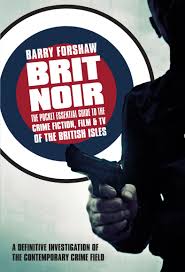
CTG Reviews: BRIT NOIR by Barry Forshaw

download

What the blurb says: “Barry Forshaw is acknowledged as a leading expert on European crime fiction, but his principal area of expertise is the crime arena of the British Isles. Continuing the earlier success of the series with Nordic Noir and Euro Noir, he now returns home to produce the definitive reader’s guide to modern British crime fiction. Every major living writer of the British Isles is considered, often through a concentration on one or two key books, and many exciting new talents are highlighted for the reader. And as the crime genre is as much about films and TV as it is about books, Brit Noir celebrates crime on the screen as well as the page.”

There isn’t anything that Barry Forshaw doesn’t know about crime fiction, so this gem of a book is like having your very own, personal crime fiction guru right at your fingertips.

This pocket guide to  crime fiction takes you on a bookish journey across the UK, and also showcases writers who set their books further afield. Taking each geographical area in turn, Barry Forshaw profiles many of the writers and characters who inhabit them, giving insight into both the writer, the characters and what it is about the authors books that especially stand out for him. By taking the journey with him you’re sure to add many more books to your ‘must read’ lists and films/TV series to your watchlist.

A treasure trove of a read – BRIT NOIR is the perfect reading companion for all those who love the crime fiction genre.


BRIT NOIR is out now. Click here to buy it from Waterstones or to buy it from Amazon click here

Barry Forshaw is one the leading experts on crime fiction, TV and film. His books include Nordic Noir, Euro Noir, Sex and Film, The Rough Guide to Crime Fiction, along with books on HG Wells and Stieg Larsson. He writes for the national press, edits Crime Time (www.crimetime.co.uk) and is a broadcaster and panellist. He teaches the history of crime fiction on the MA in Creative Writing (Crime Fiction) at City University. Follow Barry on Twitter @BarryForshaw3

#DontYouCry Blog Tour: Read an exclusive extract of Mary Kubica’s DON’T YOU CRY

Blog Tour Banner

This morning I’m delighted to be hosting a stop on Mary Kubica’s DON’T YOU CRY Blog Tour and to be sharing an exclusive extract from the book with you.

Drumroll please …

The day we met, she asked me about my job and whether or not I’d be able to afford my half of the rent. That was Esther’s only qualification, that I pay my own way. “I can,” I promised her, showing my latest paycheck as proof. Five-fifty a month I could do. Five-fifty a month for a bedroom of my own in a walk-up apartment on Chicago’s north side. She took me there, down the street from the bookshop, just as soon as she finished reading to the tiny tots who pilfered from us the blood-orange poufs. I listened to her as she read aloud, taking on the voice of a bear and a cow and a duck, her voice pacifying and sweet. She was meticulous in the details, from the way she made sure the little ones were attentive and quiet, to the way she turned the pages of the oversize book so all could see. Even I found myself perched on the floor, listening to the tale. She was enchanting.

In the walk-up apartment, Esther showed to me the space that could be my room if I so chose.

She never said what happened to the person who used to live there in the room before me, the room I would soon inhabit, though in the weeks that followed I found vestiges of his or her existence in the compact closet in the large bedroom: an inde­cipherable name etched into the wall with pencil, a fragment of a photograph abandoned on the vacant floor of a hollow room so that all that remained on the glossy image was a wisp of Es­ther’s shadowy hair.

The scrap of photo I did away with after I moved in, but there was nothing I could do to fix the closet wall. I knew it was Esther’s hair in the photograph because, like the hetero­chromatic eyes, she had hair like I’d never before seen, the way she bleached it from bottom to top to get a gradual fade, dark brown on top, blond at the bottom. The tear line on the pic­ture was telling, too, the barbed white of the photo paper, the image gone—all but Esther.

I didn’t toss the photo, but rather handed it to Esther with the words, “I think this is yours,” as I unpacked my belong­ings and moved in. That was nearly a year ago. She’d snatched it from my hand and threw it away, an act that meant nothing to me at the time.

But now I can’t help but wonder if it should have meant some­thing. Though what, I’m not so sure.


Brilliant! I can’t wait to read more!

DON’T YOU CRY is out now. Here’s what the blurb says: “In downtown Chicago, a young woman named Esther Vaughan disappears from her apartment without a trace. A haunting letter addressed to My Dearest is found among her possessions, leaving her friend and roommate Quinn Collins to wonder where Esther is and whether or not she’s the person Quinn thought she knew. Meanwhile, in a small Michigan harbour town an hour outside Chicago, a mysterious woman appears in the quiet coffee shop where 18 year old Alex Gallo works as a dishwasher. He is immediately drawn to her charm and beauty, but what starts as an innocent crush quickly spirals into something far more dark and sinister. As Quinn searches for answers about Esther, and Alex is drawn further under the stranger’s spell …”

To buy the book click here to go to Waterstones, or go to Amazon by clicking here

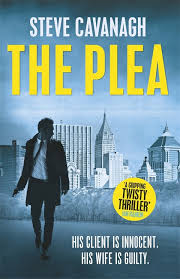
CTG Reviews: THE PLEA by Steve Cavanagh

Unknown

Here’s what the blurb says: “When David Child, a major client of a corrupt New York law firm, is arrested for murder, the FBI ask con-artist-turned-lawyer Eddie Flynn to secure Child as his client and force him to testify against the firm. Eddie’s not a man to be coerced into representing a guilty client, but the FBI have incriminating files on Eddie’s wife, and if Eddie won’t play ball, she’ll pay the price. When Eddie meets Child he’s convinced the man is innocent, despite overwhelming evidence to the contrary. With the FBI putting pressure on him to secure the plea, Eddie must find a way to prove Child’s innocence while keeping his wife out of danger – not just from the FBI, but from the firm itself.”

Steve Cavanagh’s debut novel – THE DEFENCE – was one of my top reads of 2015 so I’ve been eagerly awaiting the second book in the Eddie Flynn series – THE PLEA – and was delighted to get my hands on an early copy.

Picking up a little while after the end of THE DEFENCE, THE PLEA sees con-man-turned-criminal-defence-lawyer Eddie Flynn facing another terrifying situation: persuade social media genius David Child to become his client and get him to plead guilty to the murder of his girlfriend, or the FBI will make sure Eddie’s wife goes to prison for involvement in an illegal scheme operated by her law firm that she had no direct knowledge of. But Eddie suspects that David Child is innocent, and he won’t send an innocent man to jail. He doesn’t want his wife in jail either, especially given the ordeal their young daughter, Amy, had during the THE DEFENCE, and the fact that he’s only just beginning to get his family back together. Eddie sets out to prove David Child’s innocence, and to protect his own family. Problem is, there is more than one bunch of bad guys after David Child, and some are closer to home than even Eddie might think.

To me, Eddie Flynn is a bit like the Jack Bauer (of 24 fame) of the the legal world. He’s smart, fast and always under pressure. In fact that’s another thing I admire about Steve Cavanagh’s writing – he gets an urgent, time pressured feel to his novels right from the get-go, and still manages to turn up the tension chapter-by-chapter. The ticking clock is heard on every page.

THE PLEA is a great second outing for Eddie Flynn. We learn a bit more about him, and we get to meet some of his shadier friends (both from the criminal and legal worlds) again – including one of my favourites, The Lizard (who only talks about himself in the third person). There’s a strong investigative side to this novel too – with Eddie needing to reassess the prosecution’s evidence in order to try and get the case thrown out – which gives a great balance with the action sequences. Set against the dramatic backdrop of New York City, with a high-concept storyline and twisty-turny plot, this is a fantastic follow-up to THE DEFENCE.

Electric courtroom scenes, stunning set-piece action sequences and the brilliantly witty and unique character of Eddie Flynn, makes THE PLEA a tremendous read and an absolute must for all thriller fans.

THE PLEA is out today in Trade Paperback, eBook and Audio. Buy it here from Waterstones or from Amazon here

To find out more about crime writer Steve Cavanagh hop over to his website at www.stevecavanagh.com and be sure to follow him on Twitter @SSCav

#ThePlea Blog Tour: Guest Post by Steve Cavanagh – Influences. I’ve had a few.

Unknown

Huge thanks to CTG for letting me have a guest spot on this great blog. I’ve chosen to talk a little about my influences, and how they may have affected the books that I write, or even the way that I write. Style. That’s the word. At my first ever event as an author I remember being asked by Colin Bateman what I would say my “style” of writing was like. At the time, I’d written my first book, I’d been lucky enough to get a book deal, and I was working on my second novel, The Plea. My answer must’ve been disappointing, but it was honest. I said, “To tell you the truth, I’m not sure that I have a style.”

To me, other authors that I’d read and loved for years, had style. The likes of John Connolly – who writes in beautiful, poetic prose. His Charlie Parker novels are essentially gothic detective novels, but they are shot through with humour, warmth, and a good dollop of the supernatural. Raymond Chandler had style. His language was at times strange and wonderful especially in those extended metaphors. Michael Connelly has an almost journalistic style – a beautiful, unadorned simplicity that somehow transports you straight into the heart of Los Angeles and into the passenger seat beside Bosch. I also love the stripped back genius of Lee Child – with those tripping, declarative sentences that are almost musical. Speaking of music, Elmore Leonard played a tune in dialogue that few others could even get close to – perhaps only Ian Rankin is Leonard’s equal.

So having read all of those authors, and more, what kind of style did I have? At the time, I couldn’t see it. I think that it takes a few books to emerge. At the time I began writing, I never once thought about my style of writing or even trying to create one.

It’s difficult to determine how those authors I’ve mentioned above have influenced me or the books that I write. In asking myself that question, I can only think of one answer. All of them tell brilliant stories. And those stories are told in uniquely brilliant ways.

A style, I suppose, is the sum total of its different parts. So it’s every author that I’ve read, filtered through me. And no-one else can sound like that. If you asked me today what my style is, I’d still have to give a bit of a vague answer. I only know what I like to write. I like stories that start quickly, that move with enough speed to keep the reader hooked, and while all the fireworks are going off, I like to try and make the reader think. My language is fairly simple because I like it that way. I do aim for a twist or two, because as a reader I enjoy twists and turns. Most of my style probably comes down to character. If I can get my characters to tell the story, rather than me – the writer, then I think I’m going in the right direction.

Influences are like parents, you can’t really choose them. I’ve been lucky in that the writers that have influenced and inspired me the most are some of the greats of the genre. There’s not a bad book in any of them. Apart from the pleasure I get from their work, they also drive me to try and be a better writer.

That’s really all the influence you need.


A big thank you to Steve Cavanagh for making the CTG blog today’s stop on his blog tour.

THE PLEA is out on May 19th in Trade Paperback, eBook and Audio. It’s a tremendous read and an absolute must for all thriller fans. Here’s what the blurb says: “When David Child, a major client of a corrupt New York law firm, is arrested for murder, the FBI ask con-artist-turned-lawyer Eddie Flynn to secure Child as his client and force him to testify against the firm. Eddie’s not a man to be coerced into representing a guilty client, but the FBI have incriminating files on Eddie’s wife, and if Eddie won’t play ball, she’ll pay the price. When Eddie meets Child he’s convinced the man is innocent, despite overwhelming evidence to the contrary. With the FBI putting pressure on him to secure the plea, Eddie must find a way to prove Child’s innocence while keeping his wife out of danger – not just from the FBI, but from the firm itself.”

Pre-order THE PLEA here from Waterstones or from Amazon here

To find out more about crime writer Steve Cavanagh hop over to his website at www.stevecavanagh.com and be sure to follow him on Twitter @SSCav


Are you an aspiring Crime Writer? Check out the Richard & Judy/Bonnier Zaffre ‘Search for a Bestseller’ competition


bonnier

If you’re a new crime writer looking for a book deal this might be the competition for you!

Richard Madeley and Judy Finnigan have launched a “Search for a Bestseller” competition to find a new bestselling writer. The prize is a £50,000 publishing deal (for world rights) with Bonnier Zaffre and specialist advice from literary agency Furniss Lawton.

Supported by WHSmith the competition is open to unpublished writers. To enter, you need to submit 10,000 words, plus a synopsis of your novel. It must be a piece of original fiction and be aimed at adults. For the full terms and conditions click here: www.richardandjudy.co.uk/rjbestseller.

You’ve got until the 31 May 2016 to submit your entry via Richard and Judy’s website. The couple will lead the selection process, helped by editors from Bonnier Zaffre and agents at Furniss Lawton.

At the launch of the competition, Mark Smith, Chief Executive of Bonnier Zaffre said: ‘We are very excited to be teaming up with Richard and Judy to search for their next bestseller. At Bonnier Zaffre, we work closely with debuts and are proud to be involved with authors at every stage of their careers.’  And Richard Madeley said: ‘Judy and I are so excited to host the “search for a bestseller” competition, it gives us a chance to keep doing what we both love- reading and discovering a fantastic title for our devoted Book Club audience. We can’t wait to read the submissions!

Sounds like a great competition – good luck to all who enter.


The #DistressSignals Blog Tour by Catherine Ryan Howard: Extract Seven

Catherine H poster visual

Today I’m hosting an extract from Catherine Ryan Howard’s thriller – DISTRESS SIGNALS.

Here’s what the blurb says: “‘There’s no evidence of a murder, but a person is missing. And what’s a missing person minus a body? Not a murder. Oh, no. Never a murder. It’s a disappearance.’ The day Adam Dunne’s girlfriend, Sarah, fails to return from a Barcelona business trip, his perfect life begins to fall apart. Days later, the arrival of her passport and a note that reads ‘I’m sorry – S’ sets off real alarm bells. He vows to do whatever it takes to find her. Adam is puzzled when he connects Sarah to a cruise ship called the Celebrate – and to a woman, Estelle, who disappeared from the same ship in eerily similar circumstances almost exactly a year before.  To get the answers, Adam must confront some difficult truths about his relationship with Sarah. He must do things of which he never thought himself capable. And he must try to outwit a predator who seems to have found the perfect hunting ground…”

By following each stop on the DISTRESS SIGNALS Blog Tour you get to read a bit more of the novel. If you’ve not read extracts 1-6 yet there’s still time – check out the fabulous blogs hosting the previous extracts on the poster above. If you’re all up to date, read on …

EXTRACT SEVEN

I was expecting one of Sarah’s trademark eye-rolls and a sarcastic remark. Maybe a reminder that I was now, technically speaking, a big-shot Hollywood screenwriter and could surely hold my own in conversations about Things Adults Do instead of standing on the periphery, smiling at the right moments but otherwise only moving the ice-cubes in my drink around with a straw. Or perhaps Sarah would point out that I didn’t need to go to this thing, that it was a work night out, that she’d been going by herself until I’d moaned about spending the night before she left for nearly a week home alone, prompting her to – eventually – say, fine, tag along.

But instead she turned to face me, wrapped her arms around my neck and said: ‘I would never abandon you.’

‘Well, good. Oscar night will be stressful enough without having to find a date for it.’

I kissed her, expecting to feel her lips stretched into a smile against mine. They weren’t. I moved my mouth to her jawline, down her neck. There was a faint taste of something powdery, some make-up thing she must have just dusted on her skin. I brought my hands to her waist and went to un-tuck the towel.

Ad,’ Sarah said, wriggling out of my arms. ‘I booked a cab for eight. We don’t have time.’

I looked at my watch. ‘I suppose I should take it as a compliment that you think that.’ I turned to leave.

‘Oh, Ad?’

I stopped in the doorway.

Sarah was in front of the mirror, twisting to check her hair. Without looking at me, she said, ‘I meant to tell you: the others aren’t exactly delighted about me being the one to get to go to Barcelona. They’ve all been milking it with their honeymoons and their maternity leave but God forbid I get to have a week out of the office. I mean, it’s not like I’m off. I’m there to work. Anyway, I’ve been trying not to go on about it, so . . .’

‘Don’t worry,’ I said. ‘I won’t bring it up.’

I smiled to myself as I crossed the hall into the living room. Honeymoons and maternity leave. Now that I’d sold the script, we could finally start making our own plans instead of being forced to watch as the realisation of everyone else’s clogged up our Facebook feeds.

But first . . .

I collected Mike’s card from the coffee table, then dropped into my preferred spot on the couch. It offered a clear line of sight to my desk, which was tucked into the far corner of the living room and so, crucially, was only a few feet from the kitchen and thus the coffee-maker.

A stack of well-thumbed A4 pages were piled on it, curled sticky notes giving it a neon-coloured fringe down its right side. I got a dull ache in the pit of my stomach just looking at it. The rewrite. I had to start it tomorrow. And I would. I’d drive straight home after dropping Sarah at the airport and get stuck in, make the most of the few days and nights that I’d have the apartment to myself.

Sarah emerged from our bedroom, wearing a dress I hadn’t seen before.

The money from the script deal hadn’t arrived yet but, since I’d learned it was on its way, I’d been melting my credit card. Sarah had supported me for long enough, paying utility bills and covering my rent shortfalls with money she could’ve been – should’ve been – spending on herself. That morning I’d sent her into town with a giftcard for a high-end department store, the kind that comes wrapped in delicate tissue and in a smooth, matt-finish gift bag.

‘This is just a token,’ I’d said. ‘Just a little something for now, for tonight. You know when the money comes through . . .’

‘Ad, what are you doing? You don’t know how long that money is going to take to arrive. You should be hanging onto what you’ve got.’

‘I put it on the credit card.’

‘But you might need that credit yet. I really wish you’d think before you spend.’

‘Look, it’s fine. We’ll be fine. I just wanted to . . .’ Sarah’s mouth was set tight in disapproval. ‘Okay, I’m sorry. I am. It’s just that I don’t want to wait to start paying you back for . . . For everything.’

She’d seemed annoyed. Disappointed too, which was worse. But then, later, she’d come home with a larger version of the same bag, and now she was twirling around to show me the dress that had been inside it: red and crossed in the front, the skirt part long and flowing out from her hips.

‘Well?’ she asked me. ‘What do you think?’

She looked beautiful in it. More beautiful than usual. But with the new hair, not quite the Sarah I was used to.

‘Nice,’ I said. I pointed to my jeans and my dark, plain T-shirt.

‘But now I feel underdressed.’

‘Change, if you want to.’

Our buzzer went. The cab was here.

‘No, it’s fine,’ I said. ‘Let’s just go.’

Aside from the clothes Sarah was wearing when I drove her to the airport the next morning, that red dress was the only item I could tell the Gardaí was missing for sure.


Want to know more? Visit www.distresssignalsbook.com for more info and follow Catherine Ryan Howard on Twitter @cathryanhoward

DISTRESS SIGNALS is out now. Follow this link to buy it from Amazon – Amazon link


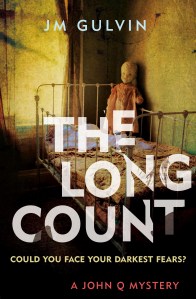
The Long Count Blog Tour: JM Gulvin talks about creating

The Long Count

Today I’m delighted to welcome JM Gulvin to the CTG Blog to talk about how he created Texas Ranger John Quarrie. His latest book – THE LONG COUNT – is out this month and is the first in a new series featuring John Quarrie.

Here’s the blurb: “In The Long Count, the first book of JM Gulvin’s masterful new crime series, we meet Ranger John Quarrie as he is called to the scene of an apparent suicide by a fellow war veteran. Although the local police want the case shut down, John Q is convinced that events aren’t quite so straightforward. When his hunch is backed up by the man’s son, Isaac – just back from Vietnam and convinced his father was murdered – they start to look into a series of other violent incidents in the area, including a recent fire at the local Trinity Asylum and the disappearance of Isaac’s twin brother, Ishmael. In a desperate race against time, John Q has to try to unravel the dark secrets at the heart of this family and get to the truth before the count is up…”

And now, over to JM Gulvin to talk about creating Texas Ranger John Quarrie … 

It was 2003 and I was researching a novel in Idaho. Taking a break, I switched on the TV and came across a documentary about a police officer from Rock Springs, Wyoming called Ed Cantrell. He was a man born out of his time, old school, tough, honest and uncompromising. Master of the quick draw, he shot and killed a fellow police officer called Michael Rosa who was going to shoot Cantrell. Rosa’s gun remained holstered and Cantrell was tried for murder. He was acquitted however, because it was proven that Rosa was going for his weapon. Cantrell just got to his faster and killed him in self-defence.

That story blew me away. It was the beginning of John Quarrie. I actually wrote a novel called THE DEFENDANT largely a fictionalization of that event, but I could not sell it. Undeterred, I knew I had found the kind of character I wanted to write, I just had to develop him.

I decided to make him a Texas Ranger and move my setting back ten years or so to a time when the world was changing and an old school police force like the Rangers were attempting to change with it. That gave me the opportunity to have this old fashioned cop, who was tough, honest and uncompromising. He was working alone in the vast landscape that is Texas in a time when prevention was still much better than cure.

I didn’t want any modern technology. No cell phones or satellite tracking. I wanted one man, one car; but none of the “lone wolf” clichés. I gave him a son, a best friend he’d served with in Korea and an extended “family” of friends all living on the same ranch in the Texas panhandle.

JM Gulvin

I already had a basis in reality through Cantrell, but in a more overt fashion I used Frank Hamer. Captain Hamer was one of the most famous Texas Rangers of the 20th century, brought out of retirement to go after Clyde Barrow and Bonnie Parker when their robberies started to involve murder. Hamer epitomized the “One riot, one Ranger” epithet that’s been applied to a group of men who, by the admission of most historians, really were “a breed apart” from the rest of us.

When WWII broke out Frank Hamer wrote to King George in London and offered a personal bodyguard of retired Rangers in case Germany managed to invade. He meant it, every word. I knew all about him before I created Quarrie so for that extra dusting of reality I made Hamer Quarrie’s godfather.


Big thanks to JM Gulvin for making the CTG blog a stop on his THE LONG COUNT Blog Tour today, and for talking to us about how he created his lead character Texas Ranger John Quarrie.

THE LONG COUNT is out this month. You can buy it here from Waterstones or from Amazon here

Find out more by following JM Gulvin on Twitter @jmgulvin

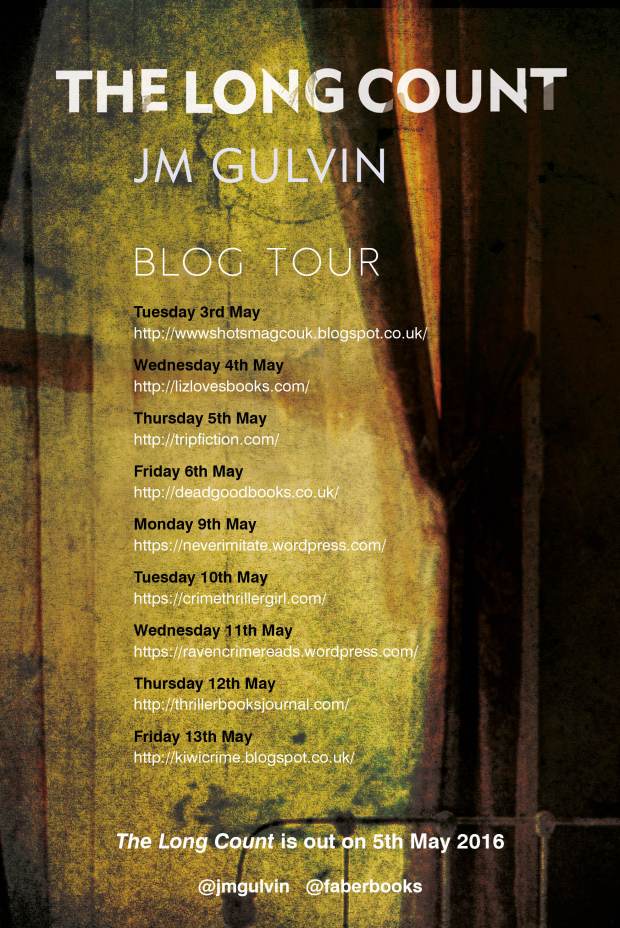
And be sure to check out all the great stops along THE LONG COUNT Blog Tour here …

LONGCOUNT_blog

#TheEvolutionOfFear Blog Tour – Guest Post: Fear of Drowning by Paul E. Hardisty

unspecified-3

Today I’m delighted to be hosting a stop on Paul E. Hardisty’s THE EVOLUTION OF FEAR blog Tour. Paul’s debut novel, the first in the Claymore Straker series, was one of my favourite reads of 2015. Now he’s back with another stonking thriller.

Here’s the blub: “Claymore Straker is a fugitive with a price on his head. Wanted by the CIA for acts of terrorism he did not commit, his best friend has just been murdered and Rania, the woman he loves, has disappeared. Betrayed by those closest to him, he must flee the sanctuary of his safe house in Cornwall and track her down. As his pursuers close in, Clay follows Rania to Istanbul and then to Cyprus, where he is drawn into a violent struggle between the Russian mafia, Greek Cypriot extremists, and Turkish developers cashing in on the tourism boom. As the island of love descends into chaos, and the horrific truth is unveiled, Clay must call on every ounce of skill and endurance to save Rania and put an end to the unimaginable destruction being wrought in the name of profit. Gripping, exhilarating and, above all, frighteningly realistic, The Evolution of Fear is a startling, eye-opening read that demands the question: How much is truth, and how much is fiction?”

With the theme of ‘fear’ strong within the story, Paul E. Hardisty is talking today about that very subject. Over to Paul …

The Evolution of Fear is the sequel to the CWA Creasy New Blood Dagger award short-listed The Abrupt Physics of Dying, featuring Claymore Straker. As the book opens, Clay is a fugitive, hiding in a lonely cottage on the rugged windswept coast of north Cornwall. Rania, the woman he loves (in his own, battle-scarred way) has disappeared, and he learns that the assassins closing in on him are after her, too. To save her, and save himself, Clay must not only vanquish those who want him dead, but he must face up to and overcome his own fears.

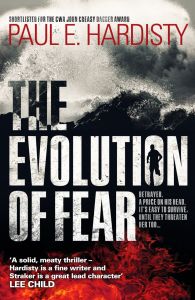
The cover of The Evolution of Fear features the clash of two primal elements: the towering waves of an ocean storm, and the searing flames of a deadly inferno. Both, once unleashed, can bring terror to the strongest hearts, and both can kill. It is perhaps this implacable, uncaring quality, the sense that these things – fire and water, waves and flames – are beyond reason, beyond emotion, which makes them so terrifying. Their judgement is arbitrary and fickle. Of all the ways to die, drowning and being burnt alive are, for me, among the very worst, the stuff of nightmares, the kind from which you wake up screaming, covered in sweat, heart jack-hammering. In the book, Clay must face both.

unspecified-4

As the title of the book implies, fear is a central theme of the book. In small ways and large, fear drives us to safety, to inaction, to the course that involves the fewest risks but also, usually, the least reward. And so we don’t go on the big trip, or take that exciting new job in a foreign country, or walk across the bar to that beautiful stranger and say hi, or stand up to that injustice. Instead we choose an easier course, we stay with what we know, or we simply do nothing. As Shakespeare said, ‘Our fears do make us traitors.’

And knowing this, those that seek to control us use fear as their weapon of choice. By playing on our fears, they manipulate us into betraying ourselves. In The Evolution of Fear, powerful people are at work enriching themselves at the expense of all. They do it, largely, with the mute compliance, and in many cases the enthusiastic support, of the population. Amazingly, and consistently, the powerful few somehow get the rest of us to act in ways which are not in our own best interest. For me, as an author, this one of the critical and most perplexing issues of our time.

As revealed in first book in the series, The Abrupt Physics of Dying, Claymore was named after the famous Scottish broadsword. Perhaps more appropriate is the eponymous M18 directional command-detonated anti-personnel mine, the Claymore, with its inscription ‘front towards enemy.’ This is what Clay must do. For this is the choice each of must make, in small ways and large, every day. Do we front up to our fears, and those that others would lodge inside us, and do what we know is right, for ourselves and others, or do we turn away, chose inaction and ease, conform to the directions others would chose for us? And if we do confront those fears, what are the costs, and what, in the end, might be gained? These are the fundamental questions explored in both books of the Claymore Straker series.

Big thanks to Paul for popping by the CTG blog today and talking about fear and his new thriller THE EVOLUTION OF FEAR.

You can find out more about Paul E. Hardisty on the Orenda Books website here and follow him on Twitter @Hardisty_Paul

THE EVOLUTION OF FEAR is published tomorrow – May 5th. You can order it from Waterstones here or Amazon here

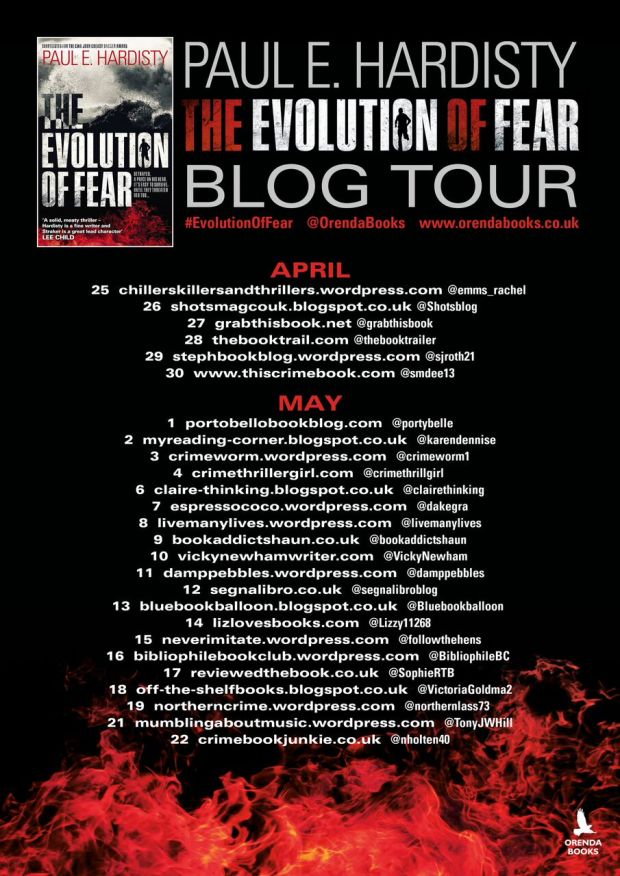
And be sure to check out all the other fabulous stops along THE EVOLUTION OF FEAR Blog Tour …

unspecified-2